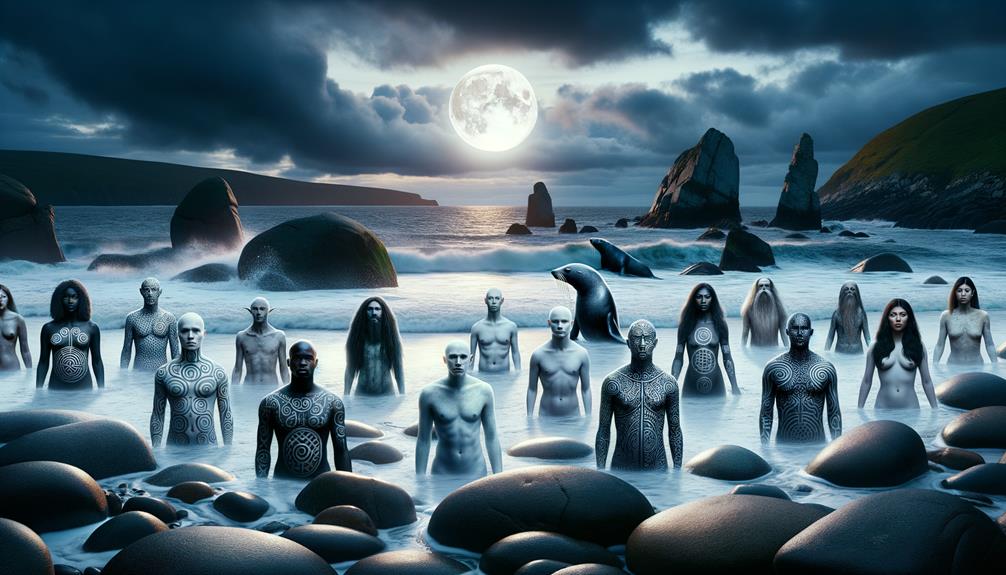
Mythical Selkies Seal Folk Tales
Explore fascinating Selkie folklore, as these mythical seals transform into captivating humans, navigating a dual identity in a world of enchanting stories.
Mythical Selkies Seal Folk Tales Read More »
Explore fascinating Selkie folklore, as these mythical seals transform into captivating humans, navigating a dual identity in a world of enchanting stories.
Mythical Selkies Seal Folk Tales Read More »
Kaleidoscopic tales of the Cauldron of Rebirth reveal ancient Celtic secrets of life, death, and transformation, beckoning you into a world of myth and mystery.
Cauldron of Rebirth Legends Read More »
Samhain is the Irish name for November and for the seasonal beginning of winter around November 1. Medieval Irish literature treats Samain as a major time of assembly, feasting, political reckoning, and supernatural encounter. Later Irish Halloween customs add further layers. The evidence does not support one universal ancient Celtic ceremony practiced identically across Europe.
Celtic Festivals Samhain's Traditions Read More »
Tír na nÓg means “Land of the Young” or “Land of Youth.” It is one name for an Irish Otherworld where age, sickness, hunger, and ordinary time may work differently. The best-known modern story sends Oisín there with Niamh of the Golden Hair, but Irish literature contains many Otherworld names and many versions of travel
Myth of Tir Na Nóg Land of Youth Read More »
Brigid, or Brigit in Old Irish spelling, is a goddess in medieval Irish literature. She is best attested as a daughter of the Dagda and a woman of poetic knowledge among the Tuatha Dé Danann. Later sources connect her with livestock and lamentation. The familiar description “goddess of fire” is plausible in some modern interpretations,
Story of Brigid Goddess of Fire Read More »
Druids were religious and learned specialists described in Iron Age Gaul and Britain and in later Irish and Welsh literature. Evidence is uneven. Most contemporary descriptions were written by Greek and Roman outsiders, some of them conquerors, while the insular stories were copied by Christian scribes centuries later. What Classical Writers Say Julius Caesar says
Druids in Celtic Culture Read More »
Cú Chulainn is the leading warrior of the Ulster Cycle, a group of medieval Irish tales centered on the Ulaid and King Conchobar’s court at Emain Macha. The manuscripts are medieval, though some language and story material may preserve older traditions. They are literary sources, not a biography of a datable historical warrior. Birth Stories
Exploring the Legend of Cú Chulainn Read More »
Epona is a Celtic horse goddess whose worship is documented mainly through inscriptions and images from the Roman Empire. She appears with horses, foals, grain, fruit, and symbols of well-being and movement. Epona in the surviving tradition Images commonly show Epona seated beside or between horses, riding, or feeding an animal. A patera, basket, cornucopia,
Epona Horse Goddess Worship Read More »