
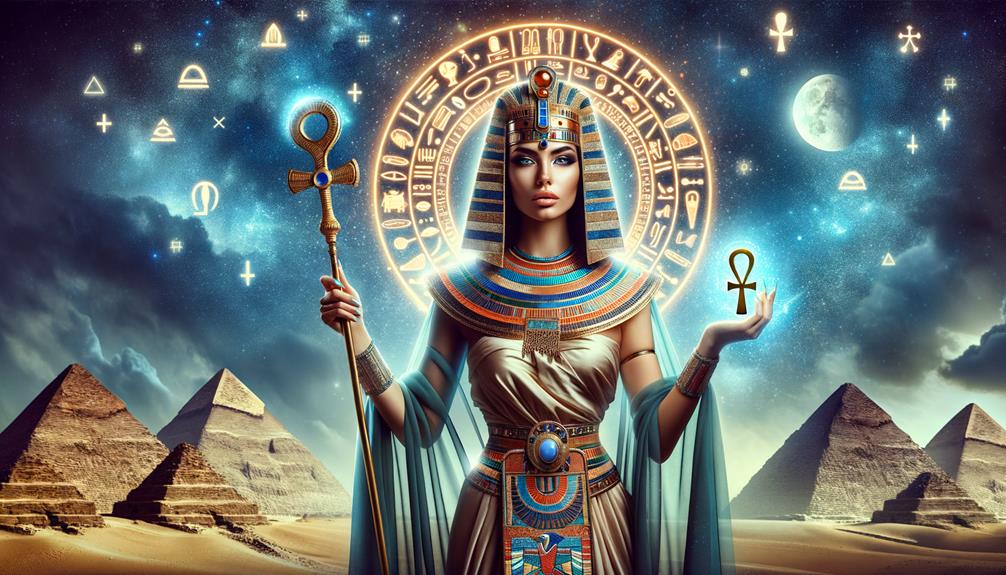
Isis was not defined by a single role. Across more than two millennia of documented worship, she could be a royal mother, mourner, healer, magician, protector, and guarantor of legitimate succession. Her earliest attestations belong to pharaonic Egypt, but her cult continued to develop through the Late, Ptolemaic, and Roman periods and eventually reached ports and cities around the Mediterranean.
That long history matters. The Isis of the Pyramid Texts, the mother nursing Horus in Late Period bronzes, and the widely worshipped goddess of the Roman world are related, but they are not identical snapshots. Her religious power grew through adaptation rather than through a timeless, unchanging list of attributes.
Isis, Osiris, and the restoration of kingship
In the Osirian tradition, Isis is the sister and wife of Osiris and the mother of Horus. After Osiris is killed, she searches for him, protects his body, and uses ritual knowledge to make renewed life and conception possible. Horus is then raised as the rightful heir who contests the rule of Seth. The cycle connects family grief with the renewal of kingship: Isis preserves continuity when violence has broken it.
“Mother goddess” is therefore accurate but incomplete. Isis’s motherhood is political and cosmic as well as domestic. By protecting Horus, she protects the future king; by mourning and revivifying Osiris, she participates in the model of death and restoration that shaped Egyptian funerary religion.
The throne name and royal identity
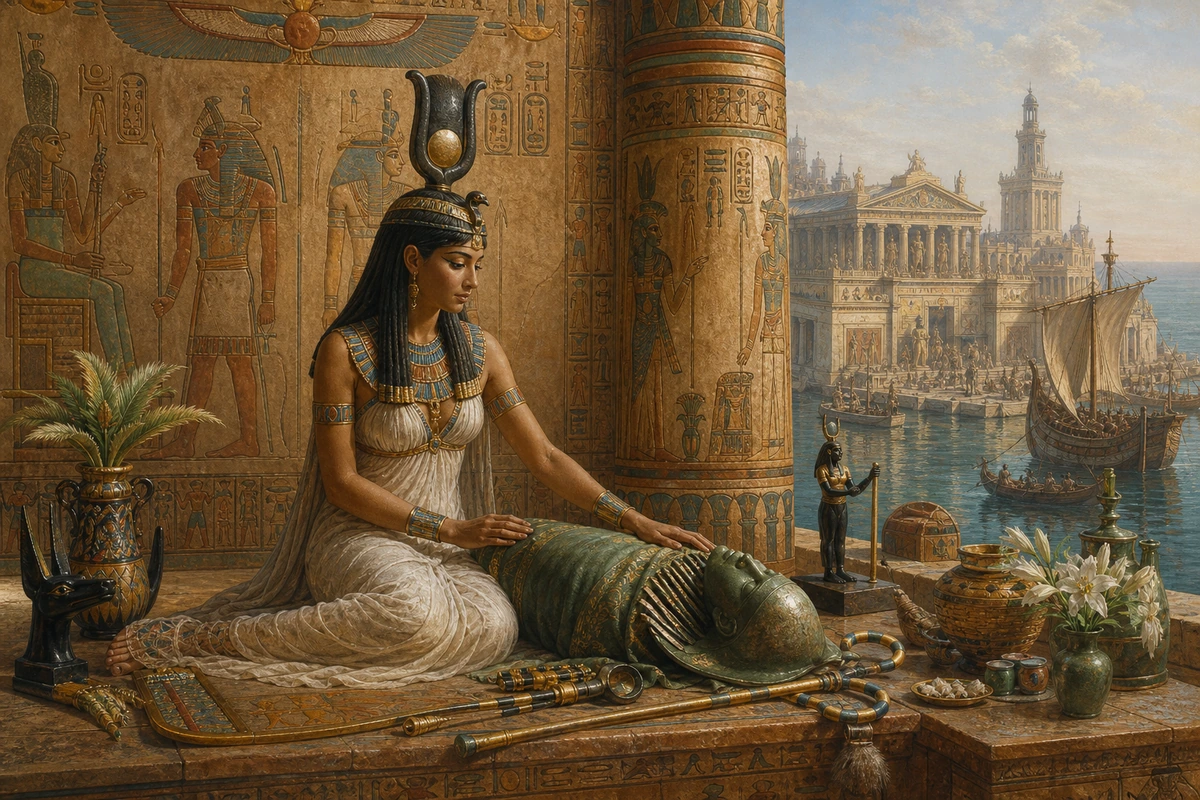
Isis’s Egyptian name is written with the sign for a throne, and that sign often appears on her head in Egyptian art. The visual connection makes her easy to identify and reinforces her relationship with sovereignty. It should not be reduced to a simplistic formula in which Isis “is” the physical throne. Egyptian divine names, images, and royal theology work through layers of association.
During later periods Isis also adopted the cow horns and solar disk familiar from the iconography of Hathor. Museum objects show that this horned crown became common, especially in images that emphasize Isis as mother and protector. The changing headdress is a useful reminder that Egyptian gods could absorb each other’s attributes without becoming indistinguishable.
Magic as effective sacred knowledge
Modern English can make “magic” sound like stage illusion or irrational superstition. Egyptian heka was instead a legitimate force woven into religion, medicine, speech, and ritual. Isis exemplifies mastery of this effective knowledge. In narratives and spells she protects Horus from poison and danger, uses names and words strategically, and performs rites that cross the boundary between death and renewed life.
Her reputation as a healer follows from this protective power. A worshipper did not need to separate prayer, medicine, and ritual in the modern way. Images, spoken formulae, divine stories, and practical remedies could operate together. Isis’s skill lies in knowing what must be said and done to restore the threatened order.
Mother of Horus and protector of the vulnerable
From the first millennium BCE, statuettes of Isis nursing the child Horus became extremely common. The Metropolitan Museum of Art notes that these figures emphasize her roles as life-giver and protector and place Horus’s royal identity at the centre of the image. They are evidence of actual ancient devotion, not simply later symbols projected backward.
The nursing pose also helped make Isis approachable. Her cosmic and royal status did not prevent people from seeking personal protection. This combination—immense power made accessible through care—was one reason her worship could travel beyond its original settings.
From Egyptian temples to a Mediterranean cult
Isis’s worship expanded significantly in the Ptolemaic and Roman eras. Philae in southern Egypt became an especially important cult centre, while temples, priesthoods, statues, and ritual objects appeared elsewhere in Egypt and across the Mediterranean. The cult reached Greek-speaking communities and later Roman imperial cities, including Rome itself.
This expansion did not simply export an unchanged Egyptian religion. In Hellenistic and Roman environments Isis could be represented in classical dress, associated with seafaring and good fortune, and paired with Serapis. Egyptian imagery and language remained important, but worshippers encountered the goddess through local institutions and artistic conventions. “Isis in Rome” is thus both Egyptian inheritance and Mediterranean religious adaptation.
What changed—and what remained recognizable
| Historical setting | Prominent evidence | Responsible interpretation |
|---|---|---|
| Old Kingdom and earlier pharaonic religion | Her name appears in the Pyramid Texts; she belongs to the royal and Osirian divine family | Early Isis is already tied to kingship and the fate of Osiris |
| New Kingdom through Late Period | Funerary texts, protective spells, temples, and increasingly common images | Her protective and magical roles become more visible and widely used |
| Late and Ptolemaic Egypt | Numerous mother-and-child statuettes and major cult centres such as Philae | Motherhood, healing, and accessibility are strongly emphasized |
| Hellenistic and Roman Mediterranean | Temples, inscriptions, classical-style statues, processional objects, and literary testimony | Her cult adapts to new languages and communities while retaining Egyptian identity |
Isis was not simply “all goddesses in one”
Greco-Roman texts sometimes praise Isis in universalizing language and identify her with other goddesses. Such language belongs to real ancient devotion, but it should be read as theological praise rather than as proof that every goddess was historically a disguised Isis. Religious identification in antiquity was flexible: two deities could share functions or be equated in one context without erasing their separate cults everywhere else.
The same caution applies to modern comparisons between Isis nursing Horus and Christian images of Mary and Jesus. The visual resemblance is meaningful and has prompted serious study, but resemblance alone does not demonstrate a simple one-directional copy. Each image belongs to its own theology, chronology, and ritual setting.
Why Isis endured
Isis joins qualities that can seem opposed: she mourns yet restores, protects a child yet outwits powerful rivals, belongs to Egyptian kingship yet becomes accessible to worshippers far from Egypt. Her myths convert vulnerability into authority. Rather than denying death or disorder, she works through them with patience, knowledge, and ritual skill.
That combination explains her longevity better than any single title. Isis could remain recognizably Egyptian while receiving new forms, names, and communities. Her history is therefore a case study in how ancient religions travelled: not by remaining static, but by making continuity possible through change.
Accuracy note and further reading
This article separates early Egyptian evidence from Late, Ptolemaic, and Roman developments. Dates and meanings are tied to museum objects or historical phases rather than presented as features of one timeless cult.