
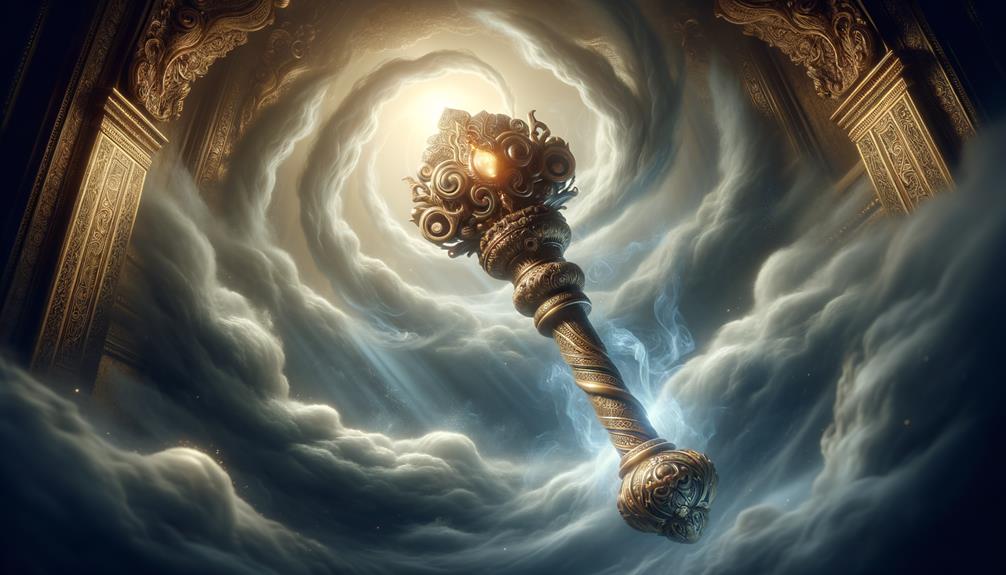
Ruyi Jingu Bang is the transforming iron staff wielded by Sun Wukong in the sixteenth-century Chinese novel Journey to the West. Anthony C. Yu translates its name as the “Compliant Golden-Hooped Rod”; other English versions use “As-You-Will Gold-Banded Cudgel.” It is a literary weapon with a specific acquisition scene, not an archaeological relic.
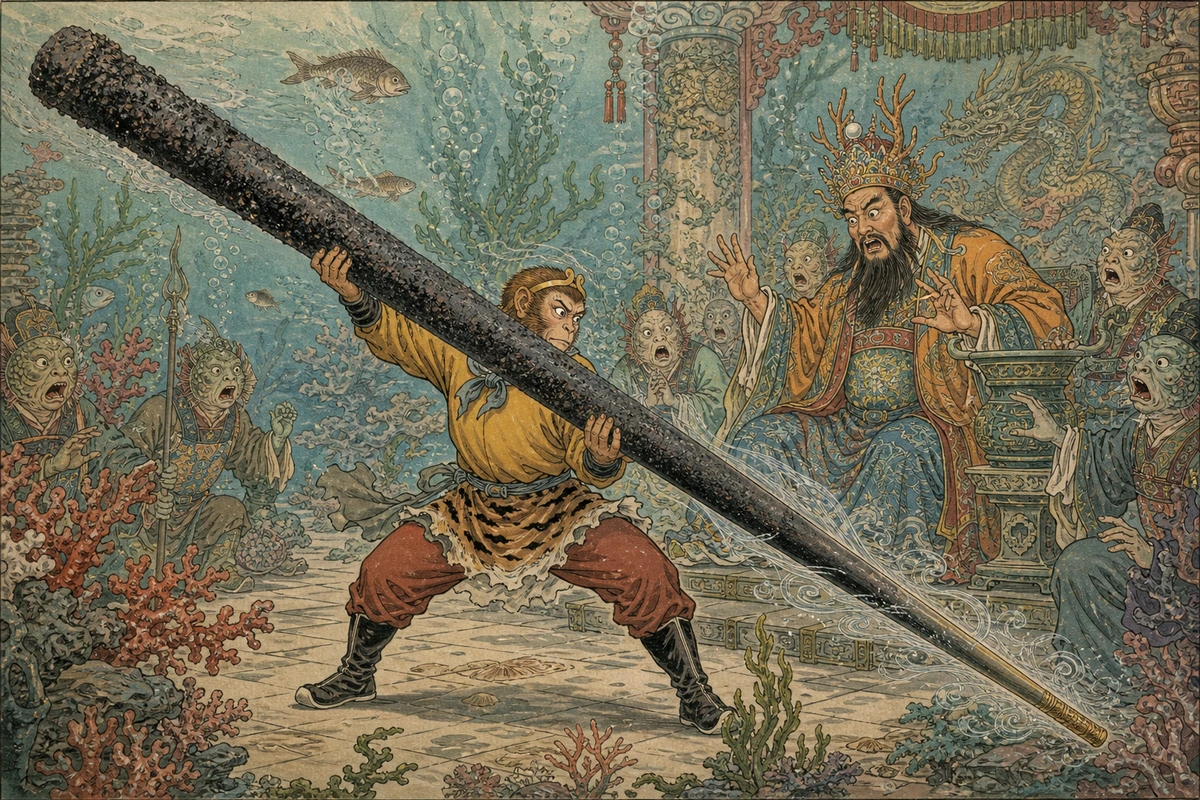
The current legend is often distorted by adaptations. Sun Wukong is directed to the Dragon King’s underwater realm in search of a weapon, rejects conventional arms as too light, and discovers the responsive iron treasure. A Dragon Queen does mention the object in the novel, but she does not simply recognize his need and hand him a destined gift: the episode is comic, coercive, and costly for the Dragon King.
The Dragon Palace episode
In chapter 3, Sun Wukong visits Ao Guang, Dragon King of the Eastern Sea. Weapons weighing thousands of catties fail to satisfy him. The court then remembers a piece of divine iron associated with Yu the Great’s control and measurement of the waters. It has recently emitted light, as though waiting for someone.
Why the rod obeys Sun Wukong
The iron is enormous, but it becomes shorter and thinner when Wukong wishes it. Once sized for combat, it reveals its name and immense weight. The word ruyi means “as desired” or “according to one’s will”: responsiveness is built into the weapon’s name.
Wukong can later shrink the rod to needle size and store it in his ear, then enlarge it for combat or display. The novel repeatedly uses this elasticity for comedy, intimidation, and impossible feats. The staff does not grant him general control over water, and it is not normally sentient in the modern character-like sense.
Great Yu and cosmic measurement
The Dragon King connects the iron with Yu the Great, the flood-controlling culture hero. Translations variously describe it as a measure that fixed the depths of rivers and oceans or a stabilizing treasure of the sea. The association turns an instrument of cosmic engineering into the unruly Monkey King’s club—an intentional contrast between order and rebellion.
Not a freely given present
After taking the rod, Wukong also demands suitable armor. The rulers of the other seas are summoned and surrender additional treasures. The Dragon Kings later complain to heaven. Calling the scene a friendly gift exchange removes the satire: Wukong uses royal confidence and overwhelming strength to obtain what he wants.
Claim check
| Claim | Assessment | Source-led correction |
|---|---|---|
| The Dragon Queen simply gives Wukong the staff | Misleading | She alerts the Dragon King to the iron after ordinary weapons fail |
| The rod changes size | Explicit in the novel | It shrinks to a needle and expands enormously |
| It lets Wukong control all water | Unsupported generalization | Its origin concerns measuring or stabilizing waters; aquatic combat remains difficult |
| It multiplies itself | Usually confused with Wukong’s hair magic | Copies often come from transformed hairs, not an independent staff power |
| It was a historical Chinese relic | Incorrect | It is a magical object in a Ming novel and related performance tradition |
The staff and Sun Wukong’s character
The rod magnifies its owner’s paradoxes. It is a tool of order taken by a rebel, a crushing weight that can become a needle, and a treasure carrying a lofty pedigree into slapstick brawls. Wukong’s mastery is not merely physical; the object responds to will, making it an ideal emblem of his volatile, disciplined, and self-transforming power.
Accuracy note and further reading
This article follows chapter 3 of Journey to the West, distinguishes the staff’s own properties from Wukong’s transformation magic, and treats English weight figures as translation choices rather than modern measurements.