Typhon—also called Typhoeus—is the last great challenger to Zeus in Hesiod’s Theogony. Modern summaries often flatten him into the “father of all monsters” or a simple symbol of chaos. The ancient evidence is more interesting: different authors give him different bodies, battles, offspring, and places of defeat.
Typhon or Typhoeus?
Both names appear in English discussions because Greek and Roman authors use related forms. Hesiod calls the being Typhoeus and says that Earth (Gaia) bore him through union with Tartarus after Zeus had driven the Titans from heaven. In this account he is Earth’s youngest child and a new threat to the Olympian settlement.
Later mythographers preserve other details and motives. Pseudo-Apollodorus also connects Typhon with Earth and Tartarus, but turns the episode into a longer campaign with journeys, wounds, helpers, and a final burial beneath Sicily. The two narratives should not be combined as though they were one continuous ancient story.
The hundred serpentine heads
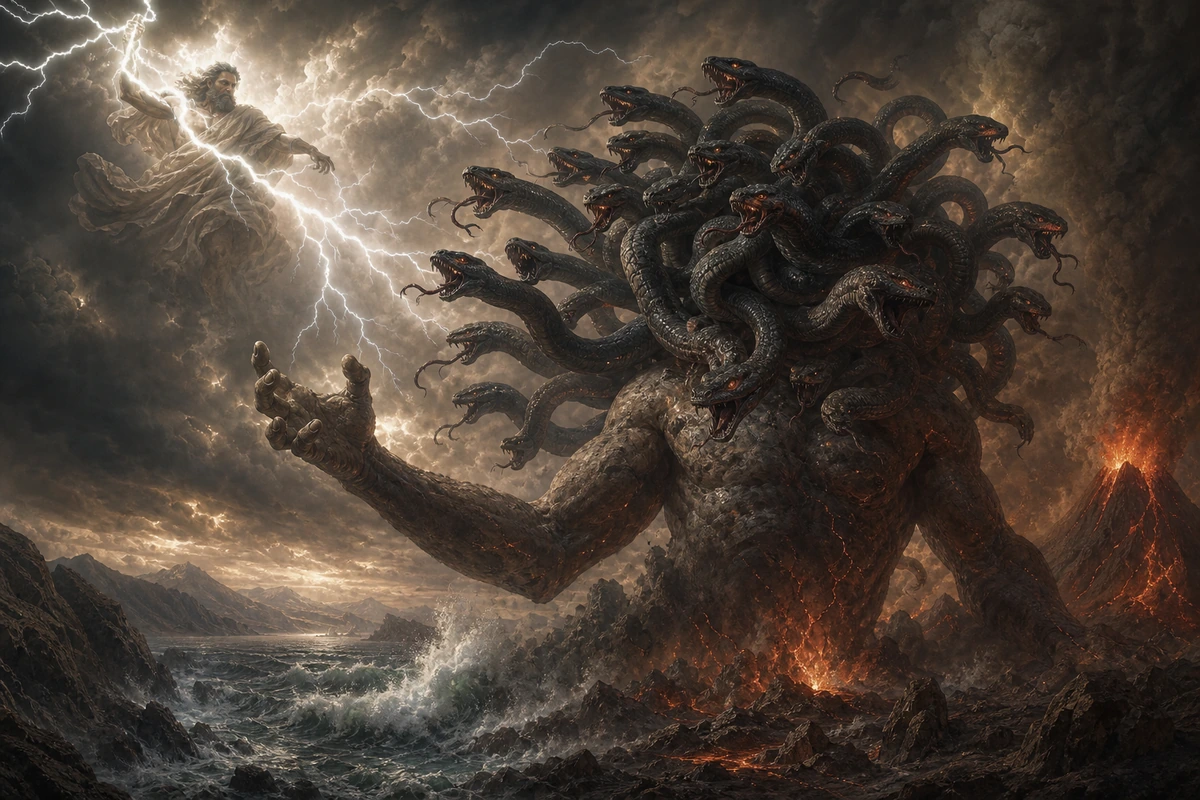
Hesiod does not give Typhoeus the familiar standardized body of modern fantasy art. He describes a powerful being whose shoulders carry one hundred snake heads. Fire flashes from their eyes, and their voices change: at different moments they sound intelligible to the gods, or like a bull, lion, puppies, and hissing snakes. The effect is auditory as well as visual.
Pseudo-Apollodorus offers a different, more human-shaped giant. His upper body reaches the stars, his outstretched hands span east and west, and snakes coil below his thighs. Wings and a grimy, streaming beard belong to this later description. Saying that Typhon simply “had a man’s torso, wings, serpentine legs, and a hundred heads” quietly fuses separate sources.
Zeus and Typhoeus in Hesiod
In the Theogony, Zeus recognizes the danger before Typhoeus can seize rule over mortals and immortals. The contest shakes Olympus, sea, earth, and the underworld. Zeus attacks with thunder, lightning, and the thunderbolt; heat from both opponents makes the sea seethe. Hades and the imprisoned Titans tremble at the noise.
Zeus burns the monster’s heads, strikes him down, and casts him into Tartarus. Hesiod then makes Typhoeus the source of destructive, irregular winds, while distinguishing those storms from the beneficial named winds Boreas, Notus, and Zephyrus. Hesiod does not place Athena and Dionysus beside Zeus in this battle, nor does he say that Typhoeus is imprisoned beneath Mount Etna.
The later battle and Mount Etna
Pseudo-Apollodorus tells a more elaborate version. Typhon drives most of the gods toward Egypt, fights Zeus with rocks and fire, and cuts the sinews from Zeus’s hands and feet after taking his sickle. The sinews are hidden in the Corycian cave and guarded by the dragoness Delphyne. Hermes and Aegipan recover them, allowing Zeus to resume the pursuit.
After attacks near Mount Nysa and Thrace, Zeus finally hurls Mount Etna over Typhon in Sicily. This version explains the volcano’s fire as the continuing effect of Zeus’s thunderbolts. The Etna ending is famous, but it belongs to a different narrative layer from Hesiod’s casting of Typhoeus into Tartarus.
Was Typhon the father of every monster?
No ancient source gives him a neat, universal family tree. Hesiod pairs Typhaon with Echidna and names Orthus, Cerberus, the Lernaean Hydra, and the Chimera among their offspring. In the same passage, however, the Sphinx and Nemean Lion are born to Echidna by Orthus. Other authors rearrange the genealogy.
“Father of monsters” is therefore useful modern shorthand, not a reliable ancient title and not a licence to assign every Greek creature to him. The safest approach is to name the source whenever a particular child is attributed to Typhon.
What the myth can—and cannot—mean
Typhon’s position after the Titanomachy makes him a final test of Zeus’s sovereignty. Reading the combat as ordered Olympian rule confronting unbounded violence is reasonable, but it is an interpretation rather than a definition supplied by Hesiod. Labels such as “pure evil,” “entropy,” or a universal hero’s-journey archetype go beyond what the early poem says.
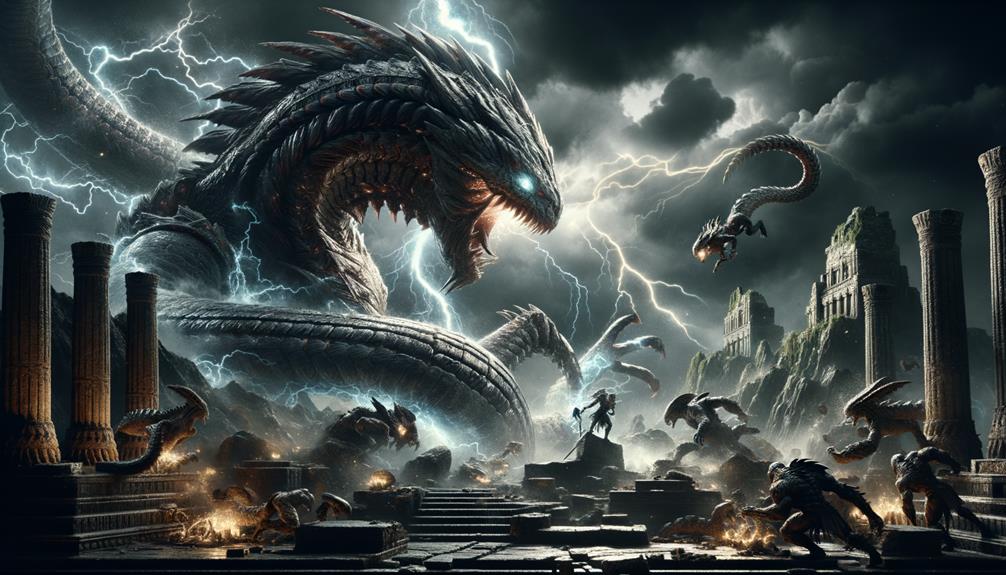
Ancient and later artists likewise selected different features: serpentine legs, wings, human musculature, or clustered animal heads. There is no single canonical portrait. The instability of Typhon’s form is part of his history, not an error to be corrected into one design.