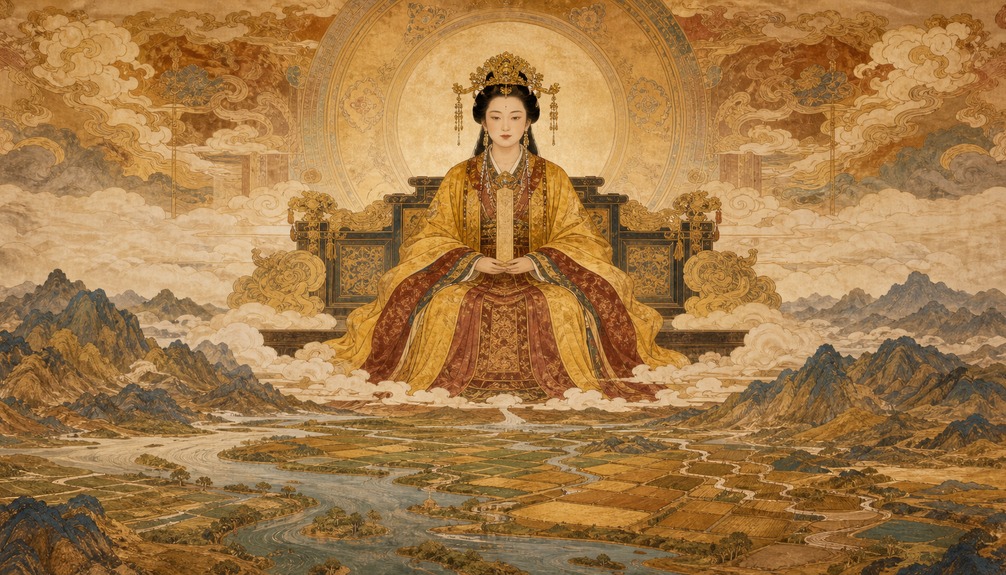
Houtu (后土, “Sovereign Earth” or “Earth Sovereign”) is a major personification of the earth in Chinese religious history. The name appears in changing ritual, literary, and Daoist settings, so Houtu is better understood as a tradition that developed over centuries than as a single character with one fixed biography. In later worship Houtu is commonly addressed as an empress or motherly earth deity, but earlier sources do not always present the power of earth in the same gendered form.
Houtu in early state ritual
Earth was central to the ritual order of early imperial China. The Book of Han records court debates and sacrifices that paired Heaven with an earth deity called Houtu. Under Emperor Wu of the Western Han, an important Houtu sanctuary was established at Fenyin, near the Yellow River in what is now Shanxi. The emperor’s relationship with Heaven and Earth was political as well as religious: correct sacrifice was expected to support cosmic balance, agricultural fertility, and legitimate rule.
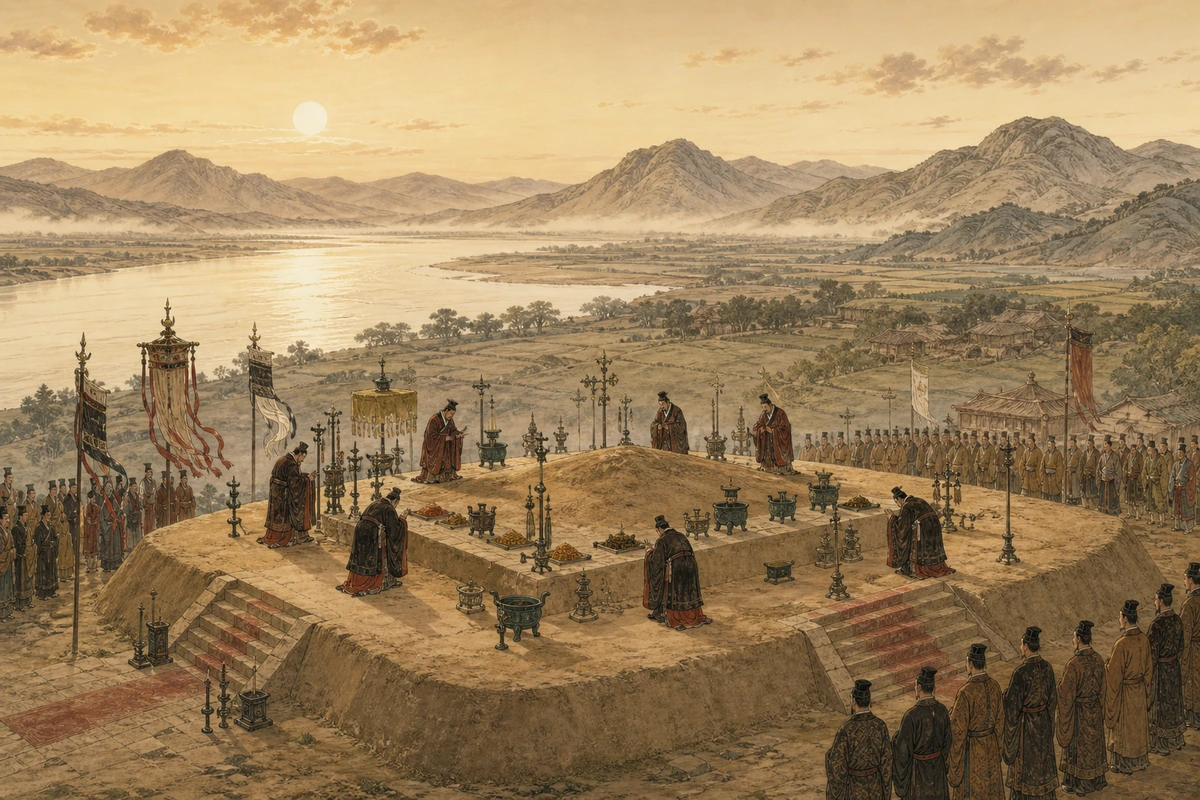
The details did not remain static. Courts revised sacrificial systems, moved or abolished ceremonies, and debated how rites should correspond to classical models. This is why a statement such as “Houtu was always worshipped in exactly this way” would be misleading. The surviving record instead shows a powerful earth cult repeatedly reinterpreted by ritual specialists and rulers.
How Houtu became an empress of the earth
Modern images often show Houtu as a richly dressed goddess called Houtu Niangniang, or Empress Houtu. Scholarship on the cult’s development finds that a distinctly female divine image became increasingly visible during the Tang period, especially from the era of Wu Zetian onward. Later Daoist systems placed Houtu high within a celestial administration and linked the deity with the generation, support, and ordering of the terrestrial world.
This history explains why different texts may use titles that sound masculine, feminine, or impersonal. It is not necessary to force every appearance into one body or genealogy. “Houtu” can name the sovereign power of earth, a recipient of state sacrifice, and a goddess in later religious iconography, depending on period and context.
Houtu and local land gods are not identical
Houtu operates at a cosmic or empire-wide scale. By contrast, Tu Di Gong is the familiar title for a local earth god who protects a village, neighborhood, field, or particular plot of land. Both belong to Chinese traditions of honoring the ground that sustains human life, and both can be described through official-sounding ranks, but their histories and ritual reach are different.
The distinction also prevents a common oversimplification: Chinese religious traditions are not one unchanging pantheon with universally agreed positions. Imperial ritual, local worship, Daoist liturgy, and popular storytelling overlap, yet each can arrange divine authority differently. The Jade Emperor, for example, may dominate popular descriptions of heaven without replacing every older cosmic power or every local cult.
Meaning and worship
Houtu embodies the earth as foundation: the ground that bears settlements, receives the dead, and makes cultivation possible. That broad symbolism helps explain the deity’s long life across changing institutions. Worship may emphasize protection, harvests, territorial peace, or the complementary ordering of Heaven and Earth. Exact practice varies by temple and community, so contemporary rites should be described from local evidence rather than reconstructed from a generalized myth.