Accuracy note: Di Jun is a divine ancestral figure found most prominently in the Classic of Mountains and Seas. He should not be presented as simply another name for Yandi, the Flame Emperor. Comparisons with Yandi, Di Ku, Shangdi, or other high gods are scholarly interpretations rather than an uncontested identity.
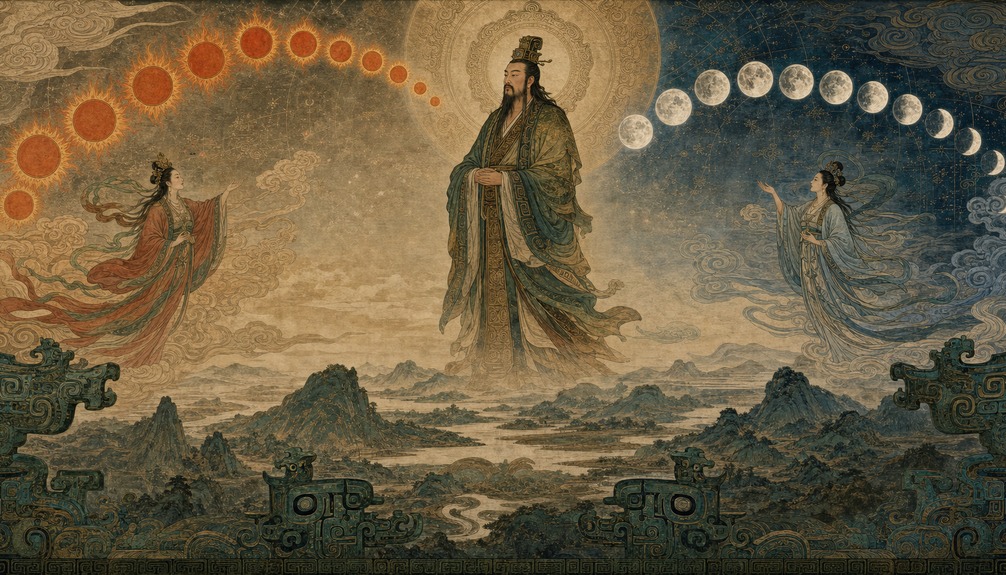
Di Jun (帝俊) stands at the center of several striking genealogies in the Shanhaijing, or Classic of Mountains and Seas. He is linked with the mothers of the ten suns and twelve moons, with distant peoples and ancestral lines, and with culture-bearing figures. Yet the text never supplies a continuous biography. Di Jun appears through brief notices scattered across a mythic geography assembled from different materials.
This fragmentary presentation is why modern summaries must be careful. Di Jun is important, but he is not a neatly defined “god of fire,” a standard solar king, or a Chinese equivalent of a deity from another pantheon. His profile emerges from relationships rather than from one canonical life story.
The Classic of Mountains and Seas
The Shanhaijing combines descriptions of mountains, waterways, plants, animals, distant peoples, ritual practices, divine genealogies, and extraordinary beings. Its present form reflects layers of composition and editing rather than one author writing at one moment. That structure matters for Di Jun: notices from separate sections may preserve related traditions, but they do not always fit into one seamless narrative.
A National Chengchi University study of Di Jun and bird imagery emphasizes his repeated appearance in the “Great Wilderness” chapters and considers possible relationships with ancient clan, ancestral, and Shang cultural traditions. Such research helps explain the figure’s importance, but it also shows why simple labels can be misleading.
Xihe and the Ten Suns
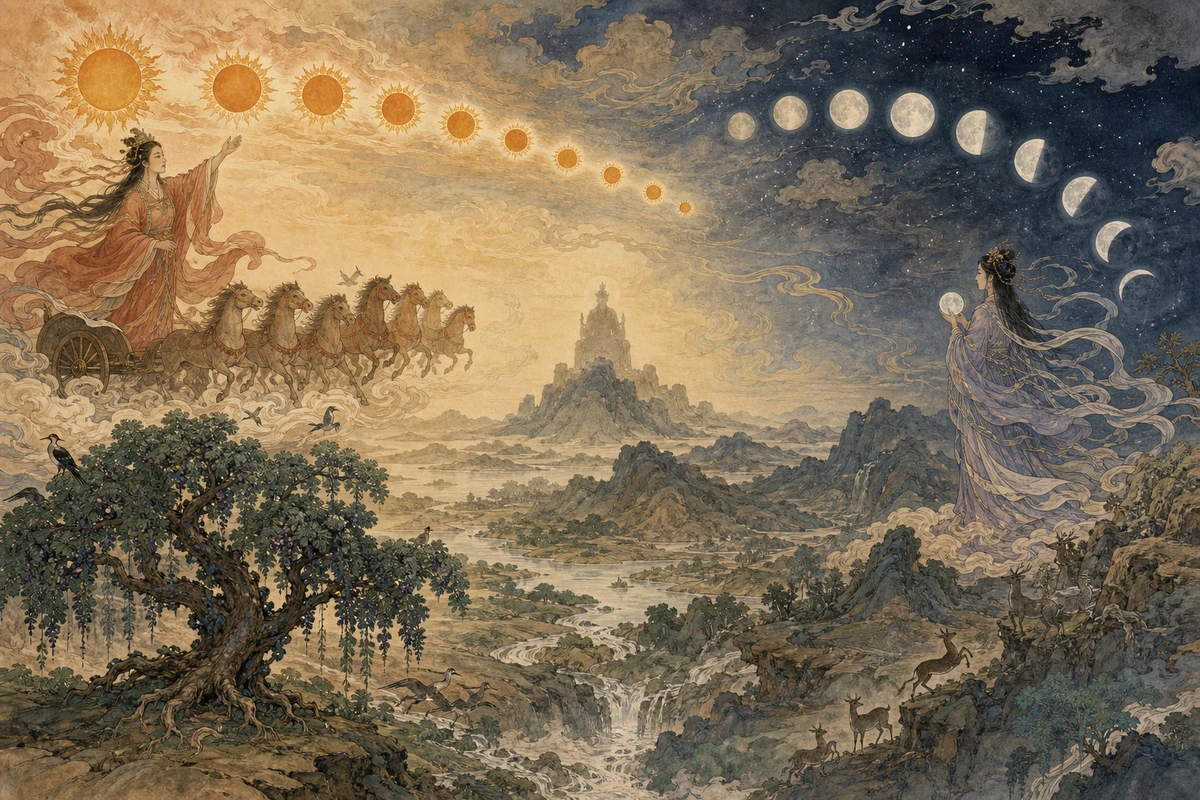
In the Great Wilderness: South, the text identifies Xihe as Di Jun’s wife and says that she gave birth to ten suns. She is shown bathing the suns at Gan Abyss. The Chinese Text Project preserves this compact passage, which establishes the relationship without explaining Di Jun’s own birth, rule, or personality.
The ten suns belong to a larger network of early solar traditions. Later retellings connect them with the catastrophe in which multiple suns appear together and the archer Hou Yi shoots down nine. However, details differ across texts. Combining every surviving solar account can produce a smoother story than the early evidence supports.
Changxi and the Twelve Moons
A western “Great Wilderness” passage names Changxi as another wife of Di Jun and says that she gave birth to twelve moons and began bathing them. The pairing of ten suns and twelve moons gives Di Jun’s family a cosmic scale connected with recurring measures of time.
Modern illustrations sometimes make Xihe and Changxi into fixed mirror-image goddesses with standardized appearances. The text gives their actions and relationships but does not establish one required iconography. Artistic reconstructions should therefore be presented as interpretations, not recovered portraits from antiquity.
Ancestry, Peoples, and Culture
Other passages make Di Jun an ancestor of figures or peoples situated within the book’s vast geography. Commentators have consequently interpreted him as an ancestral high god and have compared him with deities or legendary rulers known from other early sources. Some proposals connect him with Di Ku or with Shang ancestral religion; others examine similarities with the name and functions of Shangdi.
These comparisons are important research questions, but a resemblance does not prove complete identity. Early Chinese traditions were transmitted across regions, lineages, ritual settings, and texts. Names and genealogies could overlap, diverge, or be reorganized. It is more accurate to say that Di Jun participates in ancient divine-ancestral traditions than to collapse him into one better-known emperor.
Why Di Jun Is Not Simply the Flame Emperor
Yandi, the Yan or Flame Emperor, belongs to a different cluster of traditions. He is commonly paired with the Yellow Emperor and associated with fire, the south, agriculture, rulership, and ancestry. Later sources often connect Yandi with Shennong.
Di Jun’s clearest textual setting is different: he appears in the Classic of Mountains and Seas through cosmic spouses, descendants, far-off countries, and genealogical notices. No primary passage cited here simply states that Di Jun is Yandi. The safest editorial choice is to keep the names distinct while acknowledging that scholars compare early high gods and legendary rulers.
Reading a Fragmentary God Carefully
Di Jun’s fragmentary character is not a flaw to be repaired with invented detail. It reveals how early myth survives: in genealogies, place descriptions, ritual memories, and short narrative scenes. The figure matters because his family links celestial cycles with ancestral geography, not because he has a modern-style character biography.
A careful account therefore separates what the text says directly from later synthesis. Xihe is named as his wife and mother of ten suns; Changxi is named as his wife and mother of twelve moons; other passages connect him to ancestors and peoples. Claims beyond that need to be labeled as interpretation.
Sources and Further Reading
- Chinese Text Project: Xihe, Di Jun, and the ten suns
- Chinese Text Project: Changxi and the twelve moons
- National Chengchi University: study of Di Jun and bird imagery in the Classic of Mountains and Seas
- Tsinghua University Press: Classic of Mountains and Seas
- Mythology Vault: Hou Yi and the ten suns
- Mythology Vault: Shennong and Yandi traditions