
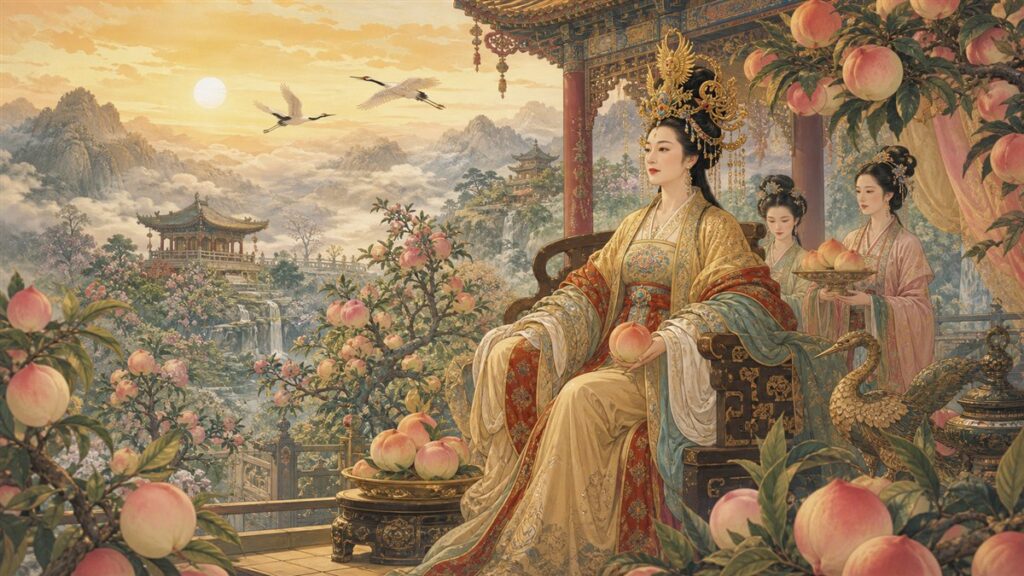
Accuracy note: Xi Wangmu and the peaches of immortality belong to Chinese tradition. This article currently sits in a Hindu Mythology URL path; the category should only be corrected when a tested redirect can preserve that address.
Xi Wangmu, the Queen Mother of the West, is one of the most enduring figures in Chinese religion and mythology. She was not created as a minor orchard keeper, nor can her long history be reduced to a single novel. Early texts present a formidable western power. Han-dynasty art places her at the center of an immortal realm, while later Daoist, literary, and artistic traditions increasingly emphasize her celestial court, her longevity-giving peaches, and the banquets where immortals gather.
Who Is Xi Wangmu?
Xi Wangmu’s name means “Queen Mother of the West.” In the received Classic of Mountains and Seas (Shanhaijing), she is a striking, untamed being associated with the far west and described with such features as tiger teeth and a leopard’s tail. That image should not be confused with the stately goddess familiar from later paintings and temples. Chinese traditions changed over centuries, and Xi Wangmu changed with them.
By the Eastern Han period, she had become a major figure in beliefs about immortality and the afterlife. A second-century stone tomb panel in the Metropolitan Museum of Art shows Xi Wangmu larger than the attendants around her and seated within a heavenly court. The museum notes that she played a major role in Han funerary belief and ruled a land of immortals somewhere to China’s west. This archaeological evidence helps explain why later artists so often depicted her enthroned, attended by immortals, birds, and other auspicious beings.
How the Peaches Became Her Emblem
The famous orchard belongs primarily to later tradition, not to Xi Wangmu’s earliest surviving description. Over time, peaches became one of China’s clearest visual wishes for long life. The Metropolitan Museum of Art records that stories placed peaches of immortality in Xi Wangmu’s celestial orchard: she served them at divine banquets and granted them to gods or deserving mortals. A peach could therefore communicate more than abundance. In art, it could signal longevity, divine favor, and entry into the company of immortals.

Different works give different ripening periods and powers to the fruit. Those numbers are details of particular versions, not a single timetable shared by every Chinese source. Museum catalogues commonly describe a flat peach that ripens only after thousands of years, emphasizing the almost unimaginable interval between divine harvests. The important idea is consistent: immortality is rare, controlled, and distributed according to the order of heaven.
The Flat Peach Banquet
The Flat Peach Banquet, or Pantao Hui, became one of the best-known scenes connected with Xi Wangmu. Later paintings, decorative objects, novels, and plays show immortals arriving at her splendid residence for a celebration of longevity. The National Palace Museum describes the banquet as a gathering held for the Queen Mother’s birthday, with immortals bringing their good wishes and sharing the extraordinary fruit.
This scene was especially useful to artists because it gathered many auspicious figures in one composition. A banquet painting could celebrate a birthday, convey hopes for a long life, and display an entire community of immortals at once. The Eight Immortals often appear in such later celebratory works, but their inclusion in a painting is not proof that every older story about Xi Wangmu featured them.
Dongfang Shuo and the Stolen Peaches
Not everyone receives the fruit with permission. In later legend, the historical Han court figure Dongfang Shuo becomes a clever peach thief. A sixteenth-century silk tapestry in the Metropolitan Museum identifies him holding one of Xi Wangmu’s magical peaches and explains that his theft made him a celebrated immortal. The story turns a learned official into a mischievous figure of longevity, and it became popular in birthday art.
The tale also reveals an important tension. The peaches promise escape from death, yet access to them belongs to a divine ruler. Stealing one is both comic and transgressive: a mortal tries to seize a privilege that the heavenly court normally controls.
Sun Wukong and Journey to the West
The most famous peach theft today belongs to Sun Wukong, the Monkey King. In chapter 5 of the sixteenth-century novel Journey to the West, he learns that he has not been invited to Xi Wangmu’s banquet, eats the peaches, drinks the immortal wine, and disrupts heaven’s preparations. The episode is a brilliant part of the novel’s satire of celestial rank and bureaucracy.
It is also a relatively late literary development. Sun Wukong’s adventure should not be projected backward into the earliest accounts of Xi Wangmu. Separating the ancient deity, Han funerary images, later Daoist traditions, and Ming fiction makes the mythology richer rather than less magical: it shows how one figure could remain meaningful while her stories continued to grow.
What Xi Wangmu’s Orchard Represents
Xi Wangmu’s orchard brings together several ideas that recur in Chinese art and storytelling. The west becomes a distant sacred realm; fruit marks both seasonal renewal and extraordinary longevity; and the banquet presents immortality as a social order governed by invitation, merit, and divine authority. Thieves such as Dongfang Shuo and Sun Wukong make that order dramatically visible by breaking it.
For that reason, Xi Wangmu is more than “the goddess with the peaches.” She links early mythic geography, Han hopes for transcendence, Daoist visions of immortality, birthday symbolism, and one of the great comic episodes of Chinese literature. The peaches are her most recognizable emblem, but her long history is the deeper story.
Sources and Further Reading
- National Museum of History: Xi Wangmu collection record
- The Metropolitan Museum of Art: Eastern Han tomb panel with Xi Wangmu
- The Metropolitan Museum of Art: Longevity in Chinese Art
- The Metropolitan Museum of Art: Dongfang Shuo holding a peach
- National Palace Museum: Immortals at the Flat Peach Assembly
- Mythology Vault: The Eight Immortals