

Accuracy note: Flora was specifically a Roman goddess of flowering and blossoming plants. Calling her simply “the goddess of spring” is convenient but too broad. The best-known narrative about her as the Greek nymph Chloris comes from Ovid’s Roman poem Fasti.
Flora governed the fragile moment when plants come into flower. That made her relevant not only to ornamental gardens but also to vines, olives, grain, beans, and every crop whose yield depends on successful blossoming. Her public festival, the Floralia, was one of Rome’s most colorful celebrations, yet much of what modern readers repeat about Flora comes from a single sophisticated literary source: Ovid.
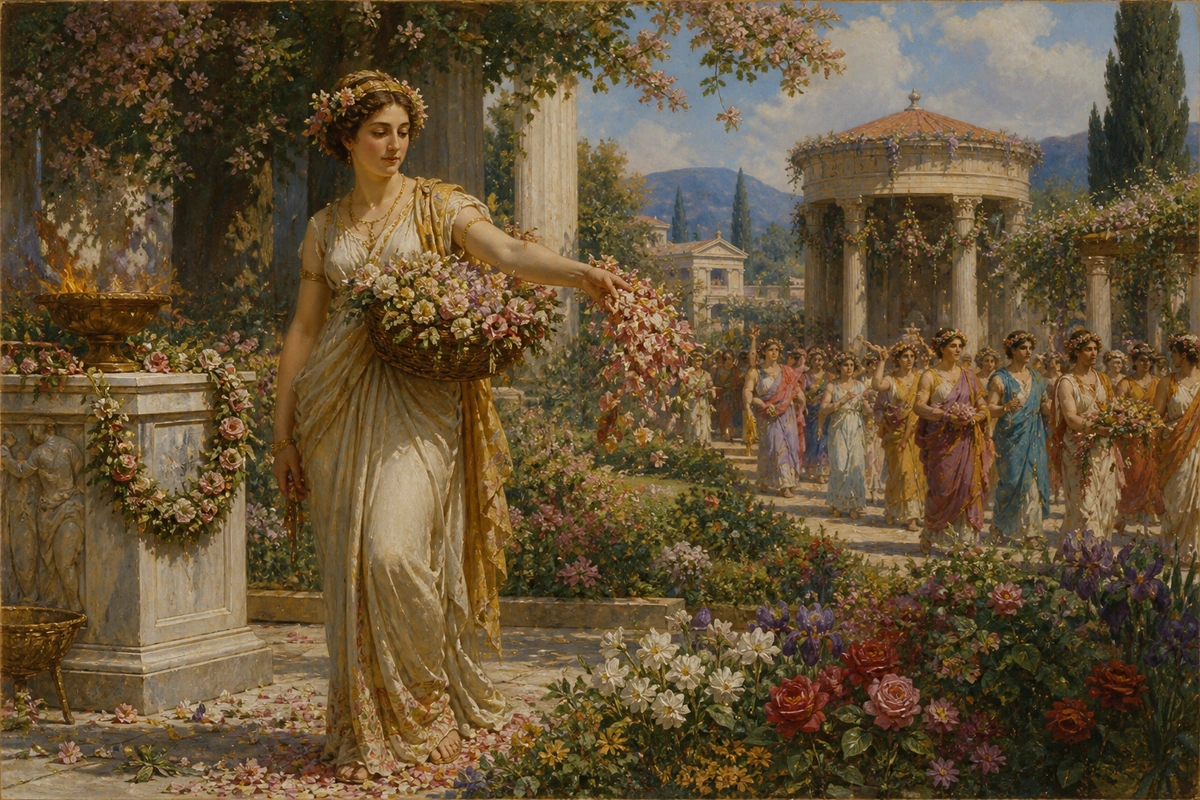
What did Flora govern?
Flora’s name is related to the Latin vocabulary of flowers and blooming. Her sphere was the flos, the blossom that precedes fruit. Ovid lets the goddess explain that damage to blossoms threatens olives, crops, vines, and beans. This is more precise than treating her as a general personification of pleasant spring weather.
Roman religion often divided natural processes among narrowly focused divine powers. Flora’s responsibility complemented, rather than replaced, the work of agricultural deities such as Ceres. She had her own priest, the flamen Floralis, and her cult was understood as old even though its surviving evidence comes from much later writers and calendars.
Chloris, Zephyrus, and Ovid’s literary myth
In Fasti 5, Ovid stages an interview with Flora. She says that she was once the Greek nymph Chloris and that the West Wind, Zephyrus, took her as his wife and granted her dominion over flowers. The Latin-speaking goddess explains that her Greek name changed in Roman pronunciation.
This scene is enormously influential in later poetry and painting, but it should be labeled correctly: it is Ovid’s Roman literary account, written around the early first century CE. It is not evidence that every Greek community worshipped a goddess Chloris whose cult simply became Flora’s. Ovid deliberately connects Greek mythic language with a Roman festival in his calendar poem.
The same passage gives Flora another striking role. Juno, wanting a child without intercourse with Jupiter, receives a special flower from Flora and conceives Mars. This is an unusual alternative to more familiar accounts of Mars’s parentage and belongs to Ovid’s creative festival narrative.
The Floralia
The Floralia developed as public games during the Roman Republic and was eventually celebrated annually. In the late Republican and imperial calendars, it ran from late April into early May. Ovid describes theatrical entertainment, colorful clothing, and a relaxed atmosphere that contrasted with the white dress associated with some other festivals.
Ancient authors also connect the festival with sexual license and performances by sex workers. That evidence has often encouraged sensational modern summaries. The safer interpretation is that the Floralia temporarily permitted forms of public display and comic performance that Roman moralists treated as disorderly. It was still an official civic festival, not simply an uncontrolled private party.
Symbols and artistic identification
| Motif | Connection to Flora |
|---|---|
| Garlands and loose blossoms | The goddess’s authority over flowering plants |
| Flower-filled garden | Later artistic shorthand for cultivated abundance |
| Colorful garments | Ovid’s contrast between the Floralia and white-robed festivals |
| West Wind | Zephyrus, Flora’s husband in Ovid’s Chloris narrative |
Ancient images are not always labeled, so identifying any flower-bearing woman as Flora can be uncertain. Renaissance and later artists made the identification easier by combining flowers, idealized classical dress, and references to Ovid. Botticelli’s Primavera, for example, helped shape the modern visual association between Chloris, Zephyrus, and a flower-covered Flora, even though it is a much later interpretation.
Flora’s legacy
Flora survives in the scientific and everyday word “flora,” meaning the plant life of a region or period. The term preserves her botanical identity more accurately than many generic spring-goddess descriptions. Her myths also show how Roman poets could create memorable narratives around cults whose ritual history was older and less story-driven.
For comparison, Faunus belongs to another Roman tradition connected with the living landscape, while Demeter illustrates a Greek agricultural cult with a very different mythic profile.
Primary sources and related reading
- Ovid, Fasti 5: Flora, Chloris, flowering crops, and the Floralia
- Faunus in Roman tradition on Mythology Vault
- Bacchus and Roman festival culture on Mythology Vault