
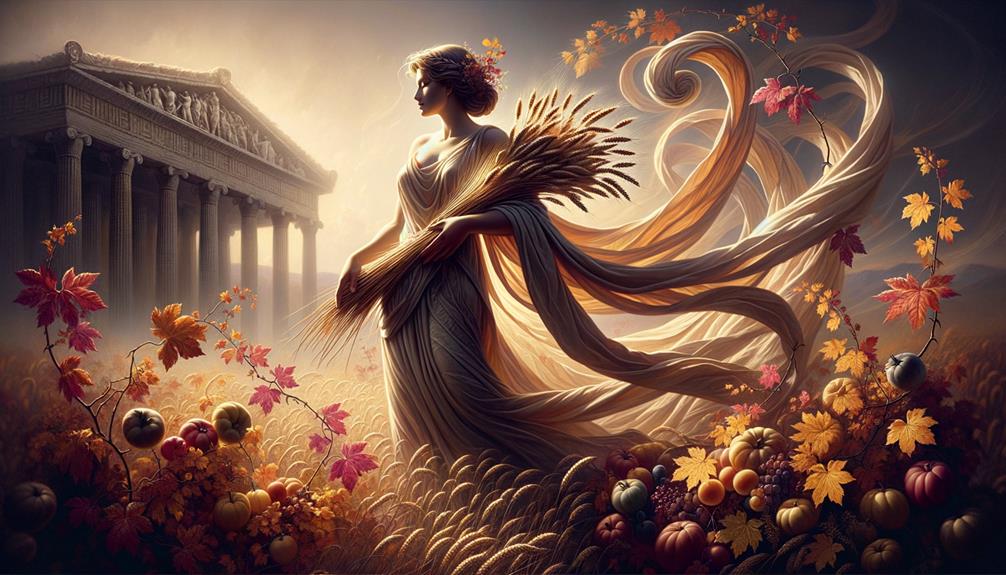
Demeter is the Greek goddess of cultivated grain and the fragile human world built around it. Her myths are not only stories about “the seasons.” They join food supply, maternal grief, divine power, civic ritual, and the boundary between life and death. The most important surviving narrative is the Homeric Hymn to Demeter, which explains both Persephone’s divided year and Demeter’s sanctuary at Eleusis.
What Demeter governs
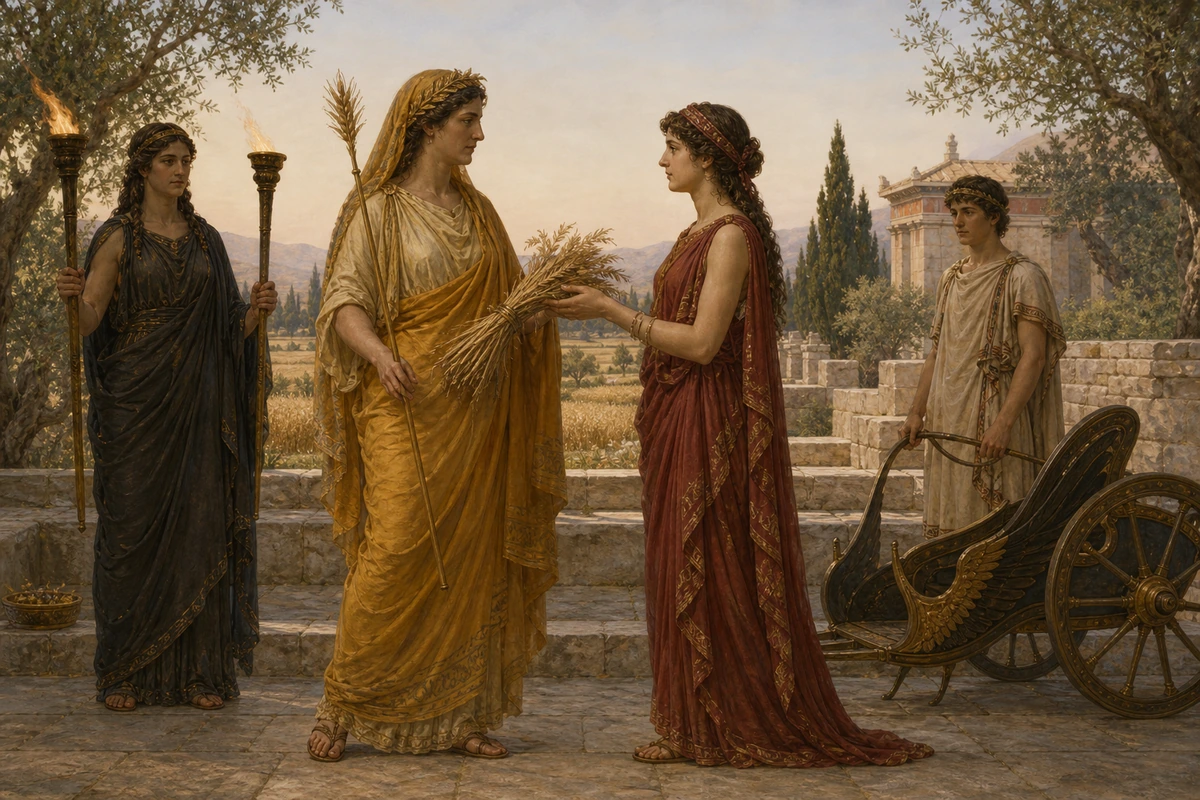
Demeter’s central domain is grain: the sowing, growth, harvesting, and social distribution of the staple crops on which Greek communities depended. Ancient art associates her with ears of wheat or barley, a scepter, torches, baskets, and sometimes a cornucopia. Roman writers identified her with Ceres, but the Greek and Roman traditions should not be treated as identical in every detail.
The second part of her name resembles the Greek word for “mother,” while the first element remains disputed. “Earth Mother” is a common interpretation, but it is not a settled translation. Ancient poets could connect Demeter closely with the productive earth without making her interchangeable with Gaia, the personified Earth.
The abduction of Persephone
At the beginning of the Homeric Hymn, Persephone—also called Kore, “Maiden”—gathers flowers with other divine girls. A wondrous narcissus opens as a lure, the earth parts, and Hades carries her into the underworld. Crucially, the hymn says that Zeus has consented to the marriage. Demeter hears her daughter’s cry but does not initially know who has taken her.
Demeter searches for nine days with blazing torches and refuses food, drink, and washing. Hekate joins her, and the sun god Helios finally identifies Hades and reveals Zeus’s role. The disclosure makes Demeter’s conflict larger than a private quarrel with the underworld. Her grief becomes resistance to the arrangement made by the ruling gods.
Demeter at Eleusis
Disguised as an elderly mortal woman, Demeter reaches Eleusis and rests near a well. The daughters of King Celeus bring her into the royal household, where Queen Metaneira entrusts the infant Demophon to her. The goddess secretly treats the child with ambrosia and places him in fire at night, intending to make him deathless. Metaneira interrupts the process in terror.
Demeter then reveals her divine form and orders the Eleusinians to build her a temple. She withdraws there and prevents seed from growing. The famine threatens humanity, but it also threatens the gods because mortals can no longer provide sacrifice. Zeus sends divine messengers, yet Demeter will not relent until she sees Persephone.
This sequence matters because Demeter is not passively waiting for help. She uses the power of agriculture to force negotiation. The story recognizes a fact that ancient society could never ignore: political and religious order depends on food, and food depends on forces that rulers do not fully command.
The pomegranate and the divided year
Zeus instructs Hades to release Persephone. Before she leaves, Hades gives her pomegranate seed to eat, creating an enduring bond with the underworld. Mother and daughter reunite, but Persephone must return below for part of each year. In the hymn’s own arrangement, she spends one-third of the year beneath the earth and the other two-thirds with Demeter and the Olympian gods.
Later versions vary in details, including the amount of pomegranate eaten and the length of Persephone’s absence. This is why the familiar claim that the myth neatly explains four equal seasons is misleading. The hymn does link absence, return, fertility, and barrenness, but its proportions are not a four-season calendar.
The agricultural setting also deserves care. In a Mediterranean climate, grain is commonly sown with the autumn rains and grows through winter before a late spring or early summer harvest. The dry summer landscape does not map cleanly onto the colder northern-European pattern often assumed in modern retellings. The myth works through ritual time, emotion, and crop dependence rather than serving as a simple weather diagram.
Figures and symbols in Demeter’s tradition
| Figure or object | Role in the tradition | What to avoid assuming |
|---|---|---|
| Persephone/Kore | Demeter’s daughter and queen of the underworld, present above and below | She is not only a passive symbol of spring |
| Hekate’s torches | Search, accompaniment, and the passage through darkness | They do not reveal the secret Eleusinian ritual by themselves |
| Triptolemos | Eleusinian hero associated with spreading the cultivation of grain | He is not Demophon under a universally agreed alternate name |
| Pomegranate | The food that binds Persephone to a recurring underworld stay | Ancient sources do not all give the same seed count |
| Grain | Demeter’s gift and the basis of agricultural wealth | Demeter is not simply the earth itself |
The Eleusinian Mysteries
The hymn links Demeter’s reconciliation with the establishment of rites at Eleusis. The Eleusinian Mysteries became the most celebrated initiation cult in the Greek world and continued for many centuries. A great public procession traveled from Athens to Eleusis, but the central experiences inside the sanctuary were restricted to initiates and protected by rules of secrecy.
That secrecy limits what modern writers can responsibly claim. Archaeology, inscriptions, art, and scattered literary references reveal the sanctuary, its personnel, processions, fasting, torches, sacred objects, and expectations concerning a better fate after death. They do not give us a complete script for the private rites. Confident modern descriptions of every stage usually fill gaps that the evidence leaves open.
The cult was strikingly inclusive by the standards of the ancient city: women, non-Athenians, and enslaved people could be initiated if they met the ritual requirements and could participate. It was not, however, a modern egalitarian movement. Initiation required resources, travel, preparation, and adherence to a highly structured sanctuary tradition.
Other cults and family relationships
Demeter was worshipped far beyond Eleusis. The Thesmophoria was a major festival practiced by citizen women in many Greek communities and concerned fertility, agriculture, and civic continuity. In Arcadia, local traditions connected Demeter with Despoina, whose identity and rites were regionally specific. Such variations warn against compressing all worship of Demeter into one standardized myth.
Her divine family also changes by source and locality. Persephone is her defining daughter, while Ploutos—“Wealth”—can embody the prosperity produced by grain. Some traditions connect Demeter with Poseidon and the mysterious Despoina. These genealogies are not errors to be harmonized; Greek religion preserved overlapping local stories and cult relationships.
How to understand Demeter
Demeter’s story asks what happens when the systems that sustain life are treated as if they can be controlled without cost. Zeus and Hades arrange Persephone’s marriage, but Demeter’s refusal makes their decision impossible to ignore. Her grief becomes a force that stops the economy of sacrifice and the reproduction of human society.
The resolution is not a complete restoration. Persephone returns and grain grows again, yet separation will recur. Demeter therefore governs not a permanent triumph over death but a negotiated continuity: seed stored and sown, food lost and restored, children changed by leaving, and communities held together through remembered ritual.