

Orpheus is the singer whose music moves animals, trees, stones, and even the powers of death. His attempt to recover his wife from the underworld is now usually told as the story of Orpheus and Eurydice, but the surviving tradition developed across centuries. Virgil and Ovid give the two most influential complete literary versions, and their backward glances do not mean exactly the same thing.
The descent is a katabasis, a journey by a living person into the realm of the dead. Unlike Heracles, Orpheus does not force his way through by strength. Song is his means of passage. The exceptional release is granted on a condition, and the condition fails only a few steps from the upper world.
Who is Orpheus?
Ancient sources usually place Orpheus in Thrace and call him a son of the Muse Calliope, though his father’s name varies. He is both poet and musician, most often shown with a lyre or kithara. His song can suspend ordinary behavior: wild animals gather peacefully, trees move, and stones follow.
Orpheus also sails with Jason’s Argonauts. In the Argonautica, his rhythm orders the rowers, his rites establish sacred space, and his music overcomes the deadly song of the Sirens. These episodes make his underworld success less surprising. He has already shown that organized sound can alter bodies, environments, and competing voices.
Before Virgil and Ovid
Classical Greek authors knew that Orpheus attempted to recover a dead wife, but not every early reference gives the familiar ending. Euripides’ Alcestis imagines that Orpheus’s song could charm the underworld powers and bring a wife back. Plato’s Symposium, by contrast, says the gods showed Orpheus only an apparition because he lacked the courage to die for love.
Names also vary in the wider tradition; Agriope appears as Orpheus’s wife in some material. “Eurydice” becomes dominant through influential Hellenistic and Roman literary treatments. The existence of variants is not a flaw but evidence that poets reshaped a well-known descent story for different arguments.
Virgil’s version in the Georgics
Virgil tells the story near the end of Georgics Book 4, inside another narrative. The beekeeper Aristaeus has lost his swarm. The sea-god Proteus reveals that the nymphs punished him because Eurydice died while fleeing his pursuit: she failed to see a snake in the grass.
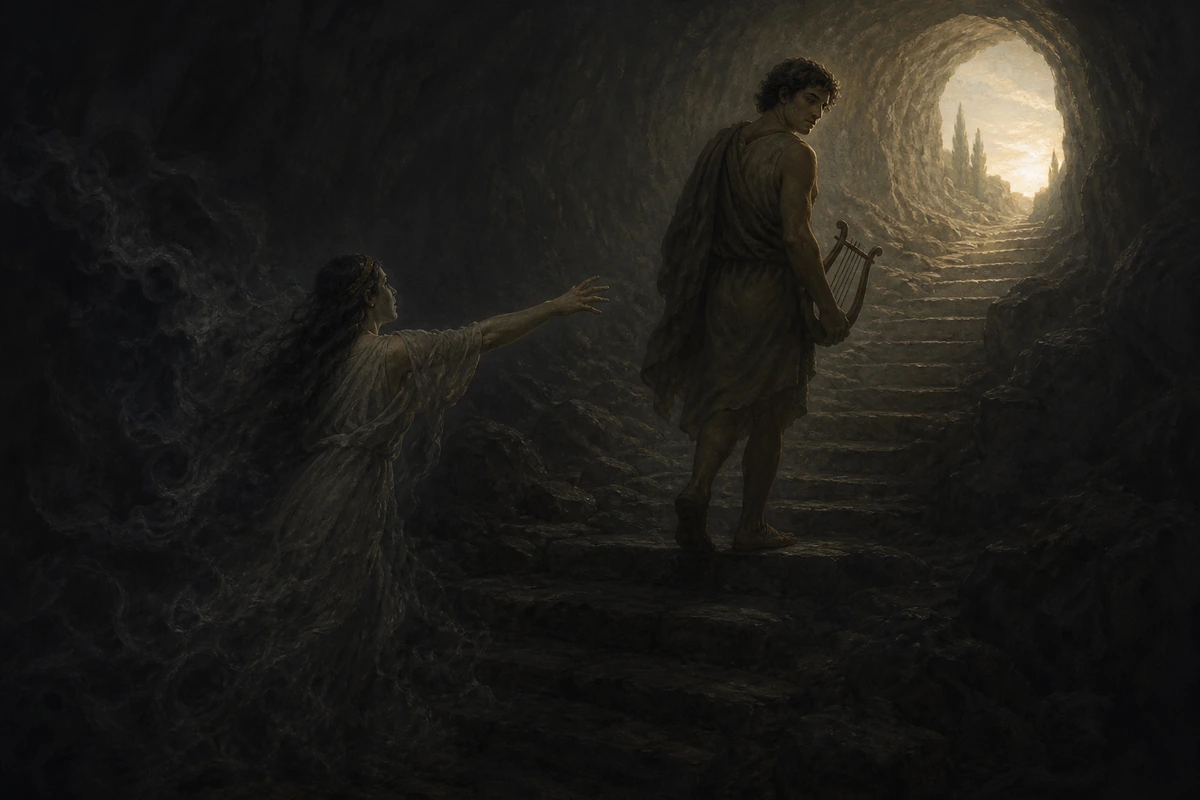
Orpheus mourns, descends, and moves the dead with his song. The underworld grants Eurydice’s return under a rule that he must not look back until the ascent is complete. Close to safety, a sudden madness seizes him and he turns. Virgil calls the lapse forgivable—if the dead knew how to forgive—but does not reduce it to one practical explanation.
Eurydice is swept back. She asks what destructive madness has ruined them, says farewell, and disappears like smoke. Orpheus tries to cross again but cannot. He mourns for seven months, rejects other love, and is eventually torn apart by Thracian women. Even in death, his severed head calls Eurydice’s name.
Ovid’s version in the Metamorphoses
Ovid begins with a failed wedding omen. Eurydice is bitten by a snake while walking with Naiads, and Orpheus descends through the Taenarian gate. His song addresses Hades and Proserpina directly: all mortals are owed to the underworld eventually, so he asks only for a life cut short to be restored.
The music stops the punishments of famous sinners and brings tears to the Furies. Eurydice is released on the familiar condition. Near the surface Orpheus becomes afraid that she may be failing behind him and eager to see her. He looks, reaches, and loses her. Ovid’s Eurydice offers no accusation; her final word is a farewell because, the poet asks, what could she complain of except being loved?
| Version | Cause of Eurydice’s death | Why Orpheus turns | Eurydice’s response |
|---|---|---|---|
| Virgil, Georgics 4 | Snakebite while fleeing Aristaeus | A sudden madness or lapse at the edge of safety | She questions the madness that destroys them and says farewell |
| Ovid, Metamorphoses 10 | Snakebite during the wedding’s aftermath | Fear for her and desire to see her | She gives a final farewell without blaming him |
| Earlier allusions | Often unstated | The condition may be absent or the outcome judged differently | Varies with the author’s argument |
Why does he look back?
Modern retellings often demand one motivation: doubt that Eurydice is present, distrust of the gods, overwhelming love, anxiety, impatience, or deliberate refusal of an unjust condition. Virgil’s furor and Ovid’s mixture of fear and longing support more than one psychological reading.
The rule itself creates the impossible situation. Orpheus must lead without verifying that the person he loves is following; Eurydice must follow without being acknowledged. The success of music in the underworld gives way to silence on the path upward. Turning is both an act of recognition and the act that removes her.
Orpheus’s own death
After the second loss, Orpheus refuses or avoids new relationships with women. Thracian women attack him during their rites. At first his music deflects their weapons, but their cries and instruments overwhelm it. They dismember him, repeating in mortal violence the bodily fragmentation found elsewhere in Dionysian stories.
Ovid sends Orpheus’s head and lyre down the river Hebrus to the sea and on toward Lesbos, an island renowned for poetry. In the underworld his shade finally finds Eurydice. He may now look at her without danger, a quiet reversal of the condition that destroyed the first reunion.
Orpheus and “Orphism”
Ancient Greeks attributed poems, initiatory rites, theogonies, and teachings about the soul to Orpheus. Modern scholars use “Orphic” and “Orphism” to organize inscriptions, gold tablets, papyri, literary quotations, and ritual evidence associated with his authority.
That evidence does not reveal a single church founded by a documented historical Orpheus. The Oxford Classical Dictionary notes that “Orphism” is itself a modern concept whose scope has been debated. It is safer to speak of Orphic texts and practices in particular contexts than to assume one uniform creed followed everywhere in the Greek world.
Why the story endures
The descent has inspired opera from Monteverdi’s L’Orfeo to Gluck’s Orfeo ed Euridice, along with poetry, painting, film, and modern theater. Adaptations regularly change the ending because the central structure is so flexible: art crosses a boundary, wins an exception, and then meets a human limit.
Its force comes from more than the instruction “do not look back.” The tale asks whether art can change reality, whether trust is possible without evidence, and whether recognition can arrive at the wrong time. The answer is tragic, but Orpheus’s continuing song prevents loss from becoming silence.
Key takeaways
- Virgil and Ovid provide the most influential complete versions, with different contexts and motives.
- Orpheus wins Eurydice’s conditional release through song, not physical force.
- The backward glance can signify fear, desire, doubt, or a divinely induced lapse; no single explanation covers every source.
- “Orphism” is a debated modern category for diverse ancient texts and practices associated with Orpheus.