
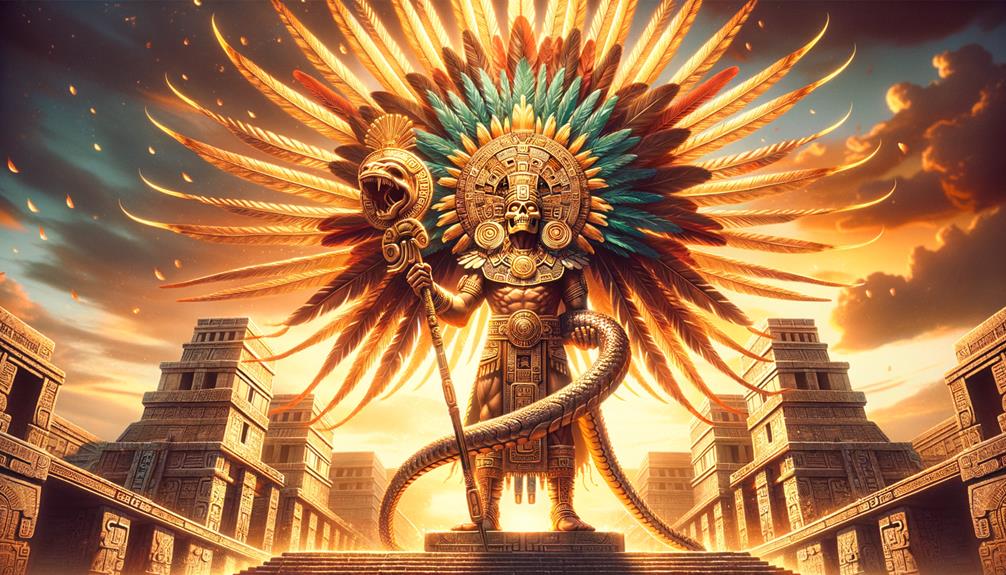
Huitzilopochtli was the patron deity of the Mexica, a god of war with a strong solar character whose shrine crowned the southern half of the Templo Mayor. Calling him only an “Aztec sun god” is too narrow: his identity was bound to migration, warfare, tribute, and the sacred history through which the Mexica understood their place in Tenochtitlan.
Name and identity
Huitzilopochtli’s Nahuatl name is conventionally rendered “Hummingbird of the Left” or “Left-Handed Hummingbird.” Because south was associated with the left in some central Mexican spatial schemes, the name may also carry a southern direction. Hummingbirds evoked speed, martial vigor, and the continuing presence of fallen warriors.
The Templo Mayor Museum describes Huitzilopochtli as a war god, solar manifestation, and patron of the Mexica. These roles overlap, but they are not interchangeable. Solar language helps explain his dawn-like victory at Coatepec; his political importance comes from guiding and protecting a particular people.
The birth at Coatepec
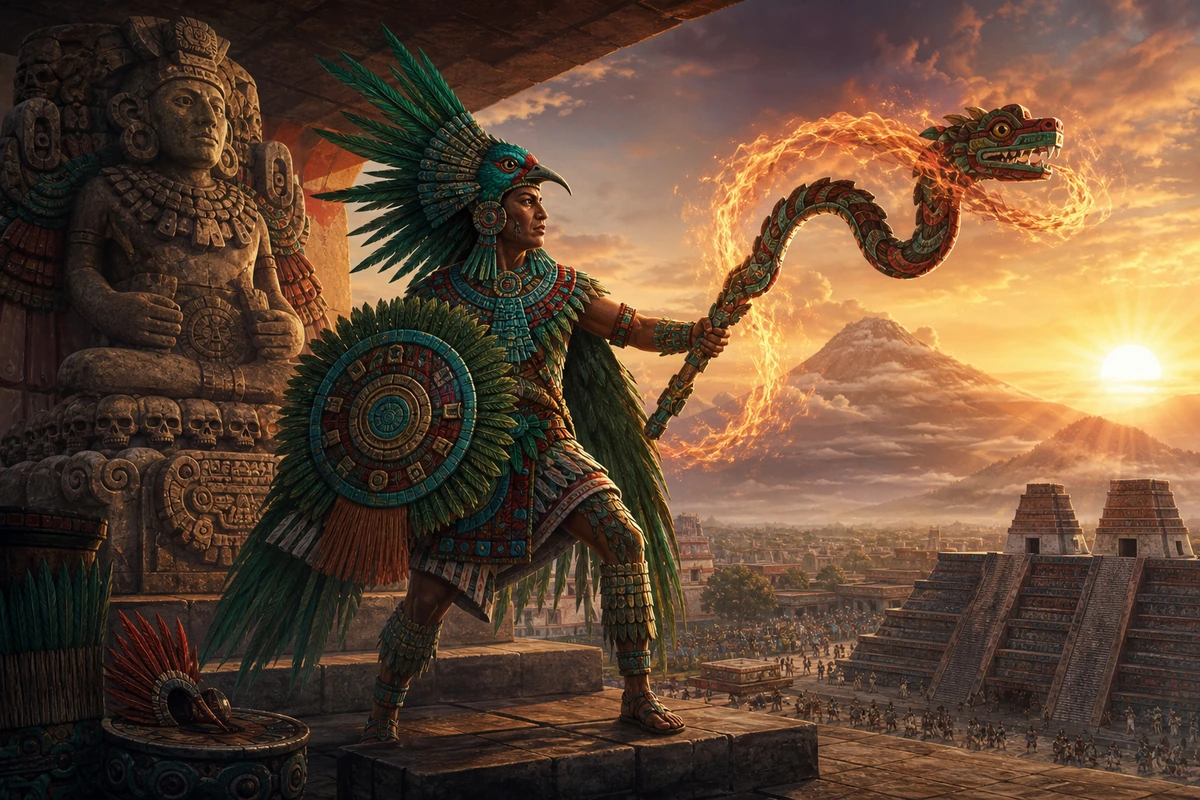
In the account recorded by Bernardino de Sahagún, Coatlicue became pregnant after placing a ball of feathers against her body while sweeping on Coatepec. Her daughter Coyolxauhqui and the Centzon Huitznahua prepared to kill her. Huitzilopochtli was born fully armed, defeated Coyolxauhqui with the Xiuhcoatl or “Turquoise/Fire Serpent,” and scattered the attackers.
A widespread interpretation reads Huitzilopochtli as the sun overcoming the moon and stars. That cosmic pattern is useful, but the narrative also expressed collective identity and conquest. It should not be flattened into a universal nature allegory.
The myth built in stone
The southern side of the Templo Mayor materialized Coatepec. A colossal basalt head of the Xiuhcoatl and figures associated with the Centzon Huitznahua were found on that side. Most dramatically, the great Coyolxauhqui relief lay near the base of Huitzilopochtli’s stairway, placing her broken body where the myth said she fell from the mountain.
This arrangement joined narrative, architecture, and ceremony. People ascending the stairway moved through a constructed sacred history. The repeated rebuilding of the temple preserved that relationship even as the capital expanded.
Migration and Mexica state power
Other traditions portray Huitzilopochtli directing the Mexica during their migration and ordering them onward until they reached the place where Tenochtitlan would be founded. These accounts were recorded after the city had become an imperial capital, so they are both sacred narratives and statements about political legitimacy.
At Tenochtitlan, Huitzilopochtli’s cult was tied to warfare and tribute. Captives taken in battle could be offered in state ceremonies, while military success sustained the empire’s economy. The deity’s prominence therefore reflected institutions as well as belief.
Huitzilopochtli and Tlaloc
Huitzilopochtli did not stand alone atop the Templo Mayor. His southern shrine was paired with the northern shrine of Tlaloc, deity of rain and agricultural sustenance. The twin sanctuary brought together two foundations of the Mexica state: tribute secured through war and food secured through rain.
That pairing gives a more accurate picture than treating the pantheon as a list of isolated “gods of” separate subjects. Mexica deities, places, rites, and institutions formed an interdependent sacred system.