
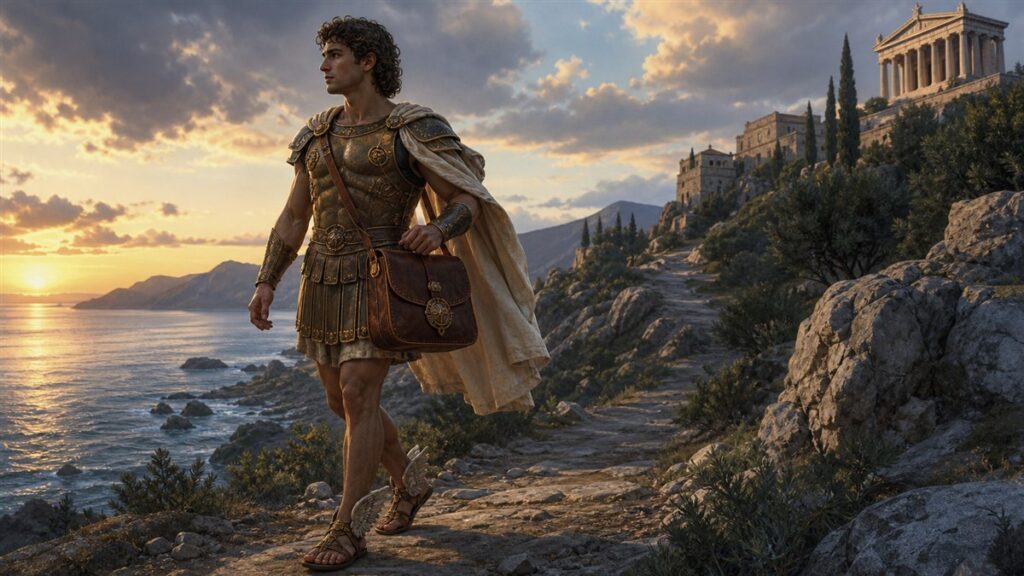
The kibisis is the bag that allows Perseus to carry Medusa’s severed head without exposing its deadly gaze. It is essential equipment, but ancient sources do not consistently describe the bag itself as enchanted. Invisibility belongs to the cap of Hades; flight belongs to the winged sandals.
What does kibisis mean?
Pseudo-Apollodorus calls the kibisis a wallet or bag and adds an ancient etymological note: clothing and food are placed inside it. The object is therefore recognizable before it is marvelous. Its mythic importance comes from what Perseus must carry, not from a catalogue of independent powers.
The Shield of Heracles, traditionally attributed to Hesiod, also places the kibisis around Perseus and describes the Gorgon’s head inside it. That early poetic image confirms that the bag is a standard part of Perseus’s equipment.
Who gives Perseus the bag?
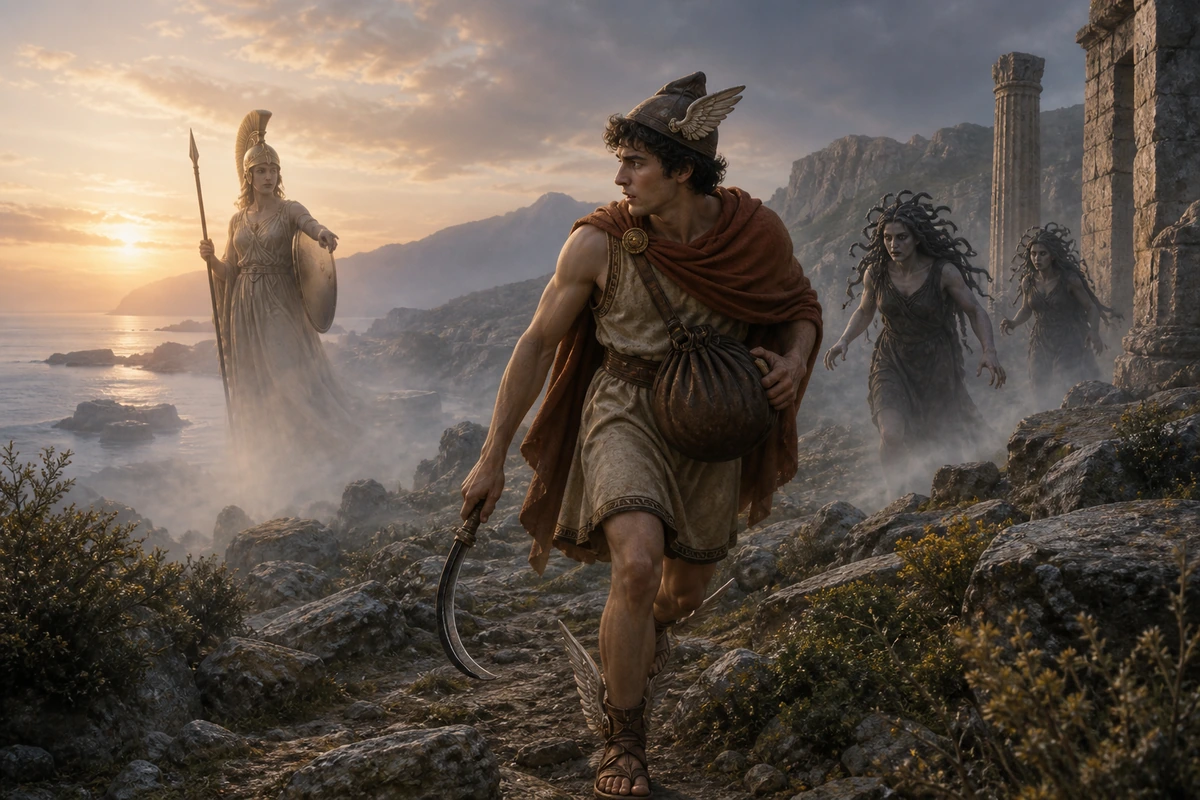
In Pseudo-Apollodorus, Athena and Hermes guide Perseus to the Graiae. After he takes their shared eye and tooth, they reveal the way to nymphs who possess the winged sandals, the kibisis, and the cap of Hades. The nymphs provide those three objects, while Hermes gives Perseus an adamantine sickle.
Ancient versions do not all distribute the gifts in exactly the same way. Later retellings often compress the donors into “the gods” or assign every object to Athena. A source-aware account keeps the equipment separate and acknowledges variation.
The cap, sandals, sickle, and shield
Each item has a distinct job. The cap of Hades conceals Perseus from sight. The winged sandals carry him to and from the Gorgons. The sickle cuts Medusa’s neck. The kibisis receives and conceals the head.
Athena guides Perseus’s hand while he looks at Medusa’s image in a bronze shield rather than staring directly at her. Calling it a “mirror shield” is a convenient modern phrase, but Pseudo-Apollodorus describes a reflected image in bronze, not a separate magical mirror with powers of its own.
Carrying Medusa’s head
Medusa alone is mortal among the three Gorgon sisters. Perseus approaches while they sleep, looks away toward the shield’s reflection, and beheads her. Pegasus and Chrysaor spring from her body. He immediately places the head in the kibisis.
Stheno and Euryale awaken and pursue him, but they cannot see him because of the cap. This line makes the division of powers explicit: the bag contains the dangerous head; the cap makes the wearer invisible. Claims that the kibisis itself hides Perseus or grants stealth conflate the two objects.
Why containment matters
Medusa’s head remains potent after death. Perseus later uses it against enemies and finally gives it to Athena, who places it on her protective aegis or shield. A secure container is therefore not a decorative accessory. It separates a living traveller from a weapon that can petrify anyone who sees it.
The kibisis can be read as a tool of safe handling and disciplined control, but ancient authors do not stop to define it as a universal symbol of “personal growth” or the hero’s journey. Its concrete narrative purpose should come first.
The kibisis in ancient art
Vase painters make the bag visually legible by hanging it from Perseus’s waist or shoulder. In some scenes he flees with the closed kibisis while Hermes or Athena accompanies him and the surviving Gorgons follow. Other images show him holding it near the moment of escape.
These representations are valuable evidence because a bag can be easy to overlook in a written list of spectacular equipment. They also show that ancient artists varied the bag’s shape and the surrounding moment rather than preserving one fixed prop design.
What happens to the equipment?
Pseudo-Apollodorus says that Perseus eventually returns the sandals, kibisis, and cap to Hermes, who restores them to the nymphs. The Gorgon’s head has a different destination: Athena sets it at the centre of her shield. The bag completes its task and leaves the story; it does not become an endlessly circulating magical relic.