
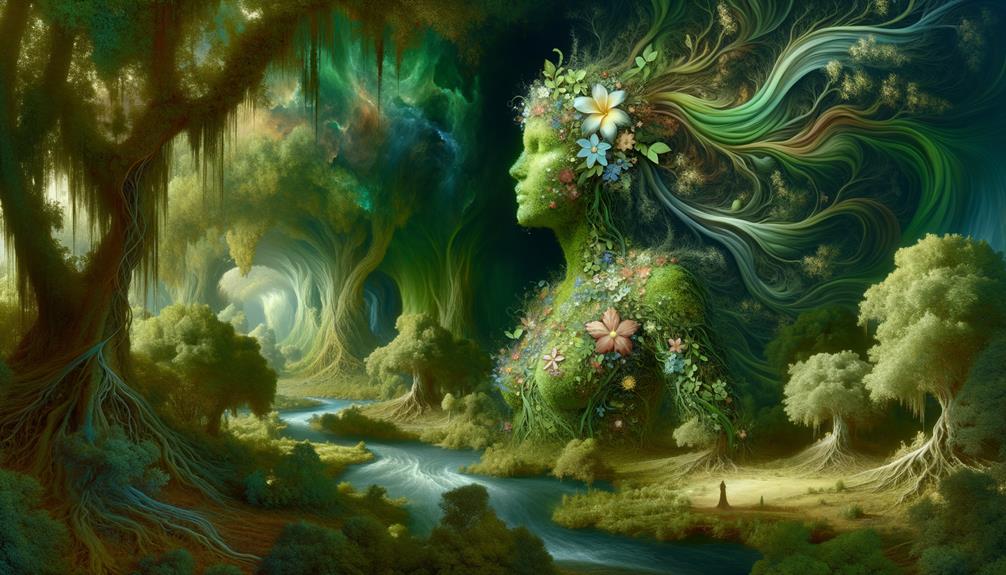
Accuracy note: In Hesiod, Gaia does not simply “come from Chaos.” Chaos appears first; then Gaia, Tartarus, and Eros come into being. Gaia is Earth itself, a primordial divine power, and not merely an Olympian goddess in Zeus’s court.
Gaia—also written Gaea, and called Gē in Greek—is the personified Earth and one of the foundations of Greek cosmogony. She generates the physical structure of the world, mothers successive divine families, gives strategic counsel, and receives cult as the nourishing and oath-bearing ground.
Gaia at the beginning of Hesiod’s cosmos
The Theogony begins with Chaos, followed by broad-breasted Gaia, Tartarus, and Eros. Gaia is the secure seat of the immortals. Without mating she produces starry Uranus, the Mountains, and the sea Pontus. These are not decorations surrounding an Earth goddess; they are the differentiated features of the cosmos emerging from Earth.
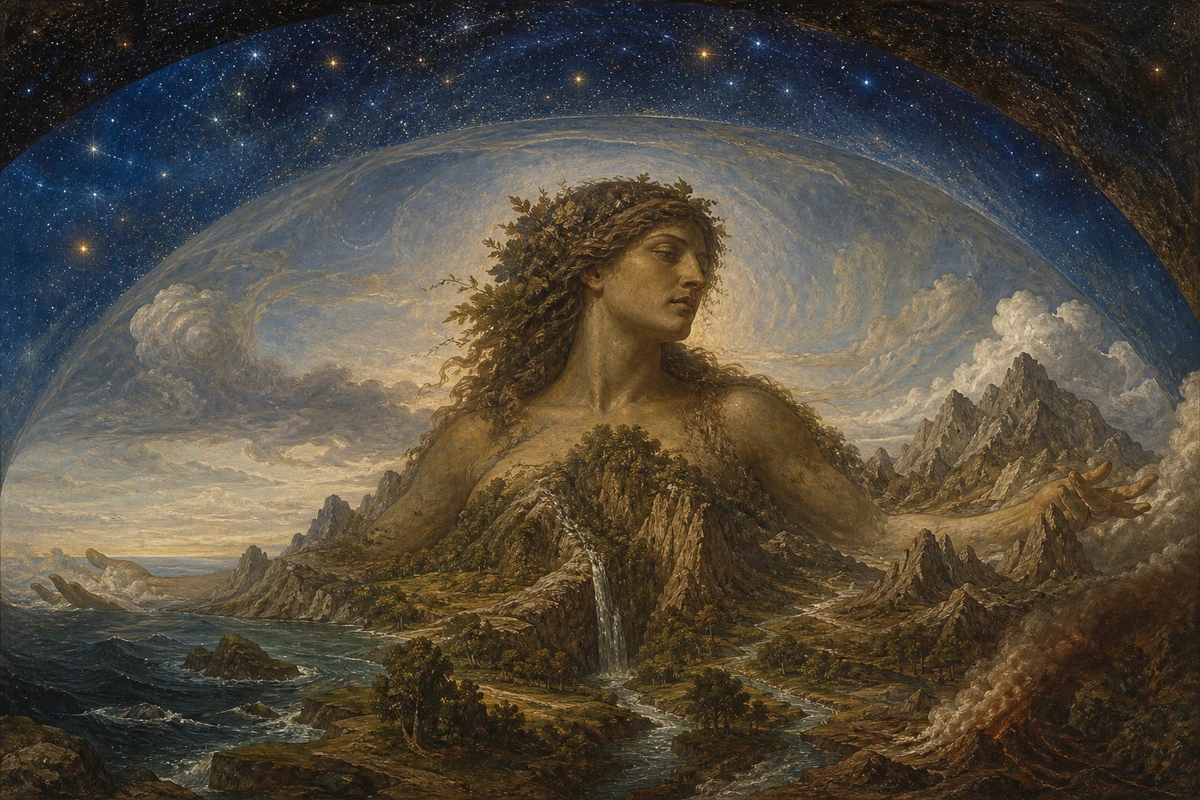
Earth and Sky produce the first dynasty
With Uranus, Gaia becomes mother of the twelve Titans, the one-eyed Cyclopes Brontes, Steropes, and Arges, and the Hundred-Handers Cottus, Briareus, and Gyes. Uranus hates some of these children and hides them within Gaia, causing her pain.
Gaia creates a sickle and asks her children to act. Cronus accepts. When Uranus comes to lie with Gaia, Cronus castrates him. From the blood falling on Earth arise the Erinyes, Giants, and Melian nymphs; Aphrodite’s sea-birth follows from the severed genitals cast into the water.
Gaia and the succession of rulers
Cronus becomes ruler but swallows his children because Gaia and Uranus have foretold that one of them will overthrow him. Gaia helps Rhea save the infant Zeus by hiding him in Crete and substituting a wrapped stone. Later, Earth’s counsel helps Zeus understand how to defeat the Titans, including the need to release the Hundred-Handers.
Gaia therefore participates in repeated changes of divine rule, but she is not consistently “against the patriarchy” or permanently opposed to Zeus. Hesiod’s Earth can aid Zeus’s victory and later bear Typhoeus with Tartarus after the Titans are defeated. Her actions respond to kinship, confinement, prophecy, and cosmic order in different episodes.
Typhoeus, Giants, and variant genealogies
Hesiod makes Typhoeus the youngest child of Gaia and Tartarus. Other authors give different versions, and the Giants’ parentage also develops across poetry and art. “Earth-born” is a recurring description of formidable beings, but not every monster belongs to one identical family tree.
Gaia as prophet
Earth can possess ancient prophetic authority. Traditions about Delphi sometimes place Gaia before Themis and Apollo, while Athenian myth connects Earth with autochthony and ancestral birth. Sanctuary histories are more complex than a simple claim that Apollo stole every oracle from Gaia.
Cult, sacrifice, and oaths
Gaia appears in ritual as the ground that nourishes living things and receives the dead. Homeric epic invokes Earth in solemn oaths and describes chthonic sacrifice. A Homeric Hymn addresses Earth as mother of all and praises the prosperity she can grant to households, fields, and livestock.
Local cult titles and pairings matter. Gaia could be honored with Zeus, Themis, Demeter, or other deities, but she is not simply another name for Demeter. Demeter’s myths and mysteries focus especially on grain, her daughter Persephone, and the agricultural cycle; Gaia’s identity is the Earth in a more encompassing sense.
How ancient artists showed Earth
Greek art can show Gaia rising from the ground, often only partly visible because her body is the earth itself. In scenes of Erichthonius’s birth she may hand the child upward to Athena. Roman art develops related images of Tellus or Terra surrounded by vegetation and abundance. Similar iconography does not make every Earth figure the same deity.
Gaia and modern environmental language
Modern environmental writing often uses “Gaia” for the living planet, and the scientific Gaia hypothesis proposes that interacting systems help regulate Earth’s conditions. These are influential modern uses of an ancient name. They should not be presented as doctrines taught by Hesiodic Greeks.
Gaia’s major children in Hesiod
| Without a partner | With Uranus | With Pontus or Tartarus |
|---|---|---|
| Uranus, Mountains, Pontus | Titans, Cyclopes, Hundred-Handers | Sea-line descendants with Pontus; Typhoeus with Tartarus |