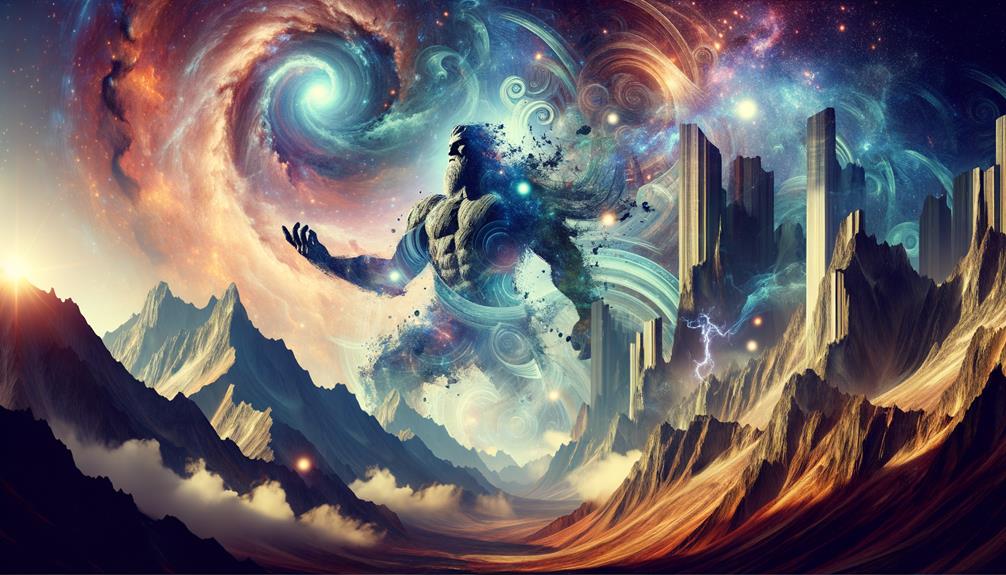
The Titans are the elder divine generation born to Gaia and Uranus in Hesiod’s Theogony. They are not a separate species of enormous stone monsters, and they do not all vanish when Zeus becomes king. Some oppose him, some support him, and others enter the Olympian order as mothers, counsellors, rivers, and sources of divine power.
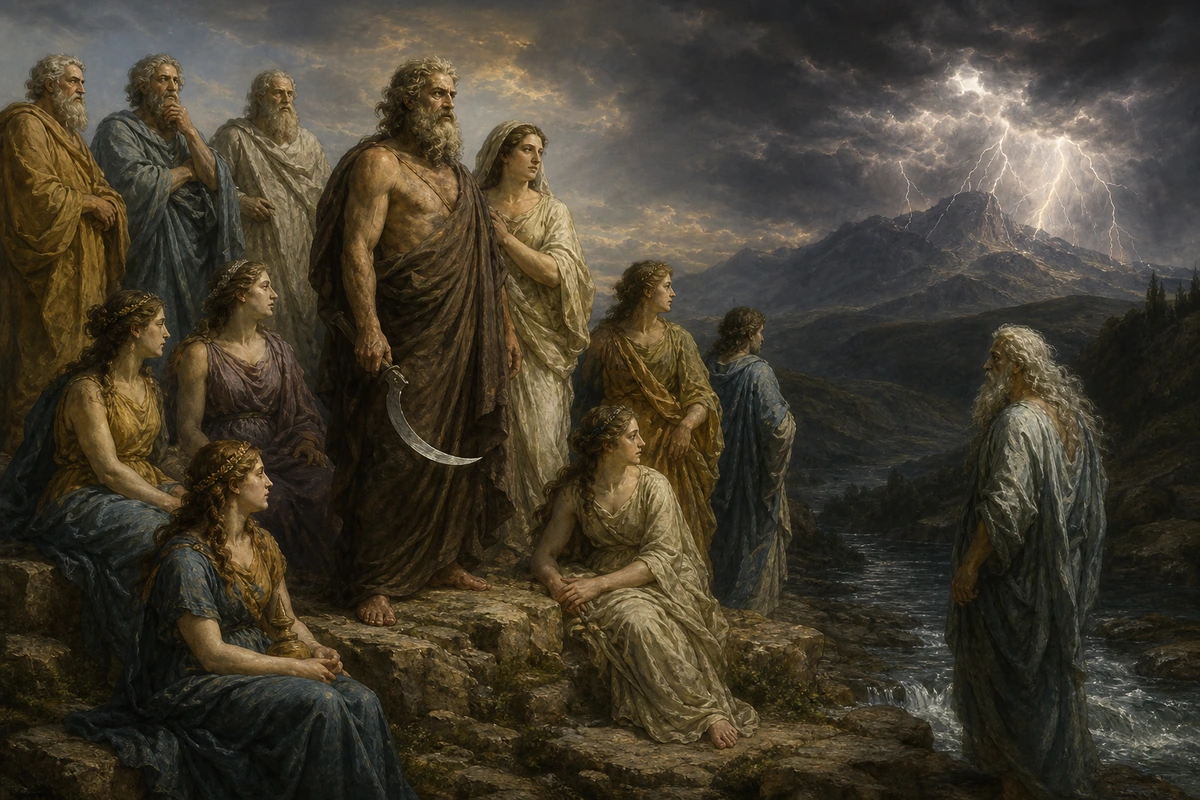
The twelve Titans in Hesiod
Hesiod names six male Titans—Oceanus, Coeus, Crius, Hyperion, Iapetus, and Cronus—and six female Titans—Theia, Rhea, Themis, Mnemosyne, Phoebe, and Tethys. All are children of Earth and Heaven. Later genealogies add or rearrange names, and the word “Titan” can also be applied to descendants such as Atlas and Prometheus.
The twelve do not share one personality or domain. Oceanus is the great encircling river; Themis embodies divine order; Mnemosyne is Memory and mother of the Muses; Hyperion’s children are Sun, Moon, and Dawn. Treating every Titan as a violent enemy of Olympus erases most of their functions.
Cronus overthrows Uranus
Uranus hides some of his children within Gaia, causing her pain. Gaia fashions an adamantine sickle and asks her children to act. Only Cronus accepts the task in Hesiod’s scene. He ambushes and castrates Uranus, after which blood and severed flesh generate new beings, including the Erinyes, Giants, Meliae, and Aphrodite.
Pseudo-Apollodorus says that the Titans, except Oceanus, attack Uranus while Cronus performs the castration. That fuller collective revolt is later evidence; it should not be read back into Hesiod without qualification.
Cronus and the swallowed children
Cronus rules with Rhea but learns that one of his children will overthrow him. He swallows Hestia, Demeter, Hera, Hades, and Poseidon at birth. Rhea saves Zeus by giving Cronus a wrapped stone and hiding the child in Crete.
When Zeus matures, Cronus disgorges the children. The new generation contests the ruling Titans in the war called the Titanomachy. The theme is succession within a divine family, not the replacement of “evil giants” by morally perfect gods.
Who fought in the Titanomachy?
Hesiod places the lordly Titans on Mount Othrys and the children of Cronus on Olympus. The war lasts ten years until Gaia advises Zeus to free the Hundred-Handers. Their rock storm, together with Zeus’s thunderbolts, breaks the deadlock.
Not every Titan belongs on the defeated side. Oceanus is not described fighting Zeus, and his daughter Styx is the first to answer Zeus’s call for allies. Prometheus, a son of Iapetus, also follows an independent path. Hecate retains honours from the earlier order, while Themis and Mnemosyne later become consorts of Zeus.
Defeat and Tartarus
The hostile Titans are driven beneath the earth, bound in Tartarus, and guarded by the Hundred-Handers. Cronus is among the defeated rulers in Hesiod’s cosmic geography. Later Greek and Roman authors offer alternatives, including traditions in which Cronus rules a blessed realm.
Statements that Zeus killed all the Titans or that every one of the twelve remains in Tartarus are therefore wrong. The divine genealogies continue through them: Apollo and Artemis descend from Coeus and Phoebe, while Helios, Selene, and Eos descend from Hyperion and Theia.
Were the Titans literally colossal?
The modern English adjective titanic encourages an image of immense size. Ancient poetry emphasizes the generation’s power and age, but it does not consistently describe the twelve as a race of physically gigantic beings. The Hundred-Handers and Giants have their own distinct bodies and myths.
Ancient artists usually render divine figures in human form and rely on attributes and context for identification. A Titan is defined by genealogy and narrative position, not by being taller than an Olympian.
What the succession myth explains
The movement from Uranus to Cronus to Zeus explores unstable kingship, suppressed children, prophecy, alliance, and the distribution of honours. Zeus succeeds where earlier rulers fail partly because he recruits allies and incorporates powers such as Styx, Themis, and Hecate rather than attempting to swallow or bury every rival.
“Order defeats chaos” can summarize one aspect of the Titanomachy, but it should not replace the poem’s detailed network of kinship and negotiated status.