
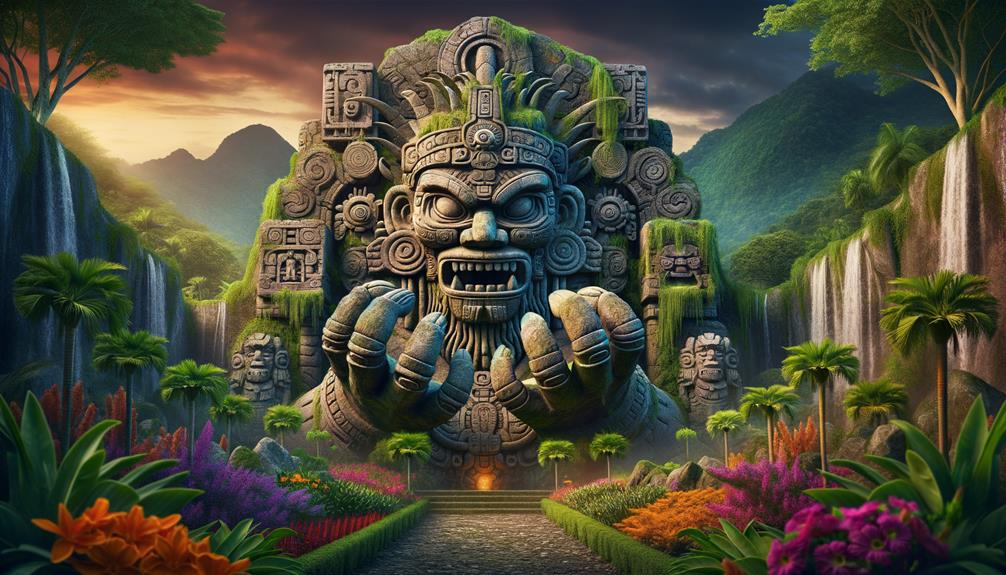
Tlaltecuhtli is one of the most vivid embodiments of the earth in Mexica religion: a body that sustains life, receives the dead, and continually demands renewal. The name is often translated as “Earth Lord,” yet surviving images do not present a single, fixed gender. Some representations are masculine; others are explicitly female. That tension is part of the evidence, not a problem to be edited away.
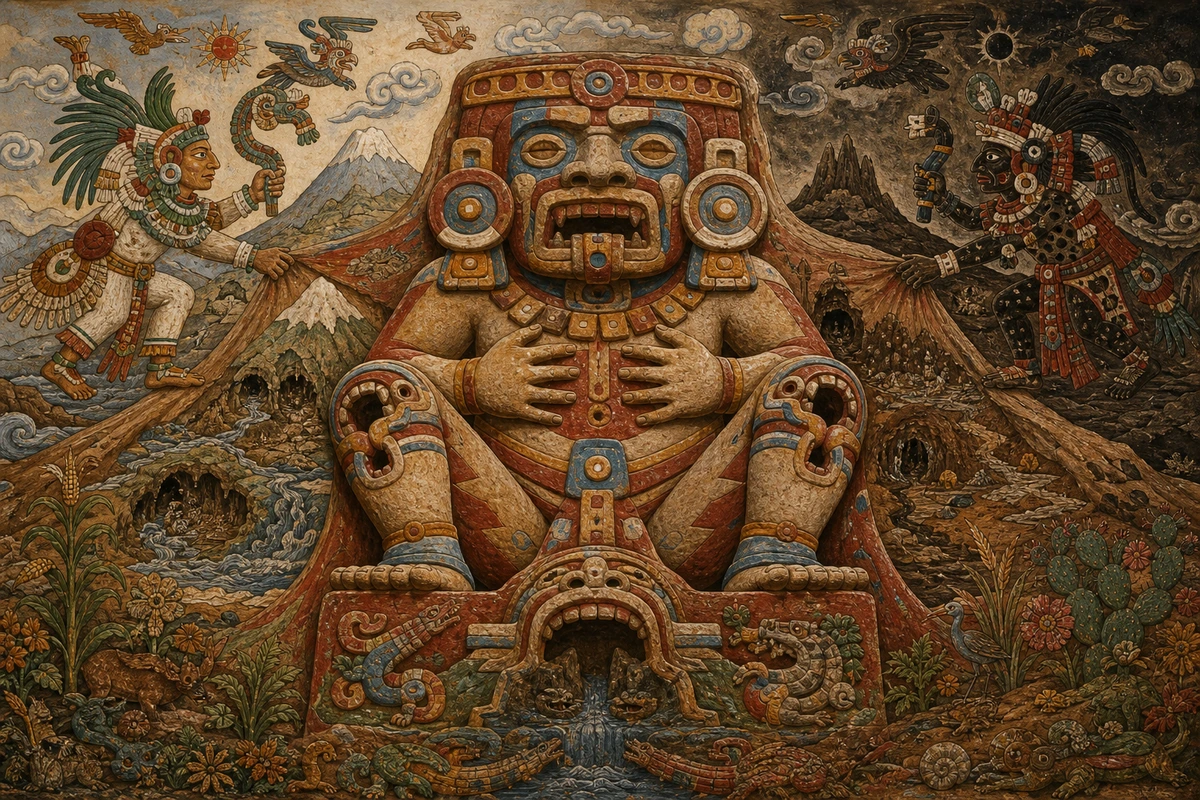
What the name means
Tlalli means earth or land, while tecuhtli is an honorific commonly rendered “lord.” A literal translation therefore sounds grammatically masculine. Iconography complicates that simple reading. Tlaltecuhtli can wear a loincloth in some images and a skirt in others; the monumental sculpture found beside the Templo Mayor is a female form. Scholars accordingly use different English pronouns, and many retain the Nahuatl name rather than force the deity into one category.
The earth made from a primordial body
Colonial-period Nahua creation accounts describe Quetzalcoatl and Tezcatlipoca confronting an earth being floating on the primeval waters. They tear the body apart and arrange it as the world: land from the body, caves and springs from its openings, and vegetation from its hair or skin. The precise details vary by source, but the central idea is consistent. The habitable earth is not inert matter. It is a divine body transformed into the conditions of life.
A giver who also consumes
Tlaltecuhtli expresses an unavoidable reciprocity. Crops, water, and human bodies arise from the earth, and bodies return to it in death. Open jaws, claws, skulls, and sacrificial knives in the imagery make the consuming side visible. These features should not reduce the deity to a villain or “monster.” In Mexica thought, fertility and death were intertwined processes: the earth could generate because it also received and transformed what entered it.
How to recognize Tlaltecuhtli
Stone sculptures and painted manuscripts often show a compact, crouching figure with the limbs spread to the four directions. The mouth can be a toothed maw, sometimes appearing at joints as well as on the face. Curled hair, skulls, claws, and earth-monster features recur, but no single checklist fits every surviving example. Many sculptures were carved on the underside of boxes, monuments, or temple objects, placing the image physically against the ground.
The great monolith of the Templo Mayor
In 2006, archaeologists uncovered an enormous polychrome relief near the Templo Mayor in Mexico City. Measuring more than four metres across, it is the largest Mexica monolith yet found. This Tlaltecuhtli is female and shown in a squatting position associated with childbirth. Red, blue, white, yellow, and black pigment survived on the stone, overturning the familiar modern impression that Mexica sculpture was unpainted.
The carving includes the calendrical name 10 Rabbit and imagery connected with death and the earth. Its discovery close to the temple complex, in an area where elite burials and offerings were expected, led archaeologists to investigate whether the stone marked or covered a significant deposit. Interpretation continues as excavation and conservation add evidence.
Earth, rulership, and imperial ritual
Tlaltecuhtli was not simply a farmer’s nature deity. Earth imagery belonged to state ceremony, warfare, burial, and the legitimacy of rulers. A ruler could be imagined as one whose body returned to the earth while his office renewed the political order. The monumental sculpture’s scale and placement therefore matter as much as the story told about the deity.
What modern retellings often flatten
Popular summaries frequently call Tlaltecuhtli either a male “earth lord” or a female “earth goddess,” as though one label settled the question. Others turn the creation account into a simple battle between gods and a monster. The archaeological and textual record is more interesting: gender varies, creation is violent, and the earth remains sacred after being divided. Tlaltecuhtli is the world beneath human life, simultaneously wounded, productive, and powerful.
Sources and further reading
- Instituto Nacional de Antropología e Historia, “Tlaltecuhtli: ¿señor o señora de la tierra?”
- INAH, Templo Mayor Museum entry for the Tlaltecuhtli monolith
- INAH, “Tlaltecuhtli, la deidad de tierra que emergió del Templo Mayor”
- Histoyre du Mechique, colonial Nahua creation account preserved in French translation