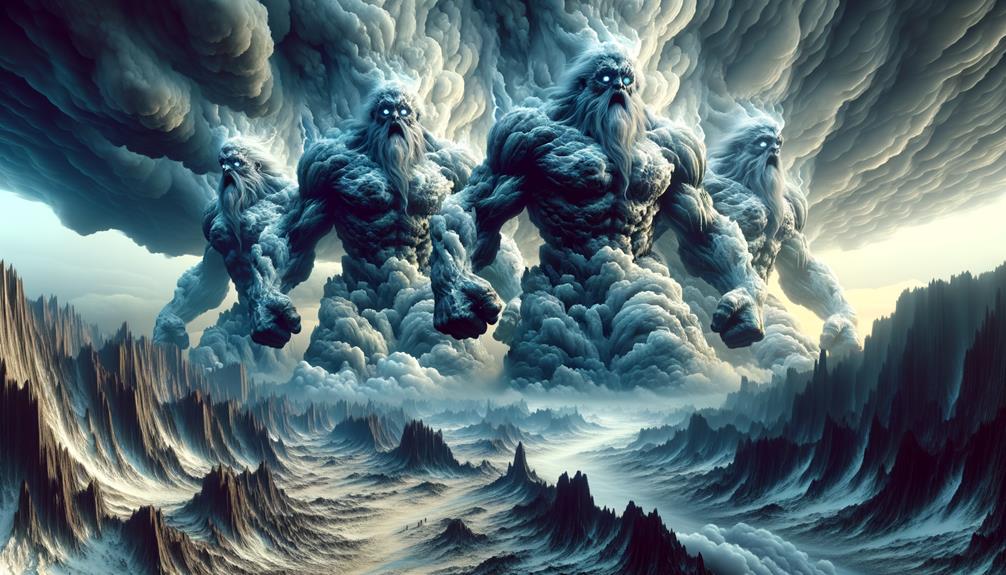
The Hecatoncheires are the three Hundred-Handers of Greek myth: Cottus, Briareus, and Gyes. Each has one hundred arms and fifty heads in Hesiod’s Theogony. Their decisive role is not a vague battle against “evil,” but a specific intervention in the Titanomachy that helps Zeus and his allies defeat the Titans.
Names, parents, and bodies
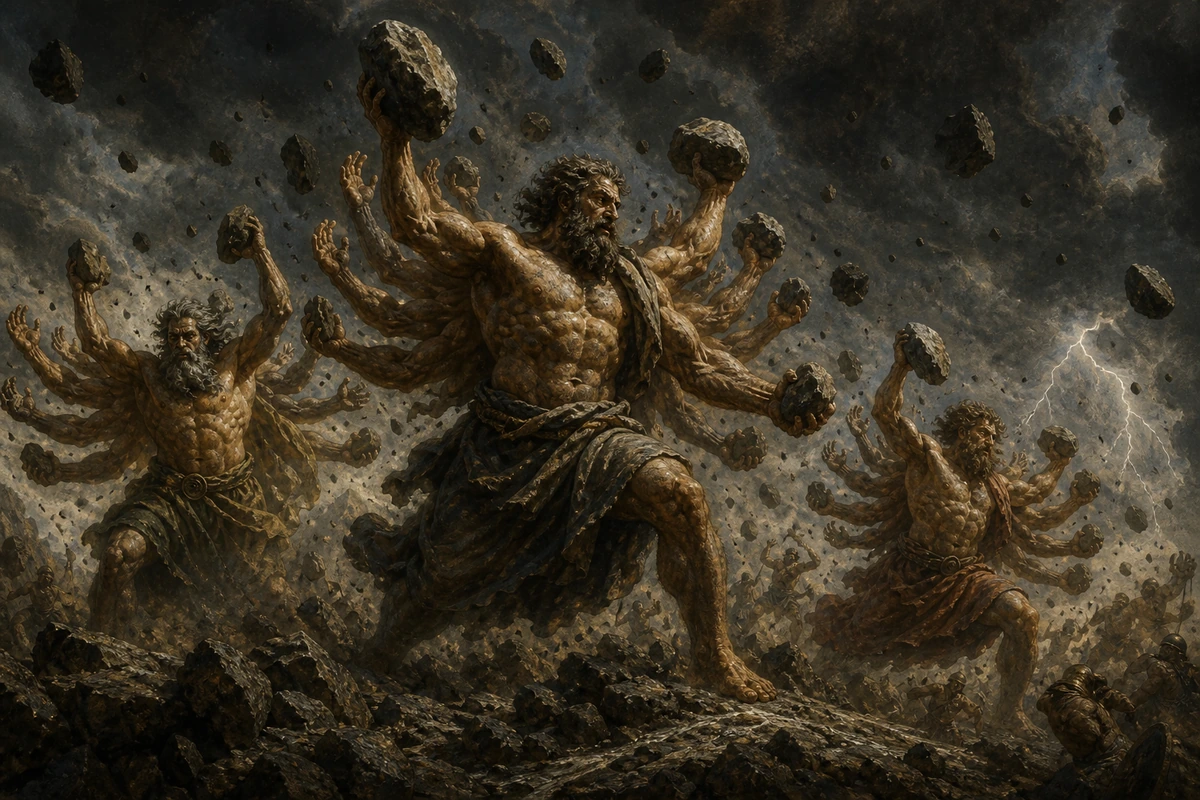
Hesiod names the brothers Cottus, Briareus, and Gyes; spelling varies in translation, so Kottos and Gyges are also common. They are children of Earth (Gaia) and Heaven (Uranus), born alongside the Cyclopes and before the Titans. Their extraordinary anatomy signals overwhelming force: one hundred arms spring from each one’s shoulders, with fifty heads above powerful limbs.
The collective Greek label “Hecatoncheires” means “Hundred-Handers,” although Hesiod identifies them by name rather than consistently using that group title. They are sometimes called giants in English, but they are not the same beings as the later Giants who fight the Olympians in the Gigantomachy.
Imprisonment beneath the earth
In the Theogony, Uranus hates these children from birth and hides them deep within Earth. Hesiod does not plainly narrate Cronus freeing and then reimprisoning them. That sequence appears in Pseudo-Apollodorus: Cronus releases the Hundred-Handers and Cyclopes during his revolt, then binds them again in Tartarus.
The distinction matters because summaries often present the later mythographer’s sequence as if every source agrees. Both traditions explain why the brothers are absent until Zeus needs them, but they do so differently.
Zeus recruits the Hundred-Handers
The war between the Olympians and Titans has lasted ten years without a clear result when Gaia advises Zeus that victory will come if he brings the buried brothers into the alliance. Zeus frees them and restores them with nectar and ambrosia. He then asks them to remember his kindness and bring their immense strength into battle.
Cottus answers for the brothers, acknowledging Zeus’s intelligence and their release from cruel bondage. The exchange makes the alliance reciprocal: Zeus does not simply command three mindless weapons; he wins the support of beings who know what imprisonment costs.
Three hundred rocks and the Titanomachy
When the battle resumes, the Hundred-Handers take the front line. Hesiod describes them launching three hundred rocks from their hands, one upon another, until the Titans are overshadowed and driven beneath the earth. Zeus’s thunderbolts fill the same battlefield with fire and noise.
The Hundred-Handers do not fight Zeus, and they are not defeated or imprisoned with the Titans. They are Zeus’s allies. After victory, the Titans are chained in Tartarus, while Cottus, Gyes, and Briareus become dependable warders near its gates.
Briareus and Aegaeon in Homer
Homer preserves a separate episode involving Briareus. In Iliad 1, Thetis reminds Zeus that she once summoned the Hundred-Hander when Hera, Poseidon, and Athena intended to bind him. The gods call the rescuer Briareus, while mortals call him Aegaeon. He sits beside Zeus, and the plot collapses through fear of his strength.
This is not the Titanomachy, and Homer does not retell Hesiod’s rock storm. It shows how one Hundred-Hander could move between genealogical poetry, divine politics, and maritime associations. Later traditions also make Briareus a sea power or an arbiter in a dispute between Poseidon and Helios.
What happens after the war?
Hesiod places Cottus and Gyes at the foundations of Ocean and calls the brothers trusty guards of Zeus. Briareus receives a distinct marriage: Poseidon gives him his daughter Cymopoleia. These details keep the Hundred-Handers inside the new divine order rather than treating them as disposable monsters.
Modern readings often call them personifications of storms, earthquakes, or raw nature. Such interpretations can be suggestive, especially given their rock-throwing force and Briareus’s marine links, but the poems do not assign the three brothers a single abstract “meaning.” Their clearest narrative identity is that of imprisoned powers whose alliance changes the outcome of the gods’ war.