
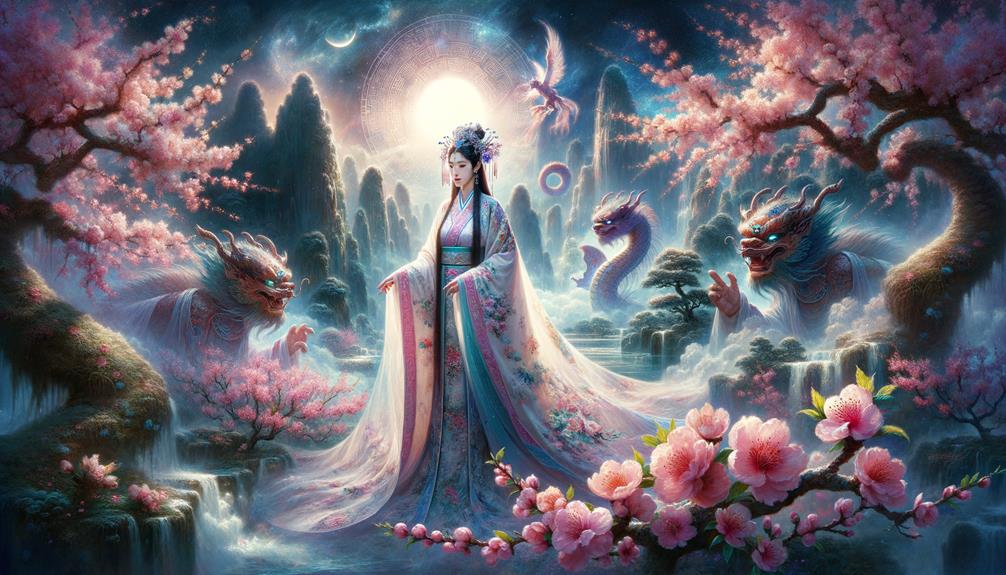
Ma Gu (麻姑, “Hemp Maiden”) is a female immortal in Chinese religious literature, Daoist tradition, and the visual arts. She is associated especially with longevity and with changes so vast that they exceed an ordinary human lifetime. Although paintings often show her as a youthful, elegant woman, the stories give her the perspective of an ancient witness who has watched whole landscapes transform.
The sea becomes mulberry fields
Ma Gu’s most famous remark appears in the transmitted narrative about her in the Shenxian zhuan, or Traditions of Divine Transcendents. Meeting the immortal Wang Fangping, she says that since entering divine service she has seen the Eastern Sea turn into mulberry fields three times. She then predicts that the waters may become shallow again.
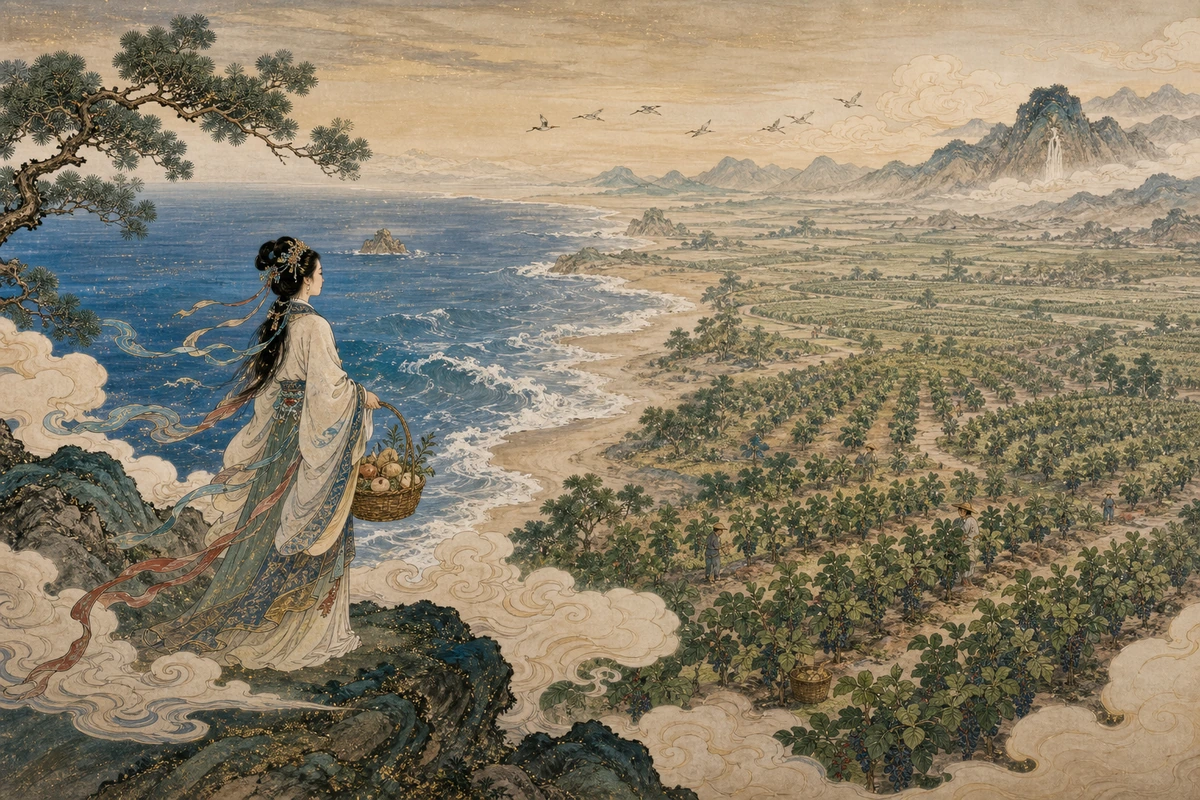
The episode gave enduring force to the expression canghai sangtian—“blue sea, mulberry fields”—as an image of enormous change. It is a statement about an immortal’s scale of time, not a dated geological field report. Over centuries, the phrase became useful far beyond religious storytelling: dynasties fall, cities change, and conditions once thought permanent are transformed.
Ma Gu in longevity art
In Ming- and Qing-period decorative arts, immortals and auspicious plants became important gifts for birthdays and retirement. Ma Gu fits naturally into this visual language. Artists may show her carrying peaches, lingzhi fungus, flowers, a basket, or a vessel of special wine. She may appear with a deer, an animal associated with long life, or on her way to a celestial gathering connected with Xiwangmu, the Queen Mother of the West.
These attributes vary because artists combine several auspicious themes. A peach does not prove that every image illustrates one exact scene, and a deer does not turn Ma Gu into another longevity deity. Museum catalogues are useful precisely because they identify the object, date, medium, and iconographic clues without pretending that every motif belongs to a single standardized biography.
Banquets, wine, and blessings
A popular theme known as “Ma Gu Presents Longevity” shows the immortal bringing an offering, often to a divine banquet or birthday celebration. The wine associated with her is sometimes described as brewed from lingzhi or other auspicious ingredients. Such pictures were well suited to congratulatory gifts: a forever-young immortal who has witnessed ages of change becomes a wish that the recipient will enjoy a long and flourishing life.
Legends about Ma Gu’s extraordinarily long fingernails, healing ability, mountain residences, or human family differ across texts and local traditions. These details should be labeled as variants rather than assembled into a falsely precise life story. Even the surviving Shenxian zhuan has a complicated textual history, so careful summaries describe the received narrative instead of claiming access to an untouched original.
Ma Gu and other immortals
Ma Gu shares the broader world of Daoist transcendents with figures such as the Eight Immortals and Zhang Guolao. She is not normally counted among the standard group of eight. Her independent identity is strongest in stories of immense time, transformations of land and sea, and visual blessings for longevity.