
journey across sea together

The Eight Immortals: Crossing the Sea by Their Own Powers

The Eight Immortals (八仙, Baxian) are among the most recognizable figures in Chinese religion, literature, theater, and decorative art. The standard group consists of Li Tieguai, Zhongli Quan, Lü Dongbin, Zhang Guolao, Cao Guojiu, Han Xiangzi, Lan Caihe, and He Xiangu. They did not appear together at the beginning of Daoist history; individual legends circulated before the group and its visual attributes became conventional.

Who are the eight?

  • Li Tieguai carries an iron crutch and gourd and appears in the body of a beggar.
  • Zhongli Quan is often recognized by a fan and the bearing of an elder.
  • Lü Dongbin, a scholar and swordsman, became the center of an important independent cult.
  • Zhang Guolao is the eccentric elder associated with a white donkey and a bamboo instrument.
  • Cao Guojiu wears court dress and carries tablets or clappers.
  • Han Xiangzi is identified with a flute and the arts.
  • Lan Caihe carries a flower basket and is represented with fluid gender and social identity.
  • He Xiangu, the standard group’s woman immortal, often holds a lotus or auspicious plant.
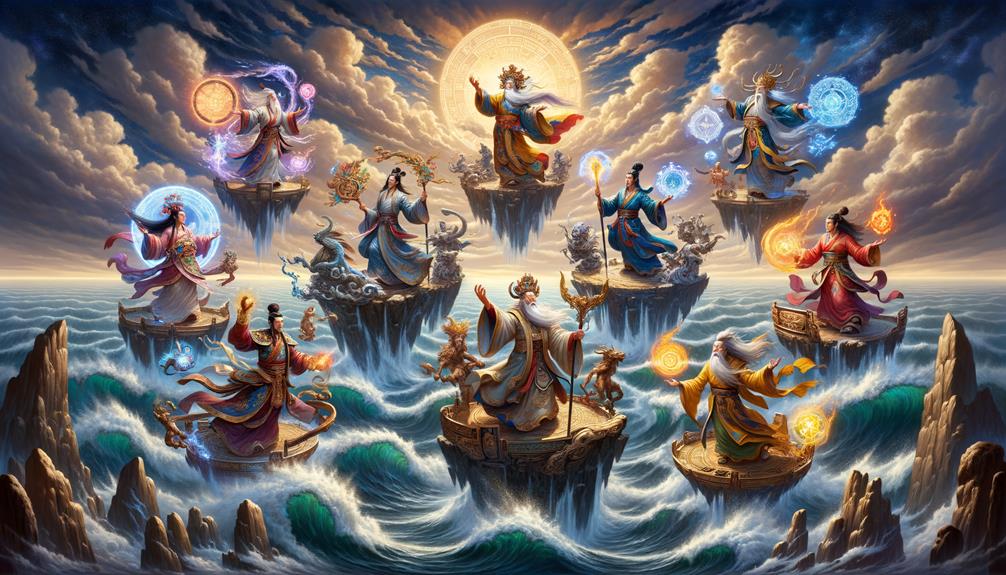
An interpretive illustration of the complete Eight Immortals crossing a rough sea with their attributes
The complete group crosses the sea by individual means in an interpretive scroll-like composition.

Attributes change among artworks and stories, so a single object should not be treated as an infallible checklist. Museum catalogues often identify figures by a combination of clothing, companions, pose, and object.

Crossing the sea

In the celebrated episode, the immortals arrive at the shore and decide that each will cross by displaying a personal ability. Rather than use a shared cloud, boat, or ferry, they cast or transform their attributes so that each becomes a means of travel. Some versions end with the successful display; others introduce a conflict with the sea’s dragon rulers.

The tale generated the proverb “The Eight Immortals cross the sea—each displays their own powers.” It describes people confronting the same challenge through different skills. The proverb’s meaning is often more stable than the plot details of any one play or story.

A group formed through art and performance

The Metropolitan Museum of Art dates the group’s broad popularity to around the twelfth or early thirteenth century. Yuan, Ming, and Qing ceramics, paintings, prints, textiles, and plays made the lineup increasingly recognizable. Some earlier and regional groups used different memberships before the familiar eight prevailed.

This formation history matters. The sea crossing is not an incident recorded by an early Daoist founder. It belongs to a later popular world in which individual cults, religious ideas of transcendence, theater, humor, and auspicious decoration met.

Why the group endured

The Eight Immortals encompass elite and humble, old and young, disciplined and eccentric, masculine, feminine, and ambiguous identities. Their variety makes the group socially expansive. In art they can wish a viewer longevity, good fortune, successful examinations, fertility, or harmony without losing their comic personalities.

Individual traditions remain important. Zhang Guolao, for example, has stories and symbols beyond the sea crossing. Ma Gu shares the world of longevity immortals but is not a standard member of the eight.

Sources and further reading

Scroll to Top