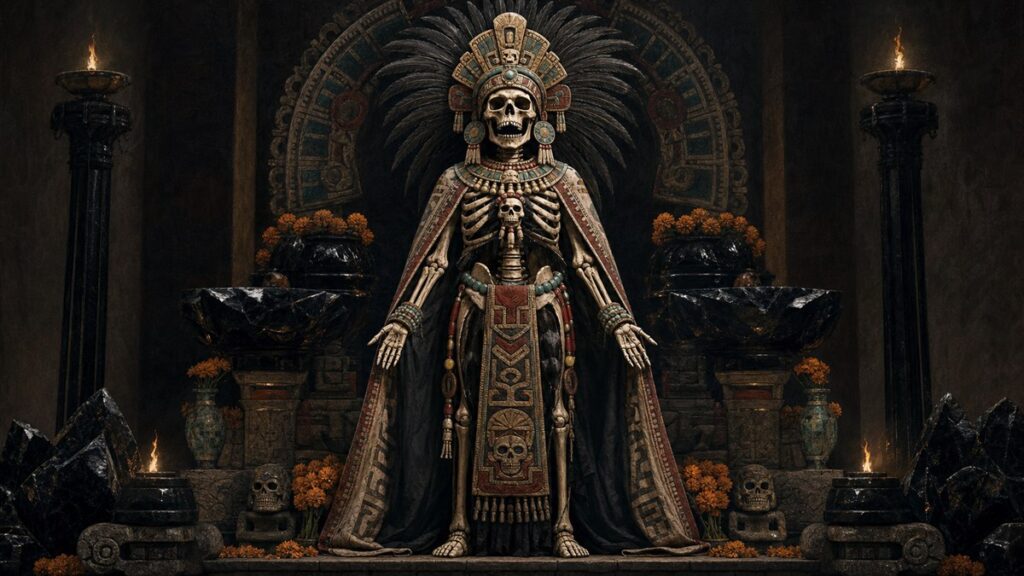
Mictecacihuatl was the female ruler of Mictlan, paired with Mictlantecuhtli in Nahua accounts of the land of the dead. Her name is commonly translated “Lady of the Dead” or “Lady of the People of Mictlan.” Colonial sources say far less about her individual biography than modern retellings do: the popular claim that she was sacrificed as a newborn is not securely grounded in the standard early accounts.
Her name and place in Mictlan
Mictlan is the “Place of the Dead.” Mictecacihuatl combines a word for an inhabitant of Mictlan with cihuatl, “woman” or “lady.” Spanish-language sources also use the form Mictlancihuatl. She is usually named beside Mictlantecuhtli, “Lord of Mictlan,” rather than as the protagonist of a long independent myth.
For many people who died ordinary deaths, Mictlan was the destination. It was not a place of moral punishment comparable to Christian hell. Nahua afterlife destinations depended strongly on the manner of death: warriors and women who died in first childbirth, those claimed by water-related deaths, and nursing infants had other destinations.
The difficult journey of the dead
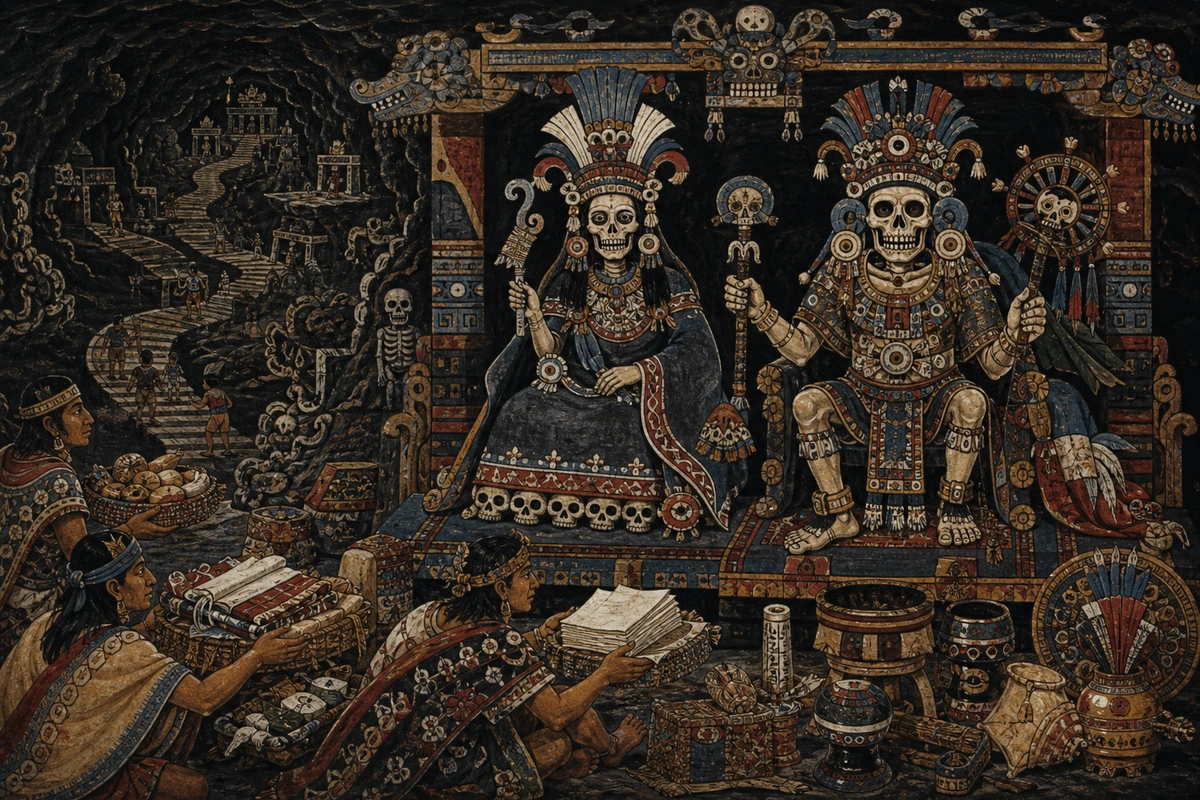
Colonial accounts describe a long journey through dangerous regions before a dead person reached the deepest Mictlan. Later summaries organize these obstacles into nine levels and describe a passage lasting four years. The dead required funerary goods and ritual care from the living.
Dogs were associated with the crossing of an underworld river, one reason canine burials and images appear in mortuary contexts. The journey ended in the domain ruled by Mictlantecuhtli and Mictecacihuatl, where the traveller’s condition was transformed rather than rewarded or punished for a moral record.
What did Mictecacihuatl look like?
Images identified as Mictecacihuatl use the skeletal visual language shared by Mictlan deities: exposed teeth or skull-like faces, bone ornaments, death signs, and dark underworld regalia. Not every female skeletal figure can be identified with certainty, because several deities and ritual beings share overlapping attributes.
Modern face paint based on a decorated skull is not an ancient portrait of Mictecacihuatl. The elegant skeletal woman called La Catrina was developed by José Guadalupe Posada and later artists in modern Mexico. She belongs to a different historical moment.
Festivals for the dead
The Mexica ritual calendar included periods when families and communities honoured the dead with food, flowers, paper, song, and ceremony. Colonial writers record observances for deceased children and adults in successive twenty-day months. Mictlan’s rulers could be invoked within the wider cult of death and ancestors.
It is too simple, however, to call Mictecacihuatl the original “goddess of Day of the Dead.” Modern Día de Muertos developed through centuries of interaction among diverse Indigenous traditions, Catholic feasts of All Saints and All Souls, regional practice, national art, and family memory. Pre-Hispanic rites are among its roots, not a complete unchanged template.
Did she guard the bones of humanity?
In the creation narrative often called the Legend of the Suns, Quetzalcoatl descends to Mictlan to recover the bones of earlier human generations. Mictlantecuhtli tests and attempts to stop him. Modern summaries sometimes transfer guardianship of those bones to Mictecacihuatl, but the surviving narrative concentrates on the male ruler’s exchange with Quetzalcoatl.
Mictecacihuatl’s securely attested importance comes from co-ruling Mictlan. It does not require inventing a childhood sacrifice, a solitary queen’s biography, or a direct one-to-one identity with every later Mexican image of death.
Death as part of cosmic order
Mexica death imagery can look severe because bones and exposed jaws were shown openly. These forms did not mean that death was treated only with fear. Mictlan was a necessary region of the cosmos, its rulers received offerings, and ancestors remained part of social life through ritual remembrance.
Mictecacihuatl is best understood within that ordered landscape: a named female authority at the far end of the dead person’s journey, paired with Mictlantecuhtli and honoured without being reduced to a modern holiday mascot.