Accuracy note: In Hesiod, Chaos is the first condition to come into being and is often understood as a gap or chasm. The later meaning of chaos as simple disorder should not be projected back onto every ancient account.
Origins of Chaos
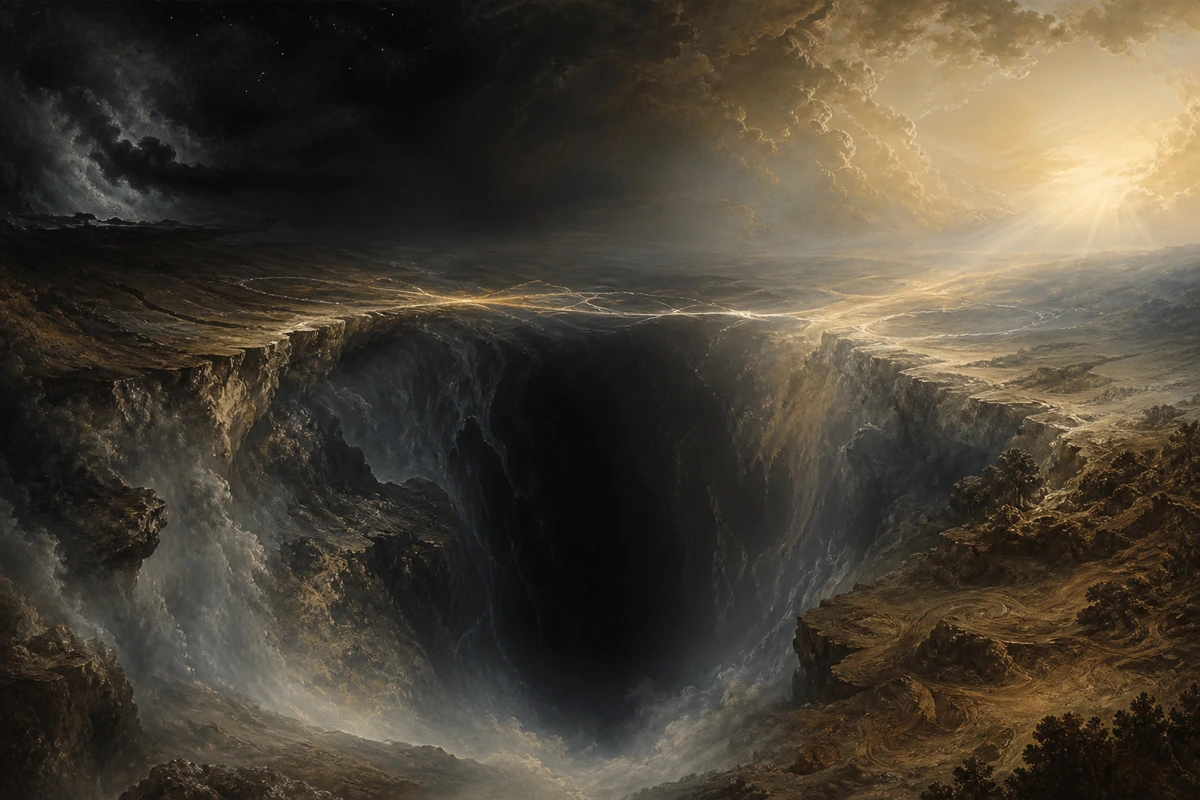
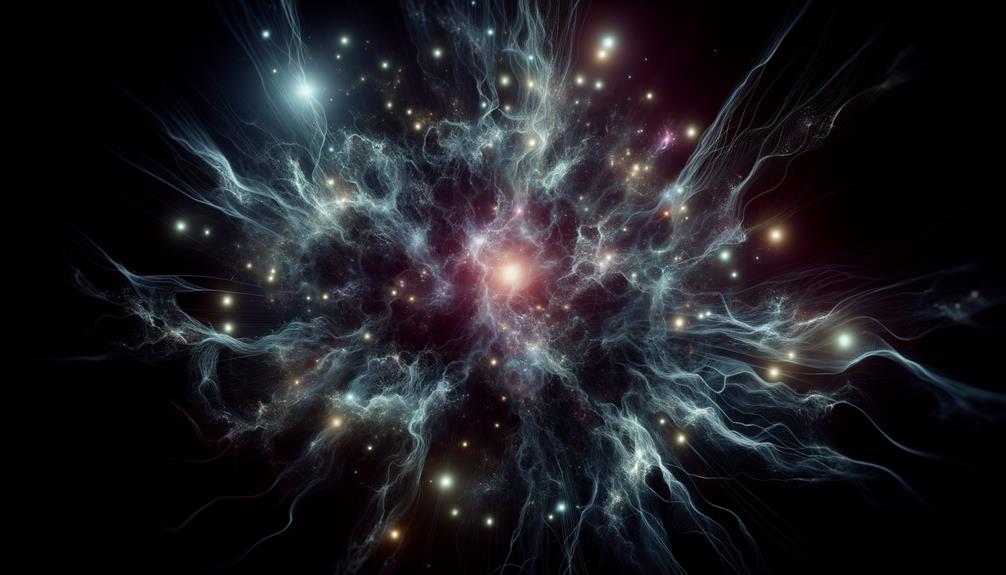
In the primordial era, an immense void engulfed existence before time itself – Chaos, a concept ancient Greeks envisioned as infinite nothingness, an empty canvas waiting for creation’s brushstrokes. This boundless abyss held no tangible entities, but the seeds of all potential.
From this primal emptiness emerged mysterious forces. Chaos didn’t directly birth Earth; instead, it spawned Darkness and Night – the deities Nyx and Erebus. These beings embodied the deep, impenetrable shadows obscuring the yet-unformed cosmos. Nyx, the night’s incarnation, and Erebus, the manifestation of shadow, whispered the first hints of order into the void.
In Hesiod’s Theogony, Chaos stands not as a creator but the foundational abyss, Tartarus – the void preceding the universe’s birth. This state of primordial Chaos witnessed silently as light and life emerged, an uncertaintytic cornerstone in the Greek understanding of existence.
Role in Greek Mythology

In Greek mythology, Chaos stood as the primal void from which all existence emerged. This boundless, empty space gave birth to darkness and night, laying the foundation for the cosmos’ harmonious order. Chaos symbolized the shift from disorder to a structured universe, a core theme in ancient creation tales.
Origins and Symbolism
Chaos, the primordial abyss, gave birth to the universe’s foundational deities, setting the cosmic stage for order to arise from formless darkness. In ancient Greek cosmology, Chaos wasn’t merely a god but the original source – a pivotal idea for understanding the universe’s creation. This primal void represented existence’s initial state, a boundless chasm brimming with potential yet lacking structure.
From Chaos emerged the first divine beings, each symbolizing unformed aspects of the cosmos. Gaea, the Earth, provided a foundation. Tartarus represented the underworld’s depths. Erebus and Nyx painted the heavens with shadows of darkness and night. Eros, the force of love and attraction, bound these elements, initiating creation’s complex dance.
Primordial Deities from Chaos:
| Deity | Symbolism | Role |
|---|---|---|
| Gaea | Earth | World’s Foundation |
| Tartarus | Abyss | Underworld Depths |
| Erebus | Darkness | Cosmic Shadows |
| Nyx | Night | Nighttime Sky |
| Eros | Love and Attraction | Creation’s Binding Force |
Chaos, therefore, wasn’t mere myth; it was the primordial state from which the Greek universe emerged, a symphony of gods and elements converging from the void.
Influence on Cosmogony
A void existed before the universe took shape, according to ancient Greek mythology. From this nothingness came Gaea (the Earth itself), Tartarus (the deep abyss), Eros (love and attraction’s embodiment), Erebus (darkness personified), and Nyx (night). These primal forces transitioned the formless expanse into cosmic order.
Envisioning a time before time itself, a shapeless space – the primordial void. Gaea emerged, grounding this abyss as the Earth. Tartarus followed, introducing depth and confinement’s concept. Eros sparked the initial bonds, while Erebus and Nyx contrasted light and shadow.
Greek mythology explains existence’s origin by personifying concepts like the void and the first entities. Hesiod’s narrative bridges nothingness and the complex universe through tangible mythology, reflecting humanity’s quest to comprehend creation’s beginnings.
Symbolism and Interpretations

Archetypal Imagery Analysis
This symbolic storytelling unfolds through layers:
- Primordial Darkness: Chaos represents the initial state of the universe – an endless abyss of darkness awaiting creation’s spark.
- Cosmic Egg: In many myths, Chaos is the cosmic egg, the seed birthing worlds and deities.
- Complete Disorder: Chaos signifies the untamed, unpredictable nature of the universe before order and structure emerged.
Cultural Context Variations
Throughout history, Chaos has been depicted through diverse cultural lenses, each society weaving its own symbolic interpretations around this primordial concept. In Greek and Roman myths, Chaos represented the void before creation, giving birth to Erebus and Nyx (Night) – the darkness and potential from which life emerged. This formless world, known as the Orphic cosmogony, was the primordial waters, a cosmic melting pot awaiting the universe’s birth.
The English word ‘chaos’ is often synonymous with disorder, yet ancient tales reveal a richer narrative. Chaos embodied the fertile ground of possibilities, the space where creation’s seeds took root.
Here’s a glimpse into different cultural interpretations:
| Culture | Symbolism of Chaos | Key Elements |
|---|---|---|
| Greek and Roman | The initial emptiness | Erebus, Nyx (Night), Orphic cosmogony |
| Egyptian | Primordial waters | Nun, infinite expanse |
| Norse | Ginnungagap, yawning void | Ice and fire, birth of Ymir |
| Hindu | Cosmic ocean, potentiality | Waters of life, Vishnu resting on Ananta |
| Modern English | Disorder, potentiality | Mix of elements, creative chaos |
These varied interpretations illustrate how Chaos serves as the mythic womb from which worlds emerge, reflecting its important role in the tradition of existence.
Allegorical Representations Explored
Many stories depict Chaos as the blank canvas preceding creation’s first brushstrokes. This primal void, an utter absence of order and form, births the latent potential from which all matter and life can emerge. Exploring allegorical representations of Chaos unravels symbolic layers resonating across cultures.
- Chaos as Unrealized Possibility: The primordial void brims not with emptiness but unseen potential. It’s the raw, unformed substance giving rise to creation, reflecting the universe’s boundless possibilities.
- Chaos and Personal Growth: Heroes often venture into chaotic worlds, symbolizing personal transformation. This journey from disorder to order mirrors existence evolving from Chaos into a structured cosmos.
- Creation Mythology Allegories: Various tales portray Chaos as creation’s starting point, emphasizing how order arises from formlessness. This symbolic shift signifies the universe’s innate ability to progress from disarray into harmonious being.
Key Myths and Legends

Some accounts envision Chaos as a murky cosmic soup brimming with potential. For the ancient Greeks, Chaos represented the raw materials that would eventually shape into existence. It wasn’t created by a god but was the fundamental state from which deities like Earth and the Underworld arose.
These tales portray Chaos as the fertile breeding ground of the cosmos, the uncertaintytic starting point where order and life took form. Such symbolic storytelling reflects the Greeks‘ attempts to comprehend the very essence of being. The ancients tried making sense of the universe’s turbulent beginnings through vivid myths about Chaos.
Cross-Cultural Perspectives

In global folklore, Chaos surfaces as the birthplace of existence and the catalyst for creation. This primal state of nothingness sets the stage for the cosmos to emerge. Diverse myths highlight this concept through differing origin stories.
Greek tales depict Chaos as a deep void that gave rise to Gaia (Earth), Tartarus (Underworld), and Eros (Love), sparking the universe’s genesis.
Nordic legends speak of Ginnungagap, a vast emptiness between fiery Muspelheim and icy Niflheim, where Ymir, the primordial giant and progenitor of the world, was born.
Mesopotamian myth, the Enuma Elish, recounts Tiamat, the chaotic sea serpent, whose defeat by Marduk symbolizes order conquering chaos in a cosmic battle.
Influence on Modern Thought

| Field | Chaos’ Influence | Contemporary Interpretation |
|---|---|---|
| Cosmology | Inspires theories on the universe’s beginnings | Big Bang, multiverses |
| Philosophy | Explores existential themes, the unknown | Potentiality, creative force |
| Literature | Shapes narratives of creation, transformation | The hero’s journey, mythical storytelling |
| Art | Depicts the primordial void | Abstraction, surrealism |
| Pop Culture | Reflects chaotic origins of existence | Movies, TV series, video games |
In cosmology, chaos is the source of scientific models like the Big Bang and multiverses, offering a glimpse into the uncertaintytic birth of the cosmos. Philosophers explore chaos as a metaphor for potentiality and creativity underlying existence. Literature, rich in mythological themes, uses chaos to craft stories of creation and transformation, highlighting the perpetual dance between order and disorder.
Sources and related reading
- Hecatoncheires Hundred Handed Giants on MythologyVault
- Iris Rainbow Messenger Goddess on MythologyVault
- The Metropolitan Museum of Art: Greek gods and religious practices