The terracotta warriors are the most famous discovery from the mausoleum of Qin Shi Huang, but they are not the emperor’s burial chamber. They occupy pits east of a much larger funerary landscape centered on a still-sealed mound. Distinguishing the excavated army from the unopened central tomb prevents modern reconstructions from being mistaken for archaeology.
Work on the complex began after the future First Emperor became king of Qin in 246 BCE and continued through the creation of China’s first unified imperial state in 221 BCE. Qin Shi Huang died in 210 BCE. The site materializes both his military power and an administrative system able to mobilize labor, raw materials, workshops, and standardized production at enormous scale.
A funerary city, not one pit
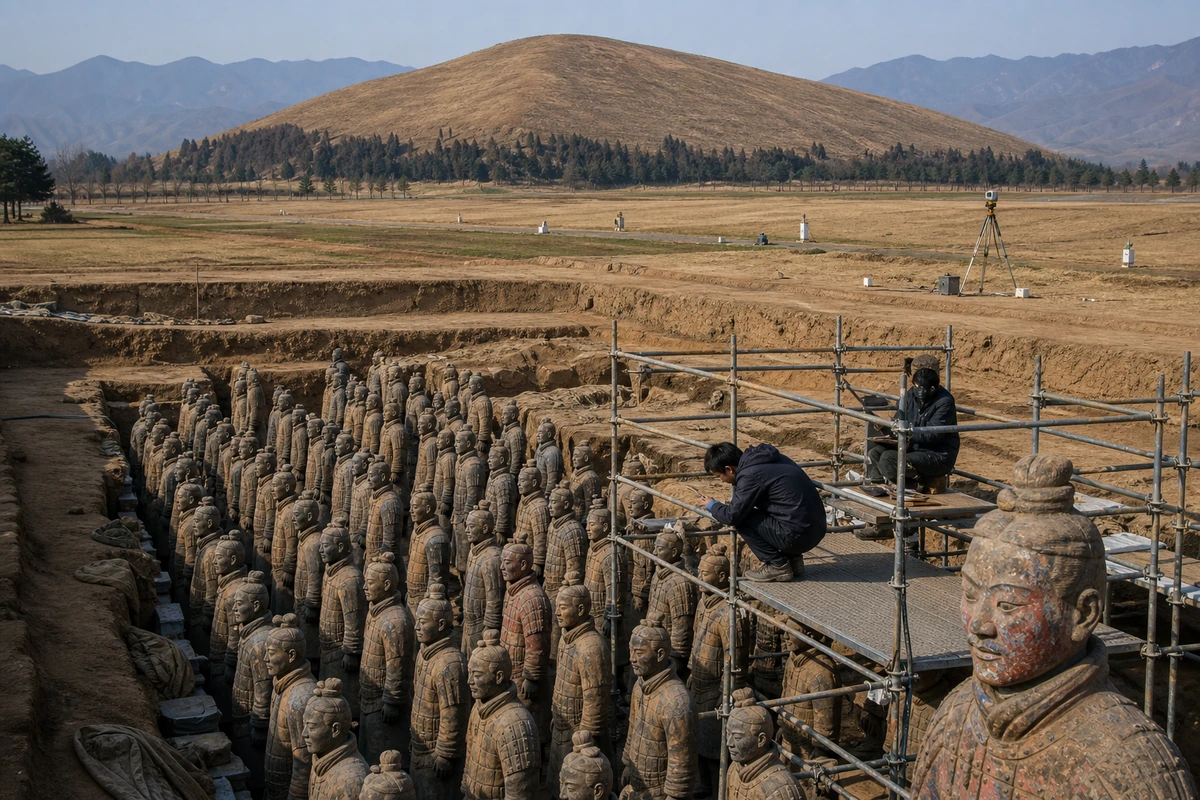
UNESCO describes a rectangular double-walled enclosure centered on the grave mound, surrounded by a property containing hundreds of associated archaeological locations. Excavated features include pits with soldiers, horses, chariots, officials, entertainers, armor, stable remains, animal burials, and architectural traces. The ensemble was organized as a model of imperial institutions serving the ruler after death.
The warrior pits lie roughly 1.5 kilometers east of the mound. Their outward-facing formations are usually understood as protective forces. Pit 1 contains the largest formation; other pits preserve command figures, cavalry, infantry, and chariots in different arrangements. Numbers change as excavation and conservation continue, so “thousands of figures” is safer than treating a popular total as a finished census.
| Claim | Evidence | Responsible conclusion |
|---|---|---|
| The figures are all portraits | Faces, hairstyles, ranks, and clothing vary greatly | Workshop variation created convincing individuals, but direct portrait sittings are unproved |
| The army was always bare clay | Surviving pigment and lacquer layers have been documented | The figures were originally brightly colored; much surface color was lost after burial |
| Sima Qian’s mercury rivers have been found | Soil surveys detected a mercury anomaly over the mound | The anomaly supports mercury’s presence, not a verified underground map or flowing mechanism |
| The emperor’s chamber has been explored | Archaeology has examined many surrounding pits and structures | The central burial chamber remains unopened |
How the army was produced
The warriors are life-size ceramic sculptures assembled through coordinated workshop processes. Bodies, limbs, and heads were made from repeatable components, then adjusted and finished by hand. Surface modeling, hair, armor, posture, and facial details created variety within standardized production. Inscriptions and marks on some objects help scholars trace workshop organization and quality control.
Weapons recovered from the pits include bronze spearheads, lances, swords, crossbow parts, and large numbers of arrowheads. Their distribution helps reconstruct formations, although robbed, burned, collapsed, and disturbed areas complicate any frozen battlefield reading.
The colors that disappeared
The gray-brown army familiar from photographs is incomplete. Conservators have identified a lacquer ground covered by mineral and manufactured pigments, including reds, greens, blues, whites, and black. Clothing, armor borders, faces, and accessories once carried strong color.
Excavation can destabilize those layers. When saturated burial conditions change, the lacquer may shrink and detach rapidly, taking paint with it. This history is one reason archaeologists do not equate opening more ground with gaining better evidence. Conservation capacity, documentation methods, and long-term preservation determine how responsibly excavation can proceed.
The sealed mound and Sima Qian
The historian Sima Qian, writing about a century after the emperor’s death, described an underground palace with models of celestial bodies, rivers and seas of mercury, valuable objects, and defensive crossbows. His account is foundational but not an eyewitness excavation report. It combines historical information with literary presentation and must be tested where independent evidence allows.
A geochemical survey published in 1985 reported a strong mercury anomaly in soil over the central mound. That is meaningful evidence consistent with some mercury below. It does not reveal the amount, arrangement, preservation, or purpose of the metal, and it cannot confirm every feature in Sima Qian’s description. Claims that scans have mapped intact “rivers” go beyond the published evidence.
The chamber has not been opened through a modern archaeological excavation. Preservation risks are central: sudden changes in air, humidity, microbial activity, and structural pressure can destroy information faster than conservators can stabilize it. Mercury exposure and the scale of the site add concerns, but sensational claims that archaeologists are simply frightened by ancient booby traps miss the professional conservation problem.
Discovery in 1974
Local farmers digging a well encountered terracotta fragments in 1974. Archaeological investigation identified a much larger pit, leading to decades of excavation, reconstruction, research, and site protection. The discovery was not the location of Qin Shi Huang’s mound itself, which was already a prominent feature; it revealed the buried sculptural army nearby.
The mausoleum was inscribed on the UNESCO World Heritage List in 1987. Its value lies not only in the realism of individual warriors but also in the spatial plan, technical organization, military information, and preservation of a political vision of empire.
Accuracy note
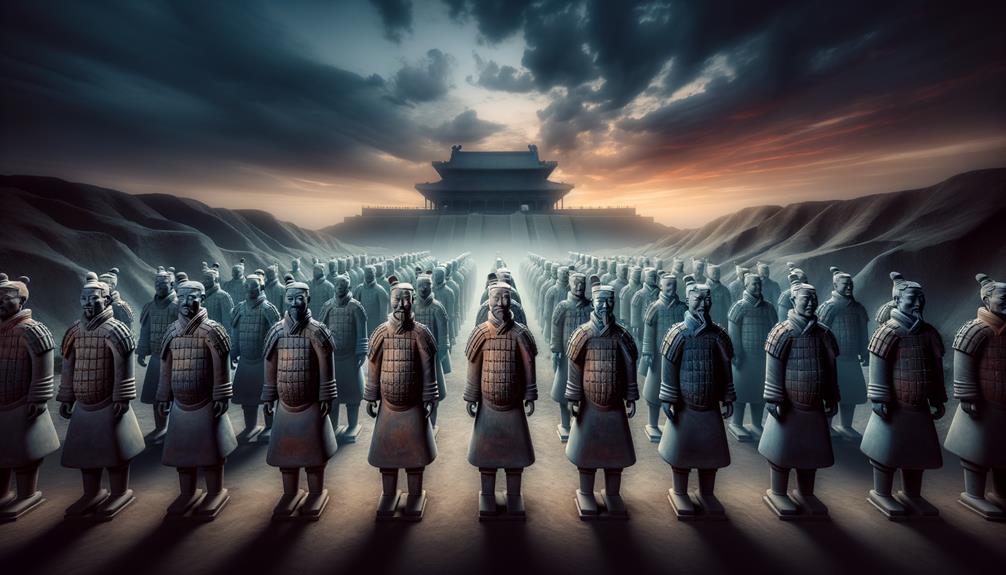
This article does not present the faces as documented portraits, Sima Qian’s narrative as a floor plan, or a mercury anomaly as an image of underground rivers. The generated illustration shows a conceptual relationship between excavated pits and a sealed mound; it is not a photograph of one actual sightline.