
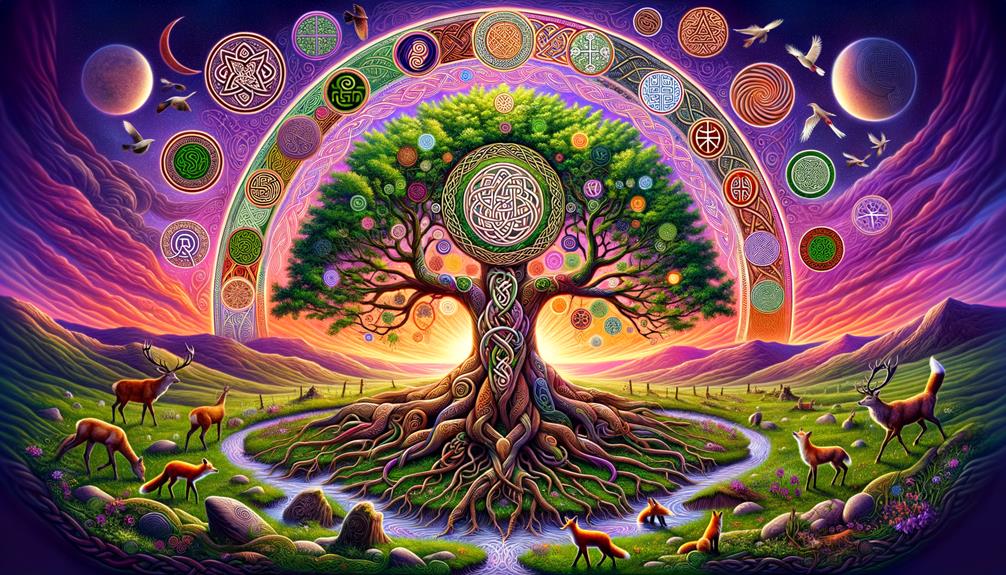
The “Celtic Tree of Life” is now one of the most recognizable Celtic-inspired designs: roots and branches mirror one another inside a circle, suggesting connection, ancestry, renewal, and balance. Those meanings are useful modern interpretations. They should not be mistaken for proof that every ancient Celtic-speaking community shared one sacred emblem, one name for it, or one universal doctrine about a cosmic tree.
Start with the word “Celtic”
“Celtic” does not describe a single timeless nation. Modern scholars use the term for related languages and for changing archaeological and historical cultures spread across large parts of Europe. Iron Age communities in Gaul, Roman-period Britons, and medieval Irish speakers did not leave one shared handbook of belief. Their evidence comes from different centuries, regions, languages, and political settings.
This matters because popular symbolism often blends them together. A statement may begin with an early Irish law tract, add a Roman author’s description of Gaul, borrow medieval Insular knotwork, and end with a modern piece of jewelry. Each element may be genuinely connected to a Celtic-language tradition, but the combined emblem is modern synthesis rather than a recovered ancient original.
What the evidence really says about trees
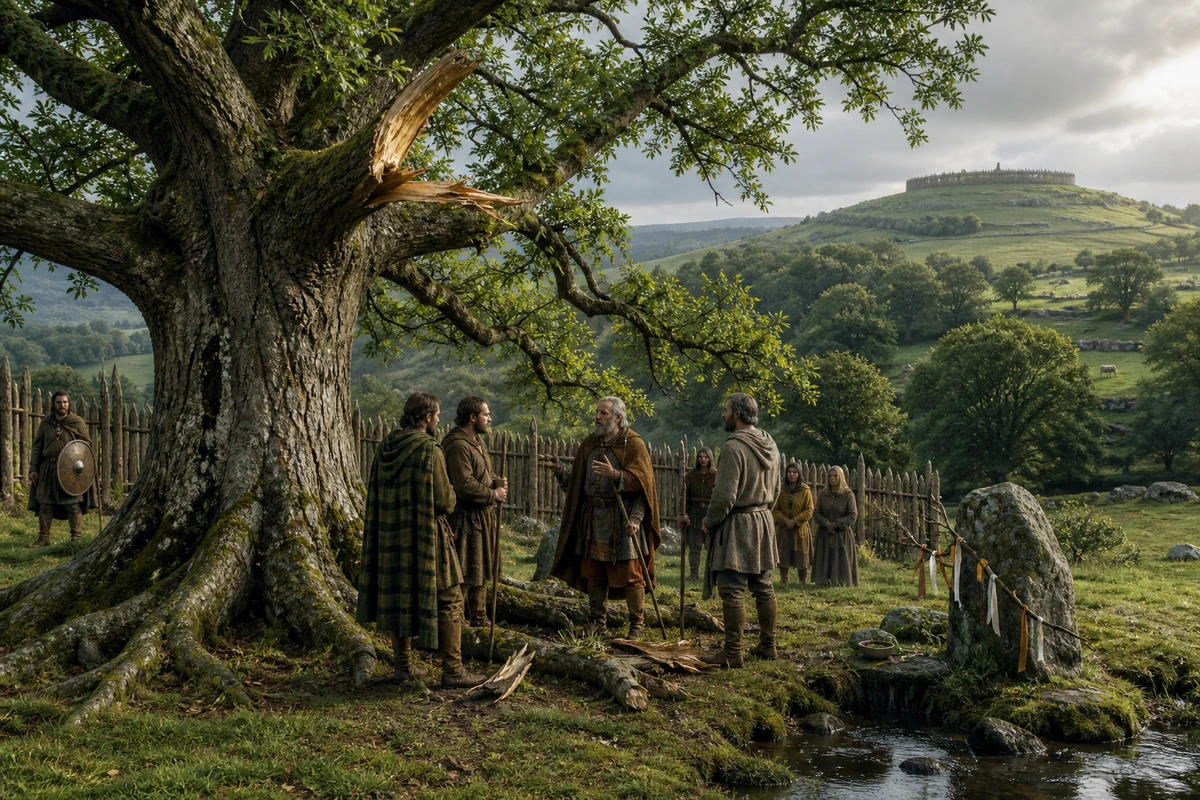
Trees were unquestionably important. They provided timber, fuel, fruit, nuts, fodder, tools, boundary markers, and places of assembly. Particular trees could become landmarks associated with a settlement, ruler, inauguration, saint, well, or remembered event. Some were treated with exceptional reverence, and destroying a prominent tree could carry political as well as economic meaning.
Medieval Irish literature uses the word bile for certain venerable or notable trees. Stories and place-lore remember major trees connected with territories and kingship. These are not interchangeable with the modern roots-in-a-circle logo. A bile is a significant living tree in a landscape and social order, not necessarily an abstract diagram of the universe.
Tree law in early Ireland
Early Irish law offers some of the strongest evidence because it treats trees as property with graded value. The law tract commonly called Bretha Comaithchesa, “Judgments of Neighbourhood,” includes a tree list that ranks species and assigns different compensation for damage. Later commentary groups trees under social labels often translated as nobles, commoners, lower divisions, and bushes of the wood.
The rankings reflect practical and cultural value rather than a modern botanical system. Oak supplied major timber; hazel and apple produced valuable food; holly, yew, ash, alder, willow, hawthorn, and other species had distinct uses. Penalties could vary according to whether someone cut a branch, damaged a fork, cut the trunk, or uprooted a tree. The legal details differ across versions and commentary, so a single neat list should not be treated as unchanging law for all of Ireland.
This material shows that trees mattered to neighbourhood rights, subsistence, status, and compensation. It does not prove that each ranked species represented a month, an alphabetic oracle, or a universal personality type. Many “Celtic tree calendar” systems popular today are much later constructions.
Sacred trees, groves, and difficult sources
Classical Greek and Roman writers describe groves and natural sanctuaries among peoples whom they called Gauls or Celts. Place-names and inscriptions also preserve forms related to nemeton, a term associated with sacred space or grove. These sources support the importance of wooded ritual places in some continental traditions, but they are often brief, written by outsiders, and shaped by Roman expectations.
Pliny the Elder’s famous description of Druids cutting mistletoe from an oak is one example. It is evidence for a Roman author’s account of a particular Gallic rite, not a complete guide to all Druids or all Celtic religion. Medieval Irish sources were written in Christian manuscript culture many centuries later. They preserve valuable vernacular traditions, but they cannot simply be used to fill every gap in Iron Age Gaul.
The safest conclusion is specific: communities in several Celtic-speaking regions gave unusual trees and groves religious or political weight. The evidence does not establish one pan-Celtic “Tree of Life” theology with a standard picture.
Ancient evidence and modern symbolism
| Claim | Evidence-based assessment | Better wording |
|---|---|---|
| All Celts used one Tree of Life symbol | No standard ancient emblem is documented across Celtic cultures | The circular tree is a modern Celtic-inspired design |
| Trees could be sacred or politically important | Supported in classical accounts, medieval Irish literature, law, and place tradition | Some communities revered particular trees and groves |
| Early Irish law protected trees | Strongly supported by legal tree lists and graded penalties | Trees had legally recognized economic and social value |
| La Tène plant motifs are the Tree of Life | Plant-like ornament exists, but the identification is not automatic | Iron Age artists used varied curving and vegetal forms |
| Roots and branches mean ancestry and renewal | A meaningful modern interpretation, not a universal ancient definition | The design can symbolize continuity for modern wearers |
What archaeology can and cannot show
Iron Age art conventionally described as La Tène uses sweeping curves, tendrils, leaves, palmettes, animals, and human faces that transform into one another. Some designs look strongly vegetal. Archaeologists can study their dates, materials, findspots, and visual relationships. They usually cannot recover one verbal “meaning” for each curve unless an inscription or strong context explains it.
Wood also survives unevenly, which complicates the evidence. Wet sites, wells, rivers, and bogs sometimes preserve carved figures or deposited objects that would disappear in dry soil. Such finds can show ritual attention to natural places, yet a wooden object near water is not automatically a tree cult, and a curving plant motif is not automatically a cosmic tree.
Where the familiar circular design belongs
The symmetrical tree whose roots and crown meet around a circle belongs comfortably to modern Celtic revival and contemporary spiritual art. Its knot-like branches draw on the visual prestige of Insular interlace, while its overall tree-and-circle form communicates wholeness immediately to a modern audience. It is widely used for family, heritage, ecology, weddings, memorials, and personal spirituality.
Calling it modern does not make it meaningless or “fake.” Symbols are continually created by combining older materials in new ways. The problem begins only when a recent design is marketed as a precisely documented emblem carved by all ancient Celts. Its honest history is a story of revival, adaptation, and the modern desire for an image that joins family roots to a living world.
How to interpret the symbol responsibly
For a wearer or artist today, roots can represent ancestry, memory, or dependence on place. Branches can suggest descendants, aspiration, or seasonal return. A surrounding circle can mean continuity and relationship. Those interpretations are valid as present-day symbolism when they are presented as choices rather than secret ancient definitions.
For historical discussion, focus on the evidence closest to the claim: Irish law for tree protection, medieval literature for notable trees, classical texts for continental groves, and archaeology for material practice and ornament. This approach replaces a vague universal “Celtic wisdom” with a richer picture of real communities managing land, remembering places, and negotiating the power of living trees.