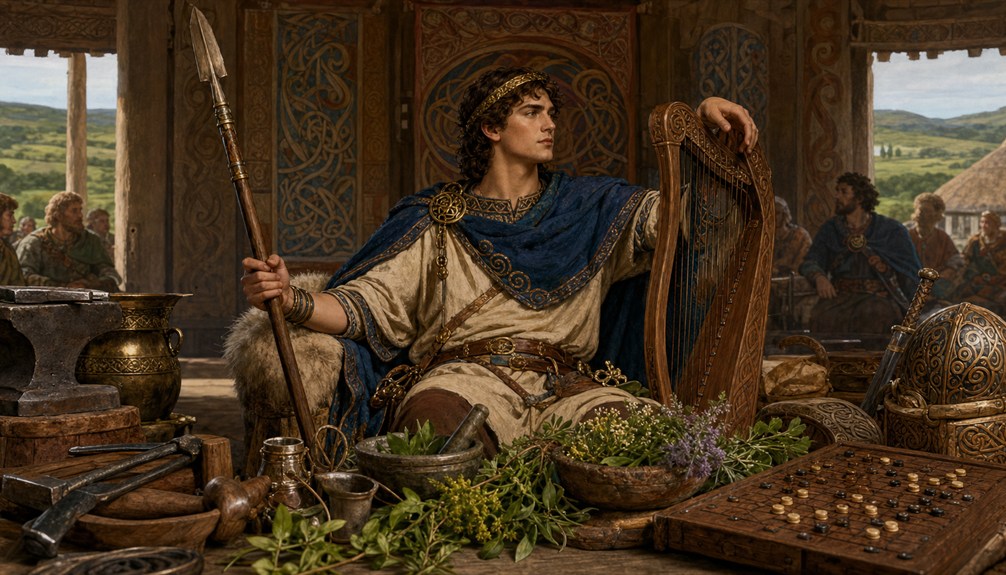
Lugh is one of the most important figures in medieval Irish myth: a warrior, ruler, organizer, and master of many arts. His best-known epithet, Lámfhada, is usually translated “Long Arm” or “Long Hand.” Yet his defining title in The Second Battle of Mag Tuired is Samildánach—the one who possesses many skills. Lugh matters not because he belongs to one narrow category, but because he can bring specialists and powers into effective cooperation.
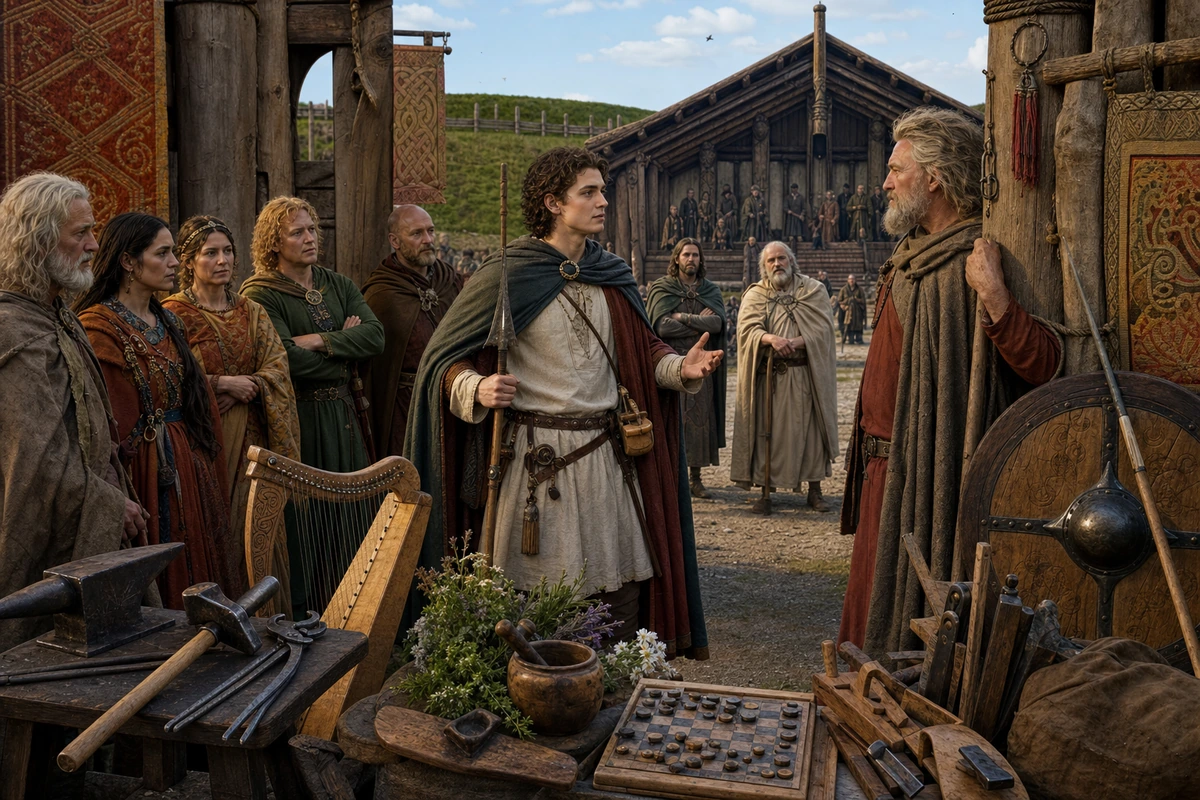
Lugh at the gate of Tara
In Cath Maige Tuired, “The Second Battle of Mag Tuired,” Lugh arrives at Tara while the Tuatha Dé Danann are under the oppressive rule of the Fomorians. The gatekeeper will admit only someone with a skill useful to the court. Lugh offers one qualification after another: builder, smith, champion, harpist, warrior, poet and historian, sorcerer, physician, cupbearer, and worker in metal.
Each time, the gatekeeper replies that Tara already has such a specialist. Lugh then asks whether the court has anyone who possesses all those arts together. It does not. The answer earns him entry and the title Samildánach. The episode is sometimes reduced to a list of superpowers, but its sharper point concerns combination. A functioning society already has experts; Lugh’s unusual value is his ability to understand and coordinate the whole.
King Nuadu tests the newcomer, and Lugh proves himself through feats of strength, music, gaming, counsel, and command. Nuadu eventually gives him the king’s seat for a period so that he can direct preparations against the Fomorians. Lugh’s authority is therefore demonstrated and delegated rather than assumed merely because of birth.
Family between two peoples
Lugh’s parentage places him across the central conflict. His father is Cian of the Tuatha Dé Danann. His mother is Ethniu, daughter of Balor of the Fomorians. This makes Balor—the terrifying enemy whose eye can destroy an army—Lugh’s maternal grandfather. The hero who defeats the Fomorians is thus not entirely outside them.
Sources do not supply one seamless childhood biography. Different texts and later retellings connect Lugh with fosterage by Tailtiu, with Manannán mac Lir, and with other households. In medieval Irish society, fosterage created serious obligations and alliances. The traditions make Lugh’s identity a network of birth, nurture, training, and political relationship rather than a simple divine family tree.
The battle is a work of many arts
Before the battle, Lugh asks the Tuatha Dé Danann what each person can contribute. Goibniu the smith promises replacement weapons. Dían Cécht the healer and other specialists describe how they will sustain the army. The Dagda, Ogma, poets, craftworkers, and supernatural practitioners all have distinct roles. The resulting victory is collective even though Lugh becomes its most visible leader.
This council scene develops the same idea as the gatekeeper episode. Skill is not ornamental. Smithing supplies weapons, healing returns fighters to battle, satire can damage reputation and legitimacy, and magical knowledge can alter conditions. Lugh’s leadership consists in recognizing these capacities and directing them toward a common task.
Lugh and Balor of the destructive eye
Balor’s great eye is normally closed and must be raised by attendants. When opened, its poisonous or destructive force can overwhelm those before it. During the battle, Lugh escapes the guards who had been keeping him safely away from combat and drives a sling stone through Balor’s eye. The eye is forced backward so that its power falls upon the Fomorian host.
The sling is explicit in the surviving battle text. Lugh is also strongly associated with a spear in Irish literary tradition, and later compendia emphasize its dangerous heat or need for restraint. It is best to keep the sources distinct: the spear is a major attribute of Lugh, while the famous killing of Balor at Mag Tuired is accomplished with a sling stone.
After the defeat, Bres offers valuable knowledge in exchange for his life. The tale tests several proposed bargains before reaching information about ploughing, sowing, and reaping. War ends not only when an enemy falls, but when the victors secure the ordered production that allows a community to continue.
Lugh’s titles and attributes
| Name or attribute | What the source supports | Common oversimplification |
|---|---|---|
| Lámfhada | An epithet usually read as Long Arm or Long Hand | A literal measurement or proof of one fixed weapon |
| Samildánach | Mastery of many arts considered together | Merely “god of crafts” |
| Spear | A major weapon associated with Lugh in Irish tradition | Every later magical detail belongs to the same early text |
| Sling stone | The weapon used against Balor in Cath Maige Tuired | Lugh always kills Balor with the spear |
| King and war leader | Authority grounded in tested skill, strategy, and kinship | A solitary fighter who wins without other specialists |
Lughnasa and Tailtiu
The early-August festival of Lughnasa bears Lugh’s name. Medieval place-lore associates its assembly games with Tailtiu, Lugh’s foster mother, after her death from the labor of clearing land. Historical Lughnasa traditions varied by region and period, combining fairs, athletic contests, legal business, courtship, trade, pilgrimage, first fruits, and gatherings on hills or at lakes and wells.
It is misleading to imagine a single unchanged “Celtic harvest ritual” practiced everywhere in exactly the same form. Lughnasa has a deep Irish textual and customary history, but local assemblies developed their own patrons, stories, dates, and practices. The festival’s connection with Lugh is strongest when that variety is retained.
Is Lugh a sun god?
Calling Lugh “the Celtic sun god” is common in popular summaries, but the medieval Irish texts do not confine him to a solar office. His brilliance, kingship, elevated appearances, and later interpretations can encourage solar readings. None outweighs the much broader profile given by the tales themselves: skilled in arts, battle, magic, music, healing, law, and leadership.
Scholars have also compared Irish Lugh with names related to the continental deity Lugus and with place-names such as Lugdunum. The linguistic relationship is important, but it does not license copying every trait from one region into another. Continental inscriptions and iconography are fragmentary, while Irish Lugh is known through Christian-era manuscripts with their own literary aims.
Lugh’s larger meaning
Lugh’s many skills do not erase the value of specialists. On the contrary, the battle narrative repeatedly names what each craft contributes. His gift is synthetic intelligence: he sees the battlefield as a problem involving logistics, morale, medicine, metallurgy, prophecy, diplomacy, and force.
That is why Lugh can be a champion without being only a war god and a craftsman without being only a smith. The gate at Tara asks what one person can do. Lugh’s answer changes the question: what becomes possible when many forms of knowledge are understood as one system?