
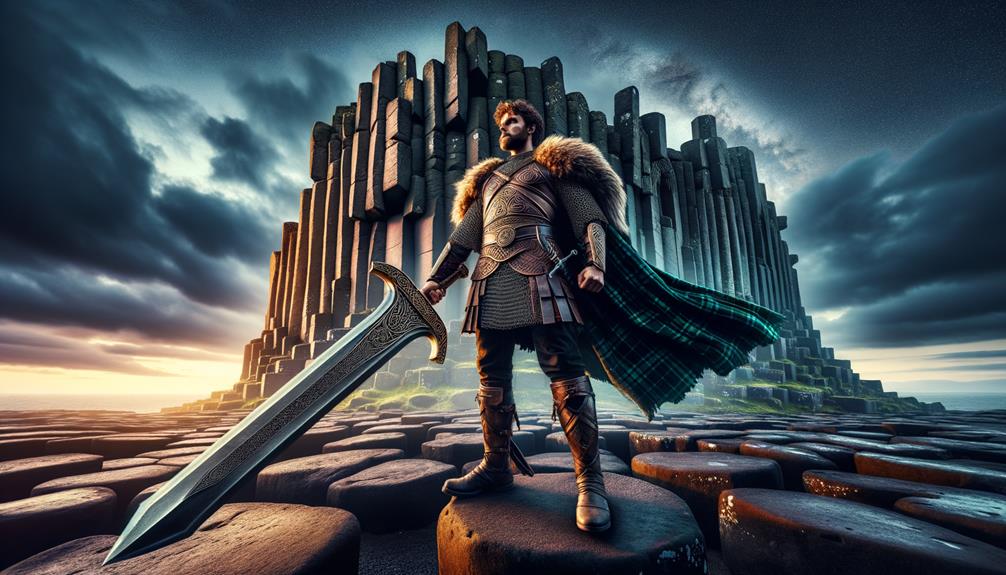
Fionn mac Cumhaill—also spelled Finn mac Cumaill and popularly anglicized as Finn MacCool—is the leader of the Fianna in Irish and Scottish Gaelic heroic tradition. His stories form the Fionn or Fenian Cycle, a changing body of medieval literature, oral narrative, poetry, and ballad rather than one fixed biography.
Fionn can be a boy in hiding, a poet with supernatural knowledge, a hunter, a king’s defender, an aging leader, a jealous pursuer, or a giant who shapes the landscape. Those roles come from different periods and genres. Reading them together is rewarding as long as their differences are not flattened into a single supposedly historical life.
Fionn, Finn, or Finn MacCool?
Fionn mac Cumhaill is the standard modern Irish spelling. Medieval texts often use forms such as Find or Finn mac Cumaill. “Finn MacCool” is an English rendering that became especially familiar through folktales and children’s books.
The name Fionn means “fair” or “bright.” In the boyhood tale, the hero is first called Demne and receives the name Finn after the episode of the salmon. Cumhaill is his father’s name; mac Cumhaill means “son of Cumhall,” not “son of Cool” in the ordinary English sense.
The death of Cumhall and the hidden child
In The Boyish Exploits of Finn, Cumhall is killed by Goll mac Morna, creating the foundational feud between Fionn’s people and the sons of Morna. The child Demne must be protected from his father’s enemies and is raised away from the royal center.
Women warriors and fosterers train him in running, swimming, hunting, and survival. Names and details vary among versions, with Bodhmall and Liath Luachra prominent in later accounts. The wilderness education explains why the adult hero combines poetic knowledge with extraordinary skill in forests and rivers.
The Salmon of Knowledge
Demne studies poetry with Finnéces beside the River Boyne. The poet has spent seven years waiting for a salmon associated with the pool of Féc, believing that whoever eats it will gain complete knowledge. When the fish is finally caught, Finnéces orders the boy to cook it without tasting it.
A hot blister rises on the salmon’s skin and burns Demne’s thumb. He puts the injured thumb in his mouth. When Finnéces asks whether he has eaten any of the fish, the boy truthfully explains what happened. The poet recognizes that the destined knowledge has passed to him and tells him to eat the salmon.
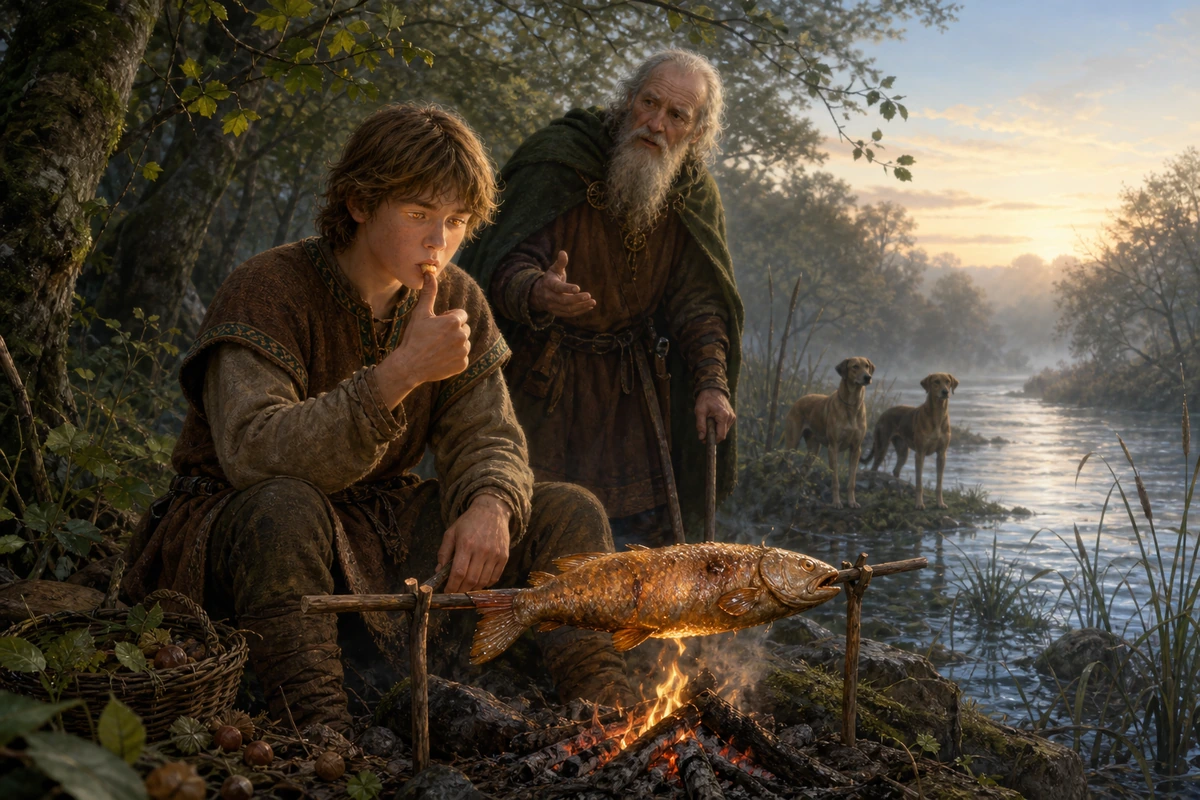
Thereafter Fionn can place his thumb in his mouth and use a form of inspired poetic knowledge to reveal what he does not know. The tale ties wisdom to accident, cooking, bodily sensation, and the transfer of a gift a teacher expected for himself.
Fionn as poet and warrior
The boyhood narrative says Fionn learns the three accomplishments of a poet, including imbas forosnai, “knowledge that illuminates.” He also composes verse about the seasons. His authority is therefore not based only on strength or descent; it joins martial action to speech, memory, and perception.
This combination distinguishes him from a simple giant-slayer. Fionn reads landscapes, recognizes threats, judges disputes, and leads through knowledge. At the same time, later tales are willing to show his judgment failing under jealousy, grief, or age.
Aillén and leadership of the Fianna
One famous accession story brings Fionn to Tara during the festival of Samhain. A destructive otherworldly figure named Aillén lulls the defenders to sleep with music and burns the royal center. Fionn resists the sleep, defeats Aillén, and is recognized as leader of the Fianna.
Versions differ in the weapon and exact method, but the structure is consistent: poetic or magical perception allows the young outsider to solve a crisis that established warriors cannot. His victory also restores the position lost when Cumhall died.
Who were the Fianna?
A fían is a mobile warrior and hunting band that operates partly outside settled society. In the romances, Fionn’s Fianna defend kings, hunt across Ireland, enforce hospitality, encounter the Otherworld, and maintain their own demanding code.
Later texts give elaborate entrance tests involving poetry, running, leaping, defense, and freedom from obligations of vengeance. These lists express an ideal of total competence; they should not be treated as regulations from a securely documented national standing army.
| Figure | Relationship to Fionn | Role in the tradition |
|---|---|---|
| Goll mac Morna | Rival, ally, and killer of Cumhall | Shows that the Fianna contain competing kindreds, not one harmonious unit |
| Oisín | Fionn’s son and poet | Preserves the Fianna’s memory and gains a major later Otherworld tradition |
| Oscar | Fionn’s grandson through Oisín | Young champion whose death at Gabhra marks the company’s catastrophe |
| Caílte mac Rónáin | Swift warrior and storyteller | Guides Patrick through a landscape filled with Fianna memories in the Acallam |
| Diarmaid ua Duibhne | Warrior pursued by Fionn | His flight with Gráinne exposes conflict between loyalty, desire, and aging authority |
Bran and Sceólang
Fionn’s most famous hounds are Bran and Sceólang, whose mother is transformed into canine form in many tellings. They are hunting partners, companions, and relatives within the enchanted logic of the cycle, not interchangeable pets.
Hunting stories use the hounds to cross the boundary between human society and the wild. Their exceptional perception can equal or exceed that of warriors. The emotional seriousness given to dogs in the tradition reflects the Fianna’s identity as a hunting community.
Diarmaid and Gráinne
In the pursuit tale, Gráinne is promised to the older Fionn but chooses the younger Diarmaid. She places him under a geis, a binding obligation, to flee with her. Diarmaid is caught between loyalty to his leader and the demand he cannot honorably refuse.
Fionn pursues the pair across Ireland despite efforts at reconciliation. Years later Diarmaid is mortally wounded by a boar. Fionn has the power to heal him with water carried in his hands, but resentment delays him until the chance is lost. Details vary, yet the story consistently presents a darker Fionn whose authority has hardened into possessiveness.
The Acallam na Senórach
The Acallam na Senórach, “Colloquy of the Ancients,” is one of the largest and most important medieval works about the Fianna. Set long after their age, it brings surviving warriors—especially Caílte, and also Oisín—into contact with Saint Patrick.
As they travel, places prompt Caílte to recount battles, hunts, loves, deaths, and poems from Fionn’s time. Patrick listens, questions, and sometimes preserves the stories. The work does not simply erase a pagan past. It places heroic memory, Christian sacred geography, and the changing Irish landscape into dialogue.
Irish and Scottish Gaelic traditions
Fionn is not exclusively an Irish literary hero. Scottish Gaelic ballads and oral tales preserve essential forms of the tradition, often with different emphases and names. The figure called Fingal in eighteenth-century literature is connected to Fionn, but James Macpherson’s Ossian poems are modern literary compositions whose claims of direct ancient translation caused major controversy.
Folktales in Ireland, Scotland, and the Isle of Man also enlarge Fionn into a giant. Stories connect him with the Giant’s Causeway and other landmarks. These are important parts of reception, but they should not be used to claim that every medieval text describes him as physically gigantic.
Was Fionn historical?
Medieval writers sometimes place the Fianna in a legendary chronology associated with Cormac mac Airt and the third century CE. That dating does not prove that the tales are biographies of one recoverable commander. The surviving material grew across many centuries and repeatedly adapted Fionn to new audiences.
It is safest to call him a legendary hero rooted in Gaelic tradition. Historical warrior bands may contribute social background, while specific adventures remain literature and folklore rather than documentary reports.
Key takeaways
- Fionn mac Cumhaill is the central hero of a diverse Irish and Scottish Gaelic tradition.
- The Salmon of Knowledge gives him poetic insight after he burns and tastes his thumb.
- The Fianna are imagined as a mobile hunting and warrior company, not a securely documented modern-style army.
- Stories of Diarmaid and Gráinne complicate Fionn’s image by showing jealousy and failed judgment.
- Giant stories and Macpherson’s Fingal belong to later reception and should be distinguished from medieval sources.