
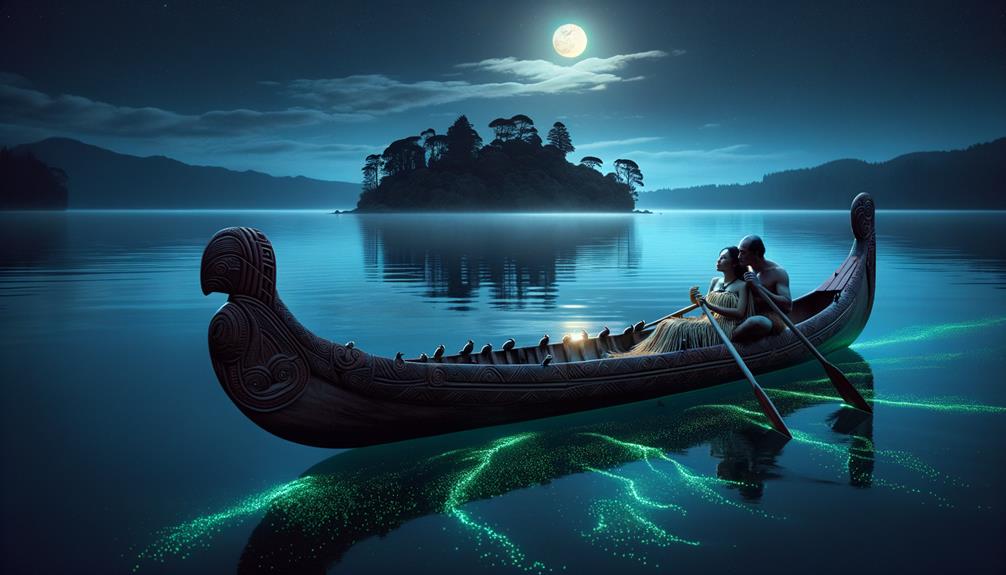
Hinemoa and Tūtānekai belong to a Te Arawa story rooted in the living geography and whakapapa of Lake Rotorua. Hinemoa’s night swim from the mainland to Mokoia Island is often presented as a universal triumph of romantic love. It is also a story about rank, whānau authority, courageous initiative, music, friendship, and the relationships created by marriage.
Cultural context: This account follows published Te Arawa and New Zealand reference sources. It does not treat the story as anonymous “Polynesian folklore.” Names, places, kin relationships, and the important 1849 record by Wiremu Maihi Te Rangikāheke keep its Te Arawa setting visible.
A love story in a network of kin
In many Māori marriage traditions, a relationship concerned more than two individuals. Whānau, hapū, and iwi could have a direct interest because marriage joined descent lines, resources, obligations, and political relationships. Te Ara places Hinemoa and Tūtānekai within this social world: passion matters, but so do the kin groups affected by the match.
Hinemoa is high-born and sought after. Tūtānekai lives on Mokoia Island and is treated as a less acceptable match by her family because of his status. Their attachment must therefore be kept secret. Calling the opposition a generic “curse against love” misses the actual tension between individual desire, rank, and collective decision-making.
Music across Lake Rotorua
At night, music carries across the water from Mokoia. Tūtānekai and his close companion Tiki play, while Hinemoa listens from the mainland. English accounts often call the instrument a flute; it is better to understand the sound within the wider world of taonga pūoro, Māori musical instruments, rather than picture a modern European concert flute.
The music does practical and emotional work. It tells Hinemoa where Tūtānekai is, makes the distance across the dark lake imaginable, and becomes the line she can follow when canoes are denied to her. The story’s lovers are united not by a map but by sound moving over a known landscape.
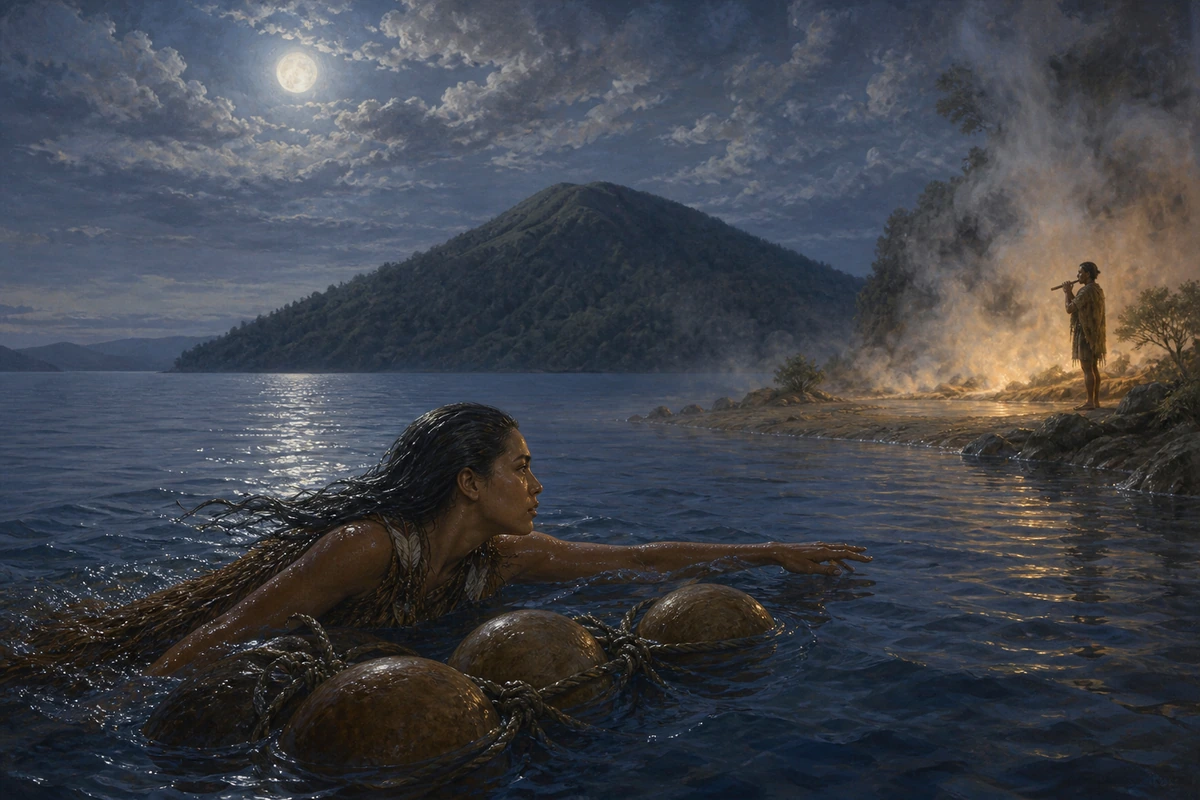
Hinemoa takes the initiative
Hinemoa’s family tries to prevent her departure by securing or beaching the canoes. She responds with a plan of her own. Te Ara’s account says she ties together six empty gourds for flotation and swims naked across the lake at night. The detail emphasizes both the seriousness of the barrier and her resourcefulness; it should not be used to eroticize the scene.
The crossing is difficult and cold. Hinemoa follows the sound toward Mokoia, then reaches the island and warms herself in the pool called Waimihia. Rotorua’s geothermal landscape is not decorative background. Warm water becomes the place where an exhausting passage ends and recognition can begin.
The broken water vessels
In a well-known version, Hinemoa hides near the warm pool when a servant comes to collect water for Tūtānekai. She deliberately breaks the vessel. After the trick is repeated, an angry Tūtānekai comes to investigate and finds her. The comic interruption releases tension after the danger of the swim.
Details differ among retellings: the type of vessel, the exchange of words, and the moment when Hinemoa reveals herself may change. These variations are normal in an orally transmitted and repeatedly adapted narrative. They do not weaken the central sequence of forbidden canoes, improvised gourds, guiding music, the night crossing, and reunion on Mokoia.
Tiki and hoa takatāpui
Wiremu Maihi Te Rangikāheke’s 1849 text includes Tiki as Tūtānekai’s close companion or hoa takatāpui. Te Ara notes that this relationship has become important in discussions of love between people of the same gender and that many Māori LGBTQ+ people use takatāpui today.
Older and present meanings should be discussed with care. It is inadequate to erase Tiki from the story as merely a spare musician. It is also too simple to force a nineteenth-century Māori phrase into one modern identity label without context. The record preserves multiple forms of attachment alongside the celebrated marriage.
| Story element | Role in the narrative | What simplified retellings miss |
|---|---|---|
| Family opposition | Creates the barrier to the marriage | Rank, whakapapa, and kin-group interests |
| Music from Mokoia | Connects the lovers and guides the swim | Tūtānekai’s companionship with Tiki and the place of taonga pūoro |
| Six gourds | Make Hinemoa’s self-directed crossing possible | Her planning and physical courage |
| Waimihia | Offers warmth and the setting for recognition | The geothermal specificity of the Rotorua landscape |
| Marriage | Resolves the lovers’ separation | The enduring bonds created among descendants and kin |
From Te Rangikāheke’s manuscript to national fame
Wiremu Maihi Te Rangikāheke produced the first important written version in 1849. A Te Arawa scholar and writer, he supplied Governor George Grey with extensive material in te reo Māori. Grey’s later publications made use of such knowledge, but returning attention to Te Rangikāheke restores the named Māori intellectual behind the record.
The story soon moved through songs, print, tourist performance, opera, film, and advertising. Hinemoa (1914), directed by George Tarr, is identified by Te Ara as the first feature film made in New Zealand. Later promotions used the lovers to market Rotorua as a wedding destination. These adaptations expanded the story’s reach while often favoring a Pākehā ideal of romance over its kinship context.
Why place matters
Mokoia is not an invented island in a distant fairy tale. It stands in Lake Rotorua and remains culturally significant to Te Arawa. Telling the story responsibly means retaining the names Mokoia, Waimihia, Rotorua, Te Arawa, Hinemoa, Tūtānekai, Tiki, and Te Rangikāheke rather than reducing them to “princess,” “poor musician,” and “magic island.”
The landscape also structures the action. Water separates communities and tests commitment; sound crosses where canoes cannot; gourds turn local material knowledge into survival; geothermal warmth makes the island a refuge. Every famous romantic image in the story is also an image of place.
More than an “eternal love” slogan
Hinemoa and Tūtānekai remain compelling because Hinemoa acts. She does not wait to be rescued or carried to the island. She judges the risk, improvises flotation, enters the lake, and claims the relationship that family restrictions denied. Their eventual marriage then reconnects individual choice with the wider world of kin.
A strong retelling can celebrate that agency without claiming there is one frozen script. It can acknowledge Tiki rather than edit him out, name the Te Arawa knowledge holder who wrote the 1849 account, and distinguish the ancestral story from the romance industry later built around it.
Sources and further reading
- Te Ara, “Love and romance”, including Hinemoa, Tūtānekai, Tiki, and Te Rangikāheke
- Te Ara, “Island romance in Lake Rotorua”
- Matariki and Māori seasonal renewal on Mythology Vault