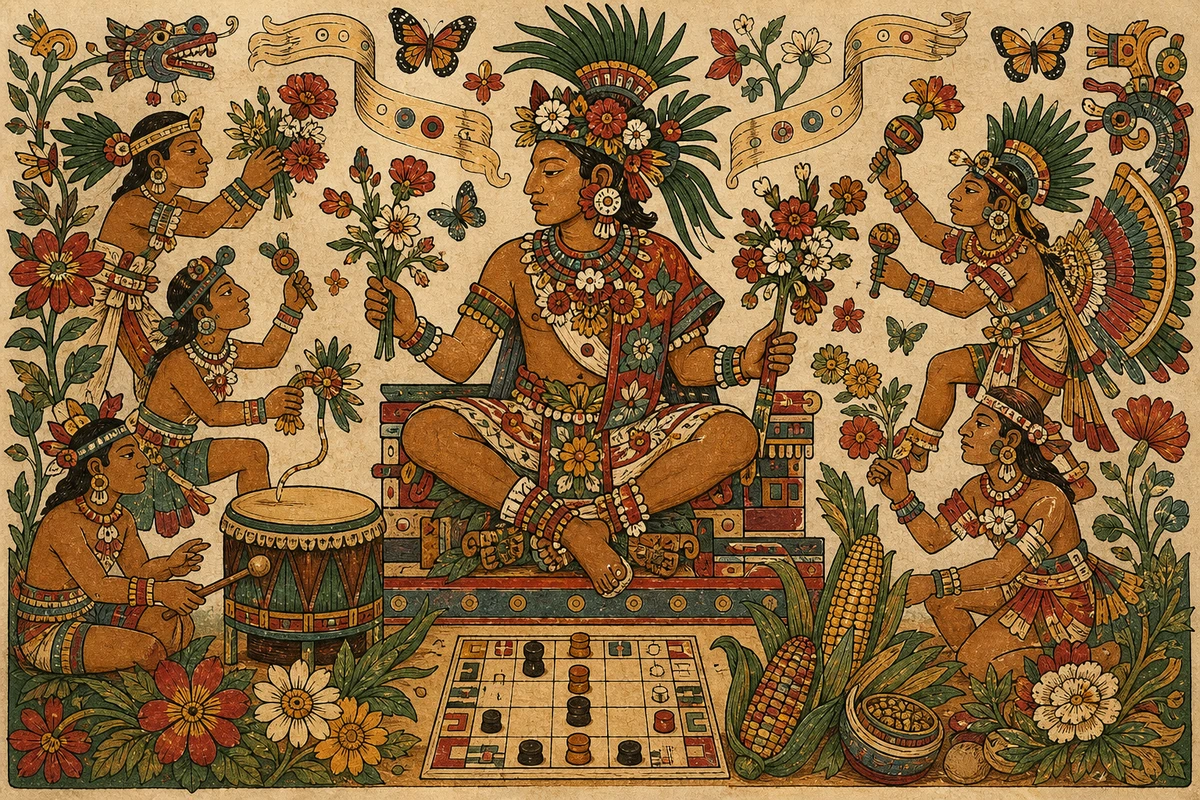
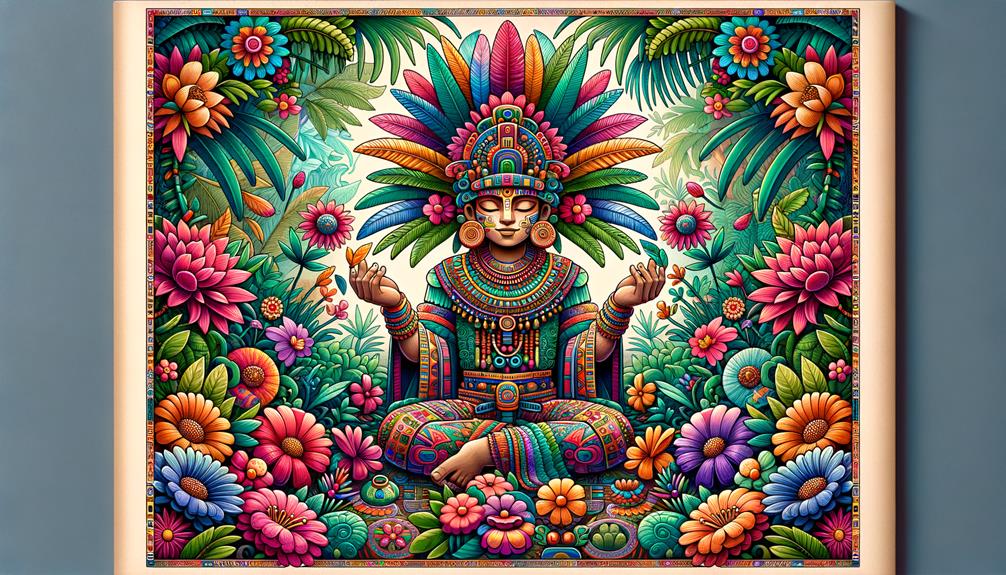
Accuracy note: Xochipilli is associated with flowers, song, dance, games, and pleasure. Modern claims about psychoactive plants on his statue remain debated and should not be presented as settled fact.
Symbolism of Flowers
In Aztec mythology, flowers burst forth as potent symbols of fertility and interconnectedness, complexly tied to life’s cycle under Xochipilli’s watchful gaze. As the flower prince and deity, Xochipilli represents life’s joys and creative energies. His connection to flowers extends beyond beauty, delving into their mystical significance.
rich flowers, particularly from psychoactive plants, often surround depictions of Xochipilli, personifying spiritual enlightenment. These plants were thought to open pathways to other worlds, enhancing the bond between the physical and spiritual dimensions. The presence of flowers in his iconography confirms their role in rituals seeking transcendence and divine communion.
Artistic Depictions

Xochipilli’s artistic representations are not mere aesthetic objects; they are gateways into a world where flora and deity unite in an exhilarating dance. Each brushstroke and sculptural detail remains relevant with the deity’s essence, evoking the transformative power of artistic expression and the reverence for nature’s boundless beauty.
Cultural Significance

Xochipilli’s roots trace back to Aztec mythology, where he represents the intertwining of nature, music, and artistic expression. As an Aztec deity, he personifies these rich worlds, symbolizing a harmonious existence where beauty and creativity thrive. His depictions, often adorned with flowers, reflect this joyous union.
Flowers aren’t mere decorations in Xochipilli’s imagery; they’re symbolic of fertility, joy, and artistic inspiration. In Aztec mythology, these plants represent the life force and creative energy Xochipilli bestows upon the world. His presence in art highlights his role as a patron of painters, musicians, and artists, underscoring the arts’ significance in Mesoamerican cultures.
The use of flowers reinforces Xochipilli’s connection to nature, beauty, and the arts, serving as a visual metaphor for the boundless creativity he inspires. His cultural significance extends beyond history, becoming an archetype illustrating the longstanding human pursuit of beauty and artistic expression amidst the natural world.
Modern Interpretations

Modern artists like Martine Gutierrez reinterpret Xochipilli’s essence, challenging contemporary ideas around gender and artistic expression. On a journey of self-discovery, Gutierrez channels Xochipilli, the Aztec deity of art and flowers, exploring her identity as a trans woman. Her portrayal boldly confronts rigid gender norms, embodying both masculinity and femininity.
Adorned in a pink ahuipil and metallic flowers, Gutierrez transforms Xochipilli into a symbol of gender fluidity. This campy aesthetic feminizes the traditionally masculine deity while celebrating the spectrum of gender performativity, echoing Judith Butler’s theories. Gutierrez’s art melds the masculine and feminine, defying conventional binaries.
Her portrayal intersects themes of inclusivity and self-expression, urging society to reconsider predefined notions of gender. By embodying Xochipilli, Gutierrez invites viewers on a mythological journey, where each accessory and garment symbolizes progress towards a more inclusive understanding of identity. Through her art, she redefines the divine archetype as a powerful narrative of gender fluidity and self-empowerment.
Xochipilli in Mythology

Xochipilli, the Flower Prince of Aztec mythology, embodies life’s joys and creativity – a symbol of art, music, dance, and nature’s beauty. His name blends the Nahuatl words for ‘flower’ and ‘prince,’ reflecting his essence as the son of the earth goddess Tlazolteotl and sun god Tonatiuh. Depicted adorned with floral garb and hallucinogenic plants, Xochipilli represents enhanced perception and spiritual euphoria, donning the oyohualli talisman signifying divine connection.
Xochipilli inspires artistic expression through music and movement, infusing rhythm and grace. Flowers underscore existence’s fleeting yet exquisite nature, while hallucinogenic plants facilitate visionary experiences linking the earthly and spiritual worlds. Through these motifs, the Flower Prince exemplifies Aztec ideals of celebrating life’s pleasures and embracing creativity’s transformative power.
Sources and related reading
- Mictecacihuatl Queen of Underworld on MythologyVault
- Ehecatl Wind God Legends on MythologyVault
- The Metropolitan Museum of Art: Aztec stone sculpture