
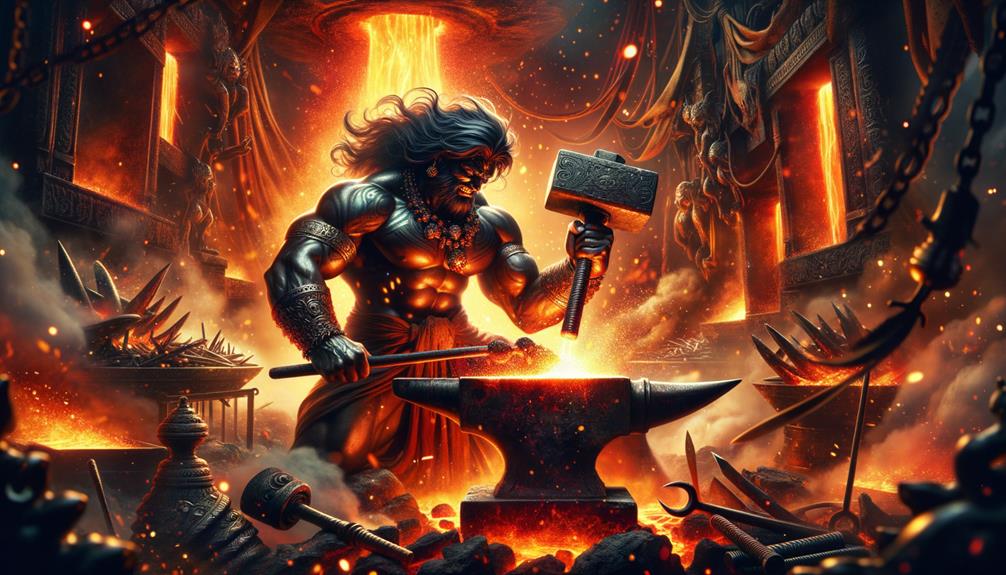
Vulcan was the Roman god of fire whose power could destroy a city, consume crops, or be directed through skilled work. Roman poets also made him a divine smith, especially when adapting Greek stories about Hephaestus. Yet the Roman cult should not be reduced to a list of magical weapons: Vulcan’s worship addressed the danger of uncontrolled flame in a society built from combustible materials and exposed to the heat of late summer.
Source note: Roman literature frequently identifies Vulcan with Greek Hephaestus, but cult, festival, and civic setting give Vulcan a specifically Roman history. This article distinguishes Roman evidence from inherited Greek myth.
Fire before the fantasy forge
Vulcan’s name can stand for fire itself in Latin poetry, especially fire that rages beyond human control. That emphasis explains why his oldest Roman sacred area, the Volcanal, lay in an open space near the Comitium rather than inside the dense city. A sanctuary for dangerous flame made practical symbolic sense outside or at the edge of concentrated buildings.
The same logic shaped his annual festival, the Vulcanalia, held on August 23 during a hot, dry period when fire threatened stored grain and urban neighborhoods. Ancient testimony says that small animals or fish were cast into fire. Later antiquarian explanations treated them as offerings made in place of human lives. The rite is evidence of propitiation—an attempt to avert harmful fire—not simply a celebration of blacksmithing.
Vulcan and Hephaestus
Roman authors translated and reworked Greek mythology, so Vulcan acquired the family, disability, marriage, assistants, and marvelous artifacts associated with Hephaestus. This was not a careless mistake by ancient writers; identifying deities across cultures was a normal part of Greek and Roman literary practice. The problem arises only when a modern summary assumes every Greek detail automatically describes early Roman cult.
In Roman epic, “Vulcan” can therefore mean the Roman god, the Latin literary form of Hephaestus, or the element of fire. Context decides. A passage about an altar and festival belongs to Roman religious history. A scene about Venus asking her husband to forge armor adapts the Greek divine-smith tradition for Rome’s national epic.
The forge in Virgil’s Aeneid
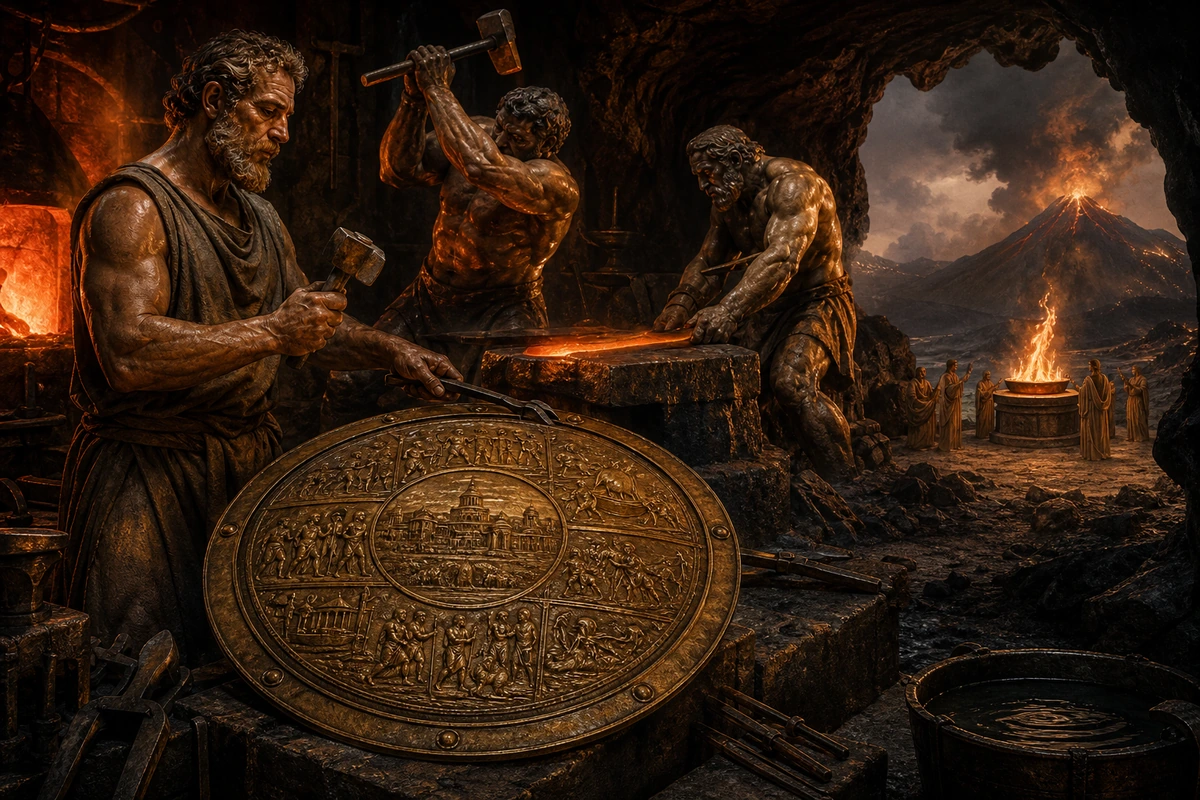
Virgil gives Vulcan his greatest Roman workshop scene in Aeneid 8. Venus asks him to make arms for her son Aeneas, who is about to fight in Italy. Vulcan descends to a volcanic island near Sicily, where Cyclopes labor in a vast cavern. They are already working on Jupiter’s thunderbolt, Mars’s chariot, and the aegis of Minerva when he orders them to begin the hero’s armor.
The description is physical and organized: bellows feed the furnace, metal liquefies, iron hisses in water, anvils groan, and coordinated blows shape the material. The result is not merely “indestructible gear.” The shield bears scenes from Rome’s future—from the she-wolf and twins through battles, ceremonies, and Augustus’s victory. Aeneas cannot know those future events, yet he lifts the shield and carries the destiny of his descendants.
What Vulcan is securely said to make
Virgil explicitly places Aeneas’s arms and shield in Vulcan’s forge. He also shows the Cyclopes working on thunder, divine vehicles, and Minerva’s aegis. Other Latin poems transfer additional Hephaestean creations to Vulcan. Modern lists often combine every Greek, Roman, medieval, and Renaissance attribution without naming a source, creating a false impression of one fixed catalog.
Claims such as “Vulcan forged Mars’s armor” or “made every thunderbolt of Jupiter” should be tied to a particular passage rather than presented as universal doctrine. The more revealing object is Aeneas’s shield because it transforms smithing into Roman historical vision: metalwork becomes a surface on which imperial memory is organized.
| Context | Aspect of Vulcan | Evidence or emphasis |
|---|---|---|
| Volcanal and Vulcanalia | Dangerous fire requiring propitiation | Open-air sacred setting, August festival, offerings in flame |
| Latin poetic language | Fire as an active destructive force | The god’s name can serve as a metonym for flame |
| Aeneid 8 | Divine smith and workshop master | Cyclopes forge the arms and prophetic shield of Aeneas |
| Greek–Roman identification | Roman counterpart of Hephaestus | Shared myths expand in literary retellings |
Volcanoes and workshop geography
Poets located the divine forge in volcanic landscapes: beneath or near Etna, on Lipari, or on a fiery Aeolian island. These locations made eruptions, smoke, subterranean sound, and molten rock intelligible as signs of supernatural metalwork. They were poetic maps, not geological claims that an excavatable workshop lies under one mountain.
The English word volcano ultimately comes through the name Vulcano, the fiery Aeolian island associated with the god. That linguistic legacy preserves the dangerous side of his identity better than many modern depictions do. A volcano creates new rock and fertile terrain over time, but its immediate power is heat, smoke, and destruction.
Craft, control, and Roman identity
Vulcan represents a force that civilization needs but can never treat as harmless. Fire cooks, lights, transforms ore, and equips armies; the same element burns homes and granaries. The forge is therefore one expression of a larger religious problem: how can communities direct a power whose escape would be catastrophic?
Virgil answers poetically by placing Roman history on a shield made in that fire. Cult answers ritually by locating Vulcan’s altar carefully and giving offerings during the season of greatest danger. Read together, these sources show a deity of both technical mastery and civic anxiety—not just mythology’s “ultimate blacksmith.”
Sources and further reading
- Virgil, Aeneid 8, Perseus Digital Library
- “Vulcanalia,” Dictionary of Greek and Roman Antiquities
- Hephaestus in Greek myth on Mythology Vault