

The Sampo is the great contested object of the Finnish Kalevala: forged by Ilmarinen for Louhi, secured inside a mountain in Pohjola, stolen by southern heroes, and shattered during a battle at sea. It is often called a magical mill because the epic says it grinds flour, salt, and money. Yet its exact shape and older meaning remain uncertain, and that mystery is central to its power.
The Kalevala is not a manuscript copied unchanged from antiquity. Elias Lönnrot assembled and reshaped oral runo songs collected in Finland and Karelia, publishing the Old Kalevala in 1835 and the expanded New Kalevala in 1849. The Sampo story therefore belongs both to older singing traditions and to Lönnrot’s influential literary architecture.
Why is the Sampo forged?
Väinämöinen is stranded in Pohjola, the northern realm ruled by Louhi. To secure his return, he promises that the smith Ilmarinen can forge the Sampo in exchange for Louhi’s daughter. Väinämöinen does not possess Ilmarinen’s consent, so the bargain already treats technical skill as a political resource.
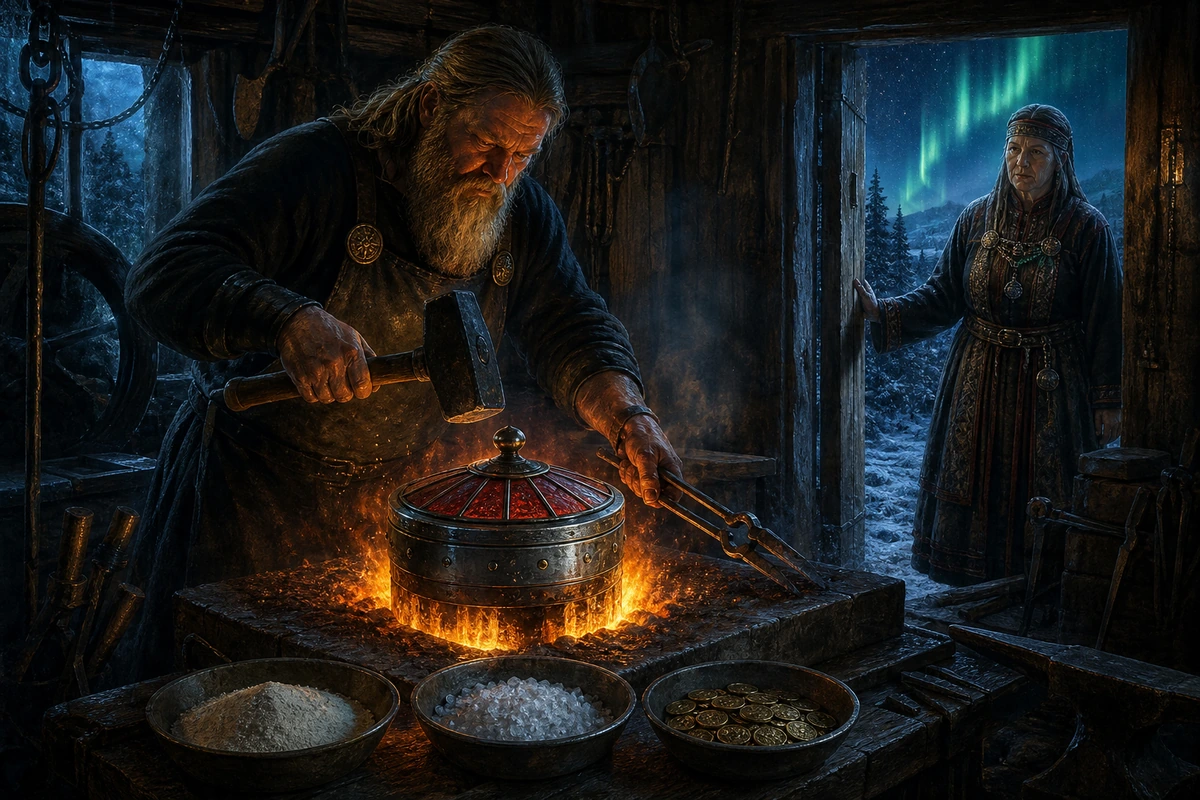
Ilmarinen is the eternal smith who forged the sky in the epic’s mythology. He has no desire to travel north, and Väinämöinen uses magic to send him there. Louhi repeats the offer: forge the Sampo with its many-colored lid, and the maiden will be his bride.
Ilmarinen’s failed creations
The forging does not succeed immediately. From the furnace emerge a golden crossbow, a red ship or boat, a golden-horned heifer, and a plough. Each is beautiful but morally or practically flawed: the bow seeks victims, the boat rushes toward battle, the cow behaves destructively, and the plough damages fields.
Ilmarinen breaks the failed objects and returns them to the fire. The sequence defines good craft as more than technical brilliance. A magnificent tool that produces disorder is not yet the object Louhi requested.
What does the Sampo produce?
The successful Sampo has a many-colored lid and begins to grind different forms of prosperity. In John Martin Crawford’s nineteenth-century English translation, one side grinds flour for eating, another grinds salt, and a third grinds money. Translations vary in their vocabulary, but threefold abundance is consistent in the literary episode.
Louhi stores the Sampo inside a copper-bearing mountain behind locks and fixes it securely in place. Pohjola prospers. The object does not merely make an individual rich; it sustains a whole region and therefore changes the balance of power between communities.
Is the Sampo really a mill?
The Kalevala describes grinding, so “magical mill” is a reasonable short label. It does not, however, give the reader a modern engineering diagram. The mysterious many-colored lid, difficult forging, fixed roots or fastening in the mountain, and cosmic consequences have encouraged many interpretations.
Scholars and artists have compared the Sampo to a hand mill, treasure-producing device, world pillar, cosmic axis, vault of heaven, ritual object, or image of social prosperity. No single proposal has ended the debate. Statements that it definitely had literal tree branches, a maiden figure, or one recoverable prehistoric design go beyond the epic’s evidence.
Why do the heroes steal it?
After later tragedies and failed relationships, Väinämöinen proposes taking the Sampo so that its benefits can be shared with his homeland. Ilmarinen joins him, and Lemminkäinen becomes the third principal companion. Their stated aim is redistribution, but from Pohjola’s perspective they are breaking into a secured mountain and stealing the source of its prosperity.
Väinämöinen uses music to put the people of Pohjola to sleep. The heroes open the locks, remove the Sampo, and carry it to their boat. Even moving it requires exceptional effort, underlining how deeply wealth has been rooted in Louhi’s land.
Battle at sea and the shattered Sampo
Louhi wakes, discovers the loss, and begins pursuit. She raises obstacles through fog, storm, and supernatural force. In the final confrontation she takes a great birdlike battle form and descends on the heroes’ vessel with warriors on her back.
The Sampo is lost overboard and breaks in the sea. Some fragments sink and continue enriching the waters; other pieces wash ashore. Väinämöinen gathers what he can and predicts that the fragments will bring growth and prosperity to his country. Louhi is left with only limited remains, often identified in translation with the lid.
The ending refuses a simple victory. No one retains the complete engine of abundance. Wealth becomes dispersed between sea and shore, and the struggle to monopolize it destroys the very object being contested.
| Stage | What happens | Question raised |
|---|---|---|
| Bargain | Väinämöinen promises Ilmarinen’s craft to Louhi | Who has the right to trade another person’s labor? |
| Forging | Beautiful but harmful objects are rejected before the Sampo appears | Is technical success enough if a creation damages society? |
| Prosperity in Pohjola | The Sampo produces staples and wealth for the northern realm | Does abundance belong to its maker, owner, or community? |
| Theft and shattering | The heroes seize it; the pursuit ends with fragments in sea and shore | Can prosperity be monopolized without being destroyed? |
Louhi is more than a villain
Louhi is frequently labeled an evil witch in simplified retellings. In the epic she is certainly a formidable antagonist, but she is also a ruler defending Pohjola, setting difficult marriage tests, negotiating exchanges, and protecting a resource made under contract for her realm.
The theft can therefore be interpreted in competing ways: heroic recovery, redistribution of hoarded abundance, or aggressive seizure by outsiders. The poem’s power comes partly from leaving those political positions visible.
The Sampo and Finnish cultural identity
The Kalevala became enormously influential during the formation of Finnish national culture. Artists, composers, writers, filmmakers, musicians, and designers repeatedly returned to the Sampo because an undefined object invites visual reinvention.
“Sampo” is now used for companies, institutions, cultural-heritage systems, scientific names, and fictional artifacts. These modern uses testify to recognition, but they should not be read backward as explanations of the older runo songs.
Reading the Sampo responsibly
Readers should distinguish at least three layers: the oral poems collected from individual singers, Lönnrot’s edited nineteenth-century epic, and later national or popular interpretations. A detail present in one layer may not appear in all the others.
That distinction does not drain the object of meaning. It shows why the Sampo can remain a mill and exceed the category of mill. It materializes the hope that craft can create common prosperity and the fear that competition over prosperity will break it apart.
Key takeaways
- Ilmarinen forges the Sampo for Louhi after several beautiful but harmful creations fail.
- The Kalevala says it grinds forms of food, salt, and money, making “magical mill” a useful but incomplete label.
- Väinämöinen, Ilmarinen, and Lemminkäinen steal it from Pohjola.
- The Sampo shatters during Louhi’s pursuit, scattering prosperity rather than leaving one side in total possession.
- Its precise form and older symbolism remain debated; unsupported decorative features should not be presented as textual facts.