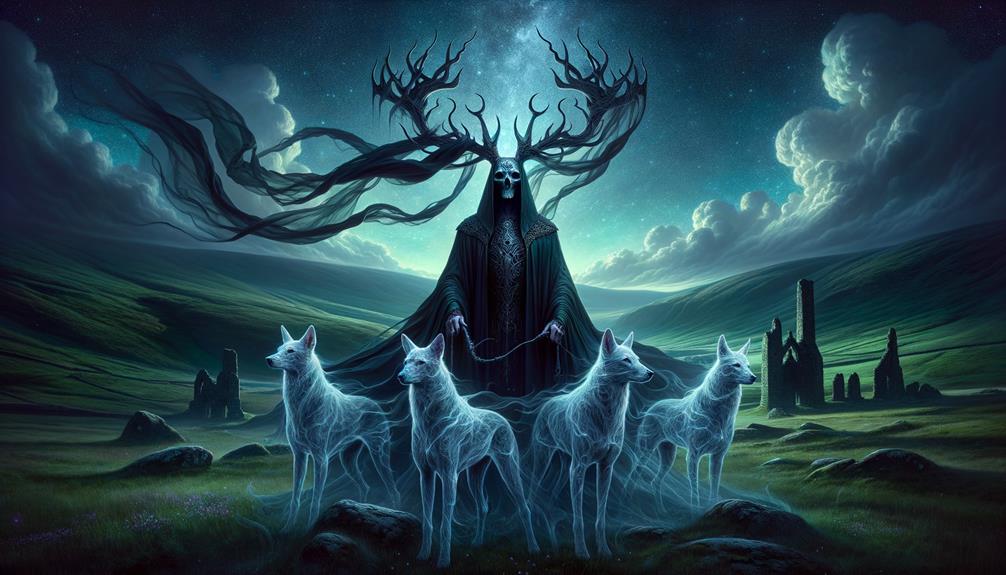
Arawn is the king of Annwn who exchanges places with Pwyll in the First Branch of the Mabinogi, a masterpiece of medieval Welsh prose. He is courteous, politically capable, and exacting about honor. Although modern summaries call him a god of death or king of the underworld, the tale itself presents him as the living sovereign of a wealthy otherworldly court—not as a devil ruling a place of punishment.
Nearly everything that can be said securely about Arawn’s character comes from a small number of Welsh texts. Later folklore and modern fantasy have expanded him far beyond that record. A source-first approach makes the original figure more precise and more interesting.
Who is Arawn?
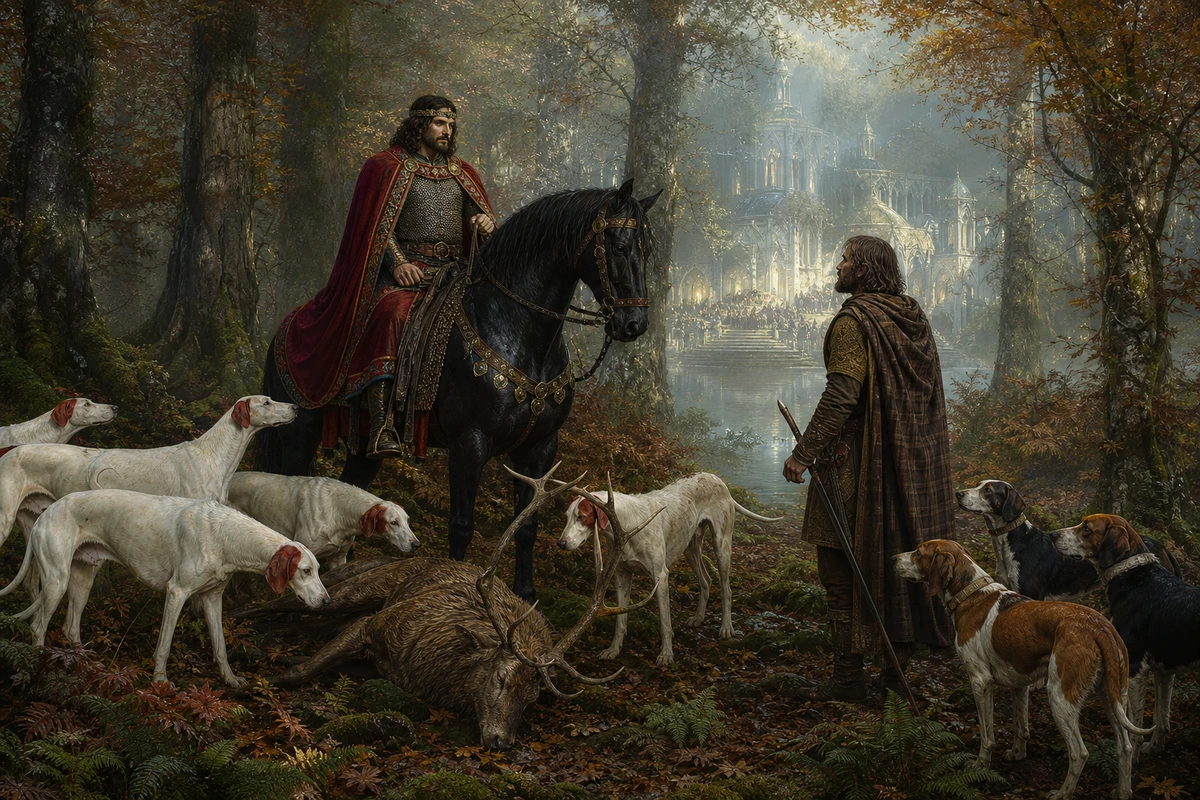
Arawn rules Annwn, the Welsh Otherworld, in the First Branch. He enters the narrative during a hunt in Glyn Cuch, where Pwyll, prince of Dyfed, comes upon an unfamiliar pack that has brought down a stag. The hounds are strikingly supernatural: white with red ears. Pwyll drives them away and sets his own dogs on the kill.
A mounted stranger arrives and rebukes Pwyll. The prince initially asks the stranger’s name, but Arawn insists that the discourtesy matters more. Pwyll offers to make amends. The exchange that follows begins not with conquest but with a violated rule of hunting and a negotiated obligation.
The exchange of appearances
Arawn explains that another king in Annwn, Hafgan, is his rival. He proposes that Pwyll and Arawn exchange appearances and kingdoms for a year and a day. Pwyll will look exactly like Arawn, rule his court, and meet Hafgan in combat; Arawn will govern Dyfed in Pwyll’s form.
Arawn gives one crucial instruction. Pwyll must strike Hafgan only once. If he delivers a second blow, Hafgan will recover with renewed strength. The condition turns the combat into a test of listening and restraint rather than mere force.
Pwyll accepts. No one in either court detects the substitution, and Arawn’s servants receive the disguised Pwyll as their king. The exchange is magical, but its success depends on each ruler’s ability to sustain the other’s public duties.
Pwyll and Arawn’s queen
Each night Pwyll shares a bed with Arawn’s unnamed queen but turns away without sexual contact. He remains friendly and conversational during the day, so she is puzzled by the sudden nightly distance. Pwyll’s restraint is not demanded in Arawn’s original instructions; it is his own decision about loyalty while inhabiting another man’s identity.
When the year ends, Pwyll meets Hafgan at the ford and fells him with one blow. Hafgan asks for another, but Pwyll refuses exactly as instructed. Hafgan’s followers acknowledge defeat, and Arawn’s two realms are united under one ruler.
Why the second blow matters
Heroic stories often reward the finishing strike. This episode reverses that expectation. Hafgan tries to induce Pwyll to repeat the blow, but obedience to Arawn’s knowledge is the only path to victory. Violence works because it remains limited.
The rule also distinguishes political legitimacy from rage. Pwyll does not attack Hafgan’s followers or seize Annwn for himself. He completes an agreed task and returns the realm to Arawn. The exchange produces alliance rather than annexation.
Arawn keeps Pwyll’s kingdom
When Pwyll returns to Dyfed, he asks his nobles how the previous year compared with his earlier rule. They praise the apparent Pwyll’s justice, courtesy, and generosity. Arawn has not merely kept the throne safe; he has governed it exceptionally well.
Arawn similarly asks about Pwyll’s conduct in Annwn and learns that Pwyll did not sleep with his queen. Mutual trust is confirmed by evidence from both households. Their friendship continues, and the two realms exchange gifts and affection.
| Test | Pwyll’s response | What it establishes |
|---|---|---|
| He takes Arawn’s stag | Offers compensation after being rebuked | A breach of etiquette can create a binding obligation |
| He rules Annwn in Arawn’s shape | Performs the king’s duties for a year and a day | Kingship is conduct, not appearance alone |
| He faces Hafgan | Strikes once and refuses a second blow | Restraint and exact obedience defeat the rival |
| He shares the queen’s chamber | Refuses to exploit Arawn’s identity | Private loyalty confirms the public alliance |
Why is Pwyll called “Head of Annwn”?
After the successful exchange, Pwyll receives the title Pwyll Pen Annwn, “Pwyll, Head of Annwn.” The title does not necessarily mean that he replaces Arawn as permanent king. It marks the prestige and authority he gains through the alliance and his victory over Hafgan.
The episode also establishes the quality of pwyll, a Welsh word associated with sense, judgment, or discretion and identical to the hero’s name. At the opening he behaves impulsively in the hunt. By the end he has learned to act with measured intelligence.
What is Annwn?
Annwn is a Welsh otherworld that can be near the human landscape yet accessible only through unusual encounters, transformations, mounds, water, or journeys. In the First Branch it has a court, political rivalry, marriage, hunting, feasting, and material abundance. Its people are not described as dead sinners undergoing punishment.
Christian scribes copied the manuscripts, and English translators sometimes used words such as “Hades.” That vocabulary can be misleading if it makes Annwn identical to Christian hell. Medieval Welsh literature contains Christian ideas, but its otherworld preserves its own narrative geography.
The pigs from Annwn
Arawn does not personally return as a major actor in the later branches, but his relationship with Pwyll’s family remains important. In the Fourth Branch, Pryderi possesses pigs that came from Annwn and were given by Arawn. They are the first such animals in the island within the story’s world.
Gwydion wants the pigs for Math’s realm and obtains them through a deceptive exchange involving magically created horses, hounds, and shields. The episode leads toward war. Arawn’s gift therefore continues to shape politics after the First Branch: otherworldly abundance creates prestige, desire, and conflict in the human world.
Arawn is not Gwyn ap Nudd
Modern retellings frequently merge Arawn with Gwyn ap Nudd, another Welsh otherworldly figure associated in different sources with Annwn, supernatural hunting, and the control of dangerous spirits. Shared motifs do not make the names interchangeable.
The Wild Hunt is likewise a broad body of later European folklore, not a scene in the First Branch where Arawn rides through the sky collecting souls. His hounds appear in an otherworldly hunt, but turning that episode into a complete Wild Hunt mythology imports material the tale does not state.
God, king, or literary character?
Arawn may preserve features of a pre-Christian divine figure, but the surviving narrative calls attention to kingship and relationship rather than providing a theology of worship. There is no detailed medieval ritual manual for a cult of Arawn.
“Otherworld king” is therefore the safest concise description. “God of death” is much more speculative, and “Welsh Satan” is wrong for the First Branch. He is a model ally whose realm mirrors human political life while exceeding it in wealth and magic.
Key takeaways
- Arawn rules Annwn in the First Branch of the Mabinogi.
- His white hounds with red ears signal an otherworldly hunt, not a demonic one.
- The year-and-a-day exchange tests Pwyll’s judgment, restraint, and loyalty.
- Annwn is not simply Christian hell, and Arawn is not the devil.
- Later claims linking Arawn to Gwyn ap Nudd or the Wild Hunt should be identified as comparison or reception, not as the First Branch’s plot.