
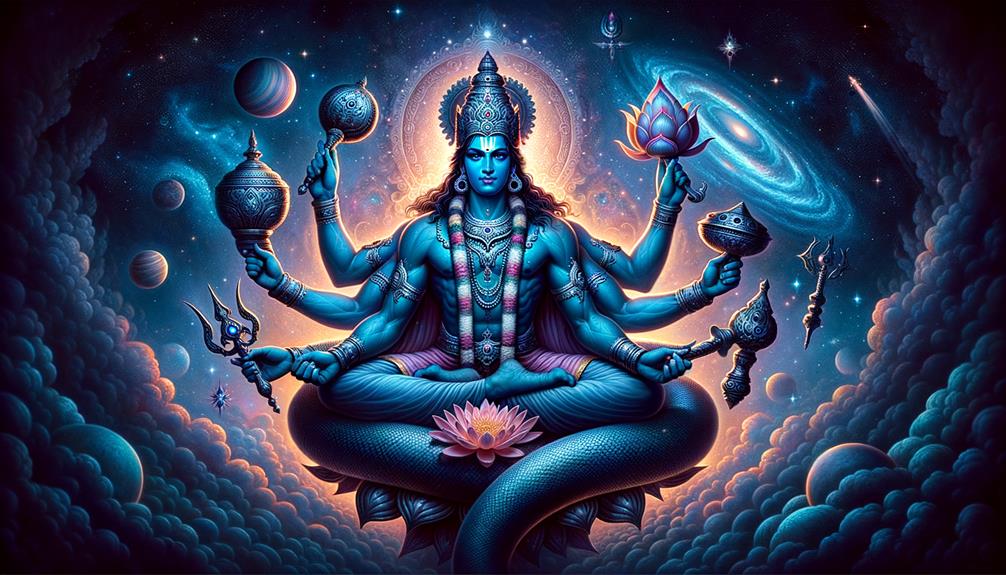
Vishnu is one of the principal deities of Hindu traditions. Vaishnava communities worship him as supreme, while broader summaries often describe his role as preservation or protection. That short label is useful but incomplete.
Vishnu in the surviving tradition
Vishnu’s imagery commonly includes four arms holding the discus chakra, conch shankha, mace gada, and lotus. He may recline on the serpent Shesha or Ananta upon the cosmic ocean, with Lakshmi nearby. These images present sovereignty, order, protection, and cosmic continuity rather than a portrait of one historical person.
Texts, objects, and evidence
Traditions of Vishnu’s descents, or avatars, explain divine intervention when dharma is threatened. Rama and Krishna are the most influential. Lists of ten avatars are common, but the identity and order of some entries vary by region and text. The future Kalki closes many lists. Calling every appearance an incarnation in exactly the same sense can hide important theological differences.
Key points
- Vedic background: The Rigveda praises Vishnu’s wide strides. Later texts and devotional traditions greatly expand his status and narratives.
- Vaikuntha: Vaishnava sources describe Vishnu’s divine abode as Vaikuntha.
- Consort: Lakshmi is closely associated with Vishnu and appears beside him in art and devotion.
- Protection: Vishnu’s role concerns the restoration of dharma and the care of devotees, not a mechanical guarantee that no harm will occur.
How to read the material
Hindu traditions are internally diverse. Shaiva, Shakta, Smarta, and Vaishnava teachings place deities in different theological relationships without fitting a single universal hierarchy.