

Aeneas is a Trojan hero who survives the fall of his city and becomes the legendary ancestor of the Roman people. He appears in Greek epic centuries before Virgil made him the protagonist of the Aeneid. Separating those stages prevents a common error: Homer’s Aeneas is destined to preserve the Trojan line, but Homer never sends him to Italy or makes him a founder of Rome.
Virgil transforms that survivor into an exile carrying people, sacred objects, and an unfinished future across the Mediterranean. The resulting hero is defined by pietas—responsibility toward gods, family, community, and destiny—yet he is not emotionless or morally simple. His mission saves a lineage while inflicting losses on Dido, Turnus, and others who stand in its path.
Who were Aeneas’s parents?
Aeneas is the son of the goddess Aphrodite, called Venus by the Romans, and the mortal Anchises. The Homeric Hymn to Aphrodite tells how the goddess disguises herself, sleeps with Anchises, reveals her identity, and foretells the birth of their son. His name is linked in the poem to her grief or dread over the unequal union.
Through his father, Aeneas belongs to a branch of the Trojan royal family. He is related to Priam’s house but is not simply another of Priam’s sons. That distinction helps explain how his line can survive after the household of Hector and Paris collapses.
Aeneas in Homer’s Iliad
In the Iliad, Aeneas is a significant Trojan commander but not the central hero. In Book 5, Diomedes wounds him and Aphrodite attempts a rescue before Apollo carries him to safety. The scene establishes both his vulnerability and divine protection.
Book 20 makes his survival especially important. Aeneas challenges Achilles and would be killed, but Poseidon removes him from danger. The god explains that destiny requires Aeneas and his descendants to continue ruling among the Trojans. The passage gives later poets a foundation for his escape, although its horizon is Trojan continuity rather than Roman history.
Virgil’s mission for Aeneas
By Virgil’s age, Greek and Roman writers had developed traditions in which Aeneas traveled west and reached Italy. The Aeneid, composed in the late first century BCE, brings these stories into a twelve-book epic that looks backward to Homer and forward to Rome and the age of Augustus.
The poem begins after years of wandering. Juno opposes the Trojans, while Jupiter promises that their descendants will found a people with a vast future. Aeneas must repeatedly place that collective future above the life he might prefer for himself.
Escaping the fall of Troy
In Aeneid Book 2, Aeneas narrates Troy’s final night. At first he rushes toward battle and an honorable death. Omens and divine instruction redirect him toward rescue. He carries his elderly father Anchises on his shoulders, leads his young son Ascanius by the hand, and tells his wife Creusa to follow.
Anchises carries the household gods because Aeneas, bloodied from combat, considers himself ritually unfit to touch them until purified. The image compresses the hero’s mission into one family group: the old generation and sacred past ride on his back, the next generation walks beside him, and the future depends on their survival.
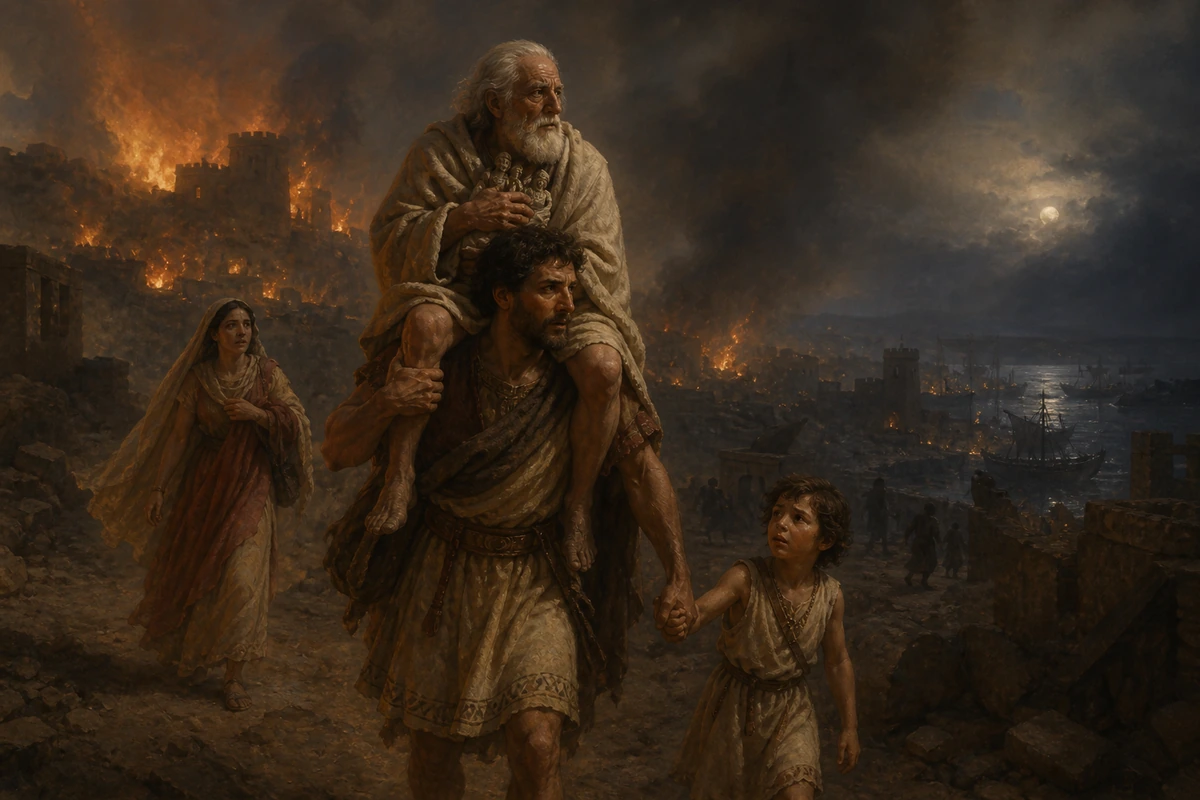
Creusa is separated from them and dies. Her shade appears to Aeneas, stops his desperate search, and tells him that a western land and royal marriage await. The escape is therefore not a flawless act of family preservation. Roman beginnings are purchased through a Trojan family’s rupture.
Wanderings, Dido, and departure from Carthage
Aeneas and the refugees travel through the eastern Mediterranean, repeatedly misreading or refining the signs that direct them toward Italy. They lose Anchises in Sicily. A storm then drives them to Carthage, where Queen Dido receives them and hears Aeneas recount Troy’s fall and the journey.
Dido and Aeneas become lovers, but they do not interpret the relationship in the same way. Dido treats it as a marriage; Aeneas later denies that he entered a formal marriage and insists that divine command requires his departure. Mercury’s message awakens him to the neglected mission.
Dido’s suicide makes the cost of Aeneas’s obedience impossible to ignore. The poem does not turn her pain into a trivial obstacle. Her curse also projects personal betrayal into the imagined future hostility between Rome and Carthage.
The underworld and Rome’s future
In Italy, the Sibyl of Cumae guides Aeneas into the underworld. He sees the consequences of death, encounters figures from his past, and finally meets Anchises in Elysium. Anchises explains the movement of souls and displays a pageant of future Roman figures.
Book 6 makes Aeneas’s private burden part of a public historical vision. Romulus, Roman generals, and Augustus appear as future descendants. The passage celebrates Roman power, but its placement among the dead and unborn also makes history feel costly. Aeneas can see the promised future, yet he must return to uncertainty and war to enable it.
| Stage of tradition | Aeneas’s role | What is—and is not—claimed |
|---|---|---|
| Homer’s Iliad | Trojan commander protected by the gods | His line will survive among the Trojans; Italy and Rome are not mentioned |
| Virgil’s Aeneid | Exile leading Trojan survivors toward Italy | He establishes the lineage and conditions from which Rome will later emerge |
| Later Roman genealogy | Ancestor of the Julian line through Ascanius or Iulus | He is an ancestor and precursor, not the direct founder of the city of Rome |
War in Italy and the death of Turnus
King Latinus welcomes the possibility that Aeneas will marry his daughter Lavinia, but Juno and the Fury Allecto inflame opposition. Turnus, ruler of the Rutulians and Lavinia’s existing suitor, becomes Aeneas’s chief rival. The second half of the epic shifts from wandering toward an Italian war modeled on the Iliad.
The poem ends when Aeneas defeats Turnus in single combat. Turnus asks for mercy, and Aeneas hesitates. Then he sees the sword-belt that Turnus stripped from the young Pallas, Aeneas’s fallen ally. In anger he kills him. The abrupt ending leaves readers debating whether the act fulfills justice, succumbs to rage, or deliberately combines both.
Did Aeneas found Rome?
No. In the standard Roman legendary chronology, Aeneas’s Italian settlement is associated with Lavinium. His son Ascanius, also called Iulus, founds Alba Longa. Generations later, Romulus founds Rome. Aeneas is therefore the ancestral bridge between Troy and Rome rather than Rome’s direct founder.
That genealogy had political force. Julius Caesar’s family, the Julii, claimed descent from Iulus and therefore from Venus. Virgil’s audience could read the epic as both a national origin story and a meditation on the power of Augustus’s regime.
What does pietas mean?
The adjective pius repeatedly describes Aeneas. English “pious” can make it sound like private religious devotion, but Roman pietas includes dutiful conduct toward gods, parents, descendants, allies, and the community. Carrying Anchises, preserving the household gods, burying companions, and continuing toward Italy all express it.
The virtue creates conflict rather than eliminating it. Duty to a future people may require leaving Dido; loyalty to Pallas may provoke the fatal blow against Turnus. Virgil’s Aeneas matters because responsibility weighs on him, not because he always acts without hesitation or anger.
Key takeaways
- Homer presents Aeneas as a divinely protected Trojan survivor, not yet as a Roman founder.
- Virgil makes him the carrier of Trojan family, sacred tradition, and destiny toward Italy.
- The escape from Troy includes Anchises and Ascanius but ends with the loss of Creusa.
- The episodes with Dido, Anchises in the underworld, and Turnus expose the human cost of his mission.
- Aeneas is a legendary ancestor of Rome; Romulus is the city’s direct founder in Roman tradition.