
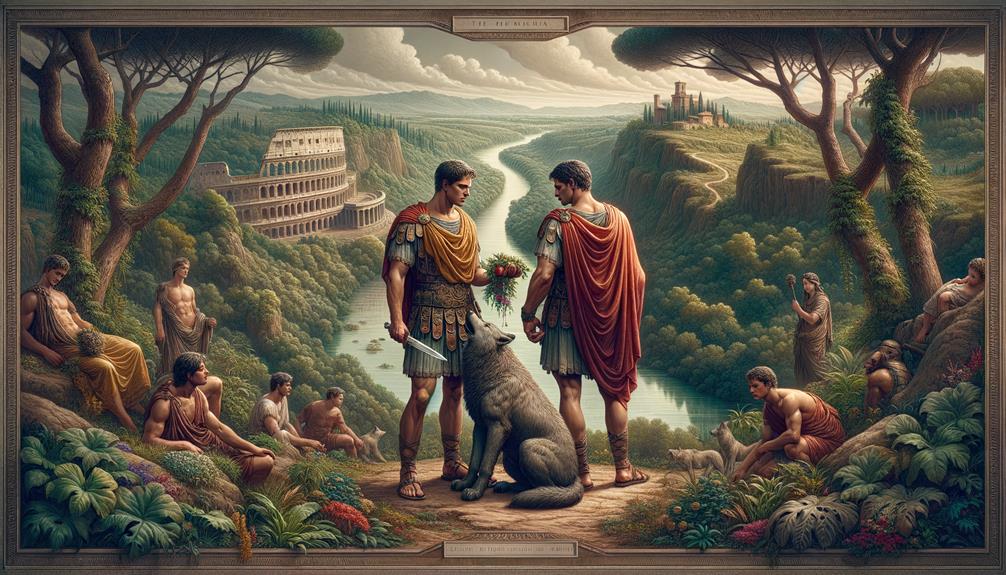
Accuracy note: Romulus and Remus belong to Rome’s foundation traditions, not recoverable biography. Ancient authors themselves preserve alternatives about the twins’ ancestry, rescue, quarrel, and Remus’s death. Archaeology can illuminate early settlement at Rome but cannot authenticate the twins as historical individuals.
The story of Romulus and Remus gave Romans a dramatic answer to several questions at once: why their city stood where it did, why it bore Romulus’s name, why divine signs mattered to political authority, and why violence seemed present at Rome’s beginning. The familiar she-wolf and exposed twins are only the opening of a myth that ancient writers told in competing versions.
Royal ancestry and exposure
In Livy’s account, the twins descend from the kings of Alba Longa. Amulius seizes the throne from his older brother Numitor and forces Numitor’s daughter Rhea Silvia to become a Vestal Virgin so that she will not produce heirs. When she bears twins, she names Mars as their father. Livy pointedly leaves room for doubt about whether she believed this or used a god’s name to disguise a human father.
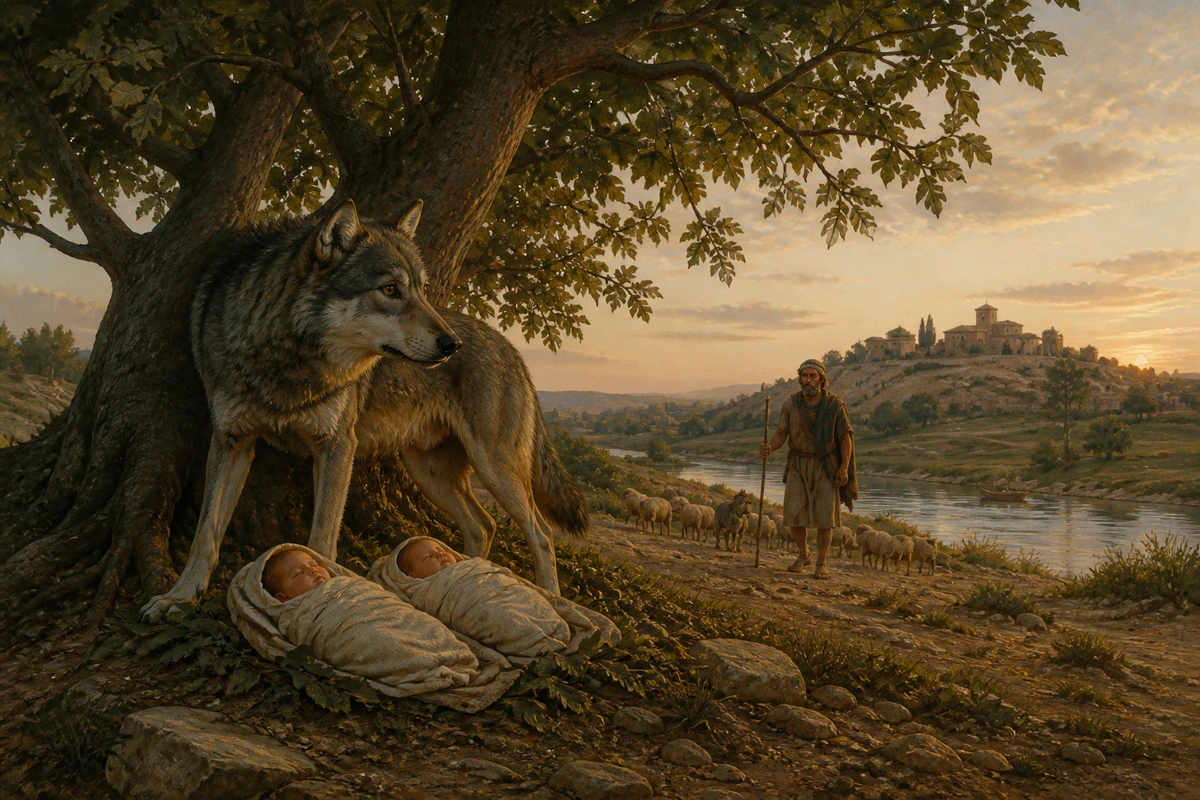
Amulius orders the infants drowned. Because the Tiber has flooded, the servants leave the basket in shallow water rather than reach the main current. As the water falls, a she-wolf finds and nurses the children near the fig tree later called the Ficus Ruminalis. The royal shepherd Faustulus discovers them and brings them to his wife, Larentia.
Livy notes a rationalizing alternative: lupa, “she-wolf,” could also be used as a slur for a sex worker, and Larentia may have acquired the nickname. He reports the explanation without removing the animal from the traditional story. This is a useful reminder that ancient historians could preserve wonder and skepticism side by side.
Return to Alba Longa
Raised among shepherds, Romulus and Remus become leaders of young men in the countryside. A dispute with Numitor’s herdsmen leads to Remus’s capture. The resulting revelations allow Numitor to recognize his grandsons. The twins then organize an attack, kill Amulius, and restore Numitor to the Alban throne.
Rather than inherit Alba Longa directly, they decide to establish a settlement near the place of their exposure and upbringing. Their shared success now becomes rivalry over location, name, and authority.
Augury and the death of Remus
Livy says the brothers appeal to augury because they are twins and age cannot decide precedence. Remus watches from the Aventine and first sees six vultures; Romulus, positioned on the Palatine, then sees twelve. Their followers dispute whether priority or number should determine the winner.
Violence follows, but Livy records more than one version. In one, Remus dies in the general clash between the factions. In the more famous account, Remus mockingly jumps over Romulus’s new wall and Romulus kills him, declaring that the same fate should meet anyone who crosses the fortifications. Other authors attribute the fatal blow to a follower. Saying simply “Romulus murdered Remus” hides the ancient disagreement.
The traditional founding date
Later Roman chronology placed the city’s foundation on 21 April 753 BCE, a calculation associated with Marcus Terentius Varro. The day was also the Parilia, a pastoral festival. It became Rome’s civic birthday, but it is not an archaeologically documented timestamp for a single foundation event. The hills beside the Tiber developed through long settlement processes.
Romulus after the founding
Romulus fortifies the Palatine and creates an asylum to attract newcomers. The population’s lack of women leads to the episode traditionally called the rape or abduction of the Sabine women. During the subsequent war, the women intervene between their Roman husbands and Sabine relatives, producing a political union. In some accounts Romulus then shares rule with the Sabine king Titus Tatius.
Ancient stories also disagree about Romulus’s end. In one tradition, a storm or eclipse surrounds his disappearance and he becomes the god Quirinus. In a more suspicious version, senators kill and dismember him. The alternatives make the founder both a sacred ancestor and a warning about kingship.
What the foundation myth explains
| Mythic element | Roman concern it addresses |
|---|---|
| Mars as father | Divine ancestry and Rome’s military identity |
| She-wolf and shepherd household | Survival, pastoral origins, and the landscape beside the Tiber |
| Vulture augury | Religious signs as authorization for public power |
| Remus’s death | The sanctity of boundaries and violence within civic beginnings |
| Sabine union | Growth through incorporation of outsiders |
The myth should neither be treated as literal reportage nor dismissed as meaningless fiction. Livy and Plutarch used it to think about Roman identity, political legitimacy, family conflict, and the price of city-building. It also connects back through Alba Longa to Aeneas, the Trojan survivor placed at the beginning of Rome’s legendary genealogy.
Primary sources and related reading
- Livy, History of Rome 1.4: exposure, wolf, and foster family
- Livy, History of Rome 1.7: augury, Remus’s death, and Romulus’s rule
- Aeneas and Rome’s Trojan genealogy on Mythology Vault