
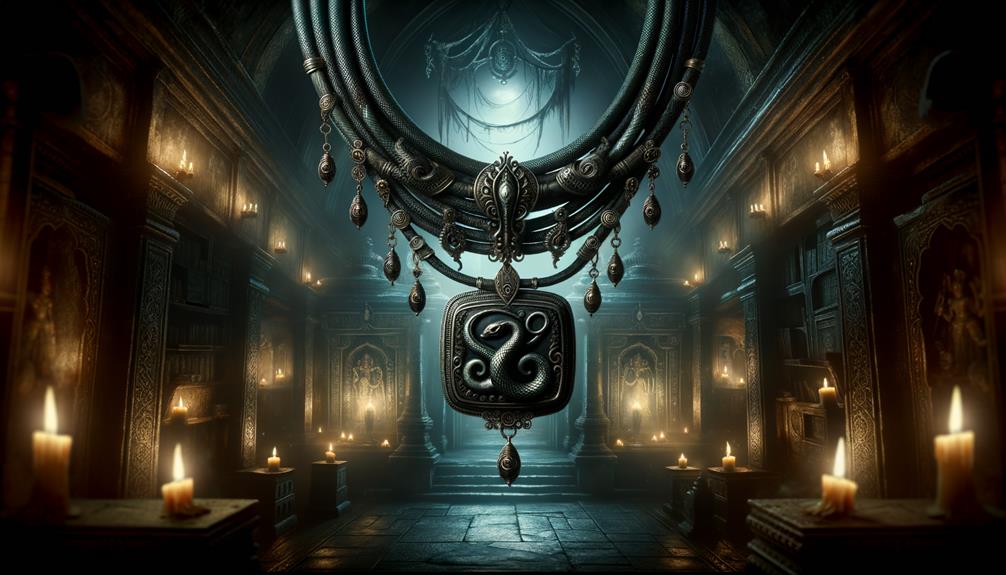
The Necklace of Harmonia is a brilliant wedding gift that becomes entangled with the disasters of the royal house of Thebes. Modern summaries often call it an explicitly cursed jewel forged by Hephaestus to punish Aphrodite and Ares. Ancient sources are less consistent: they vary on who made or first owned it, and its destructive power often works through bribery and human choices rather than visible magic.
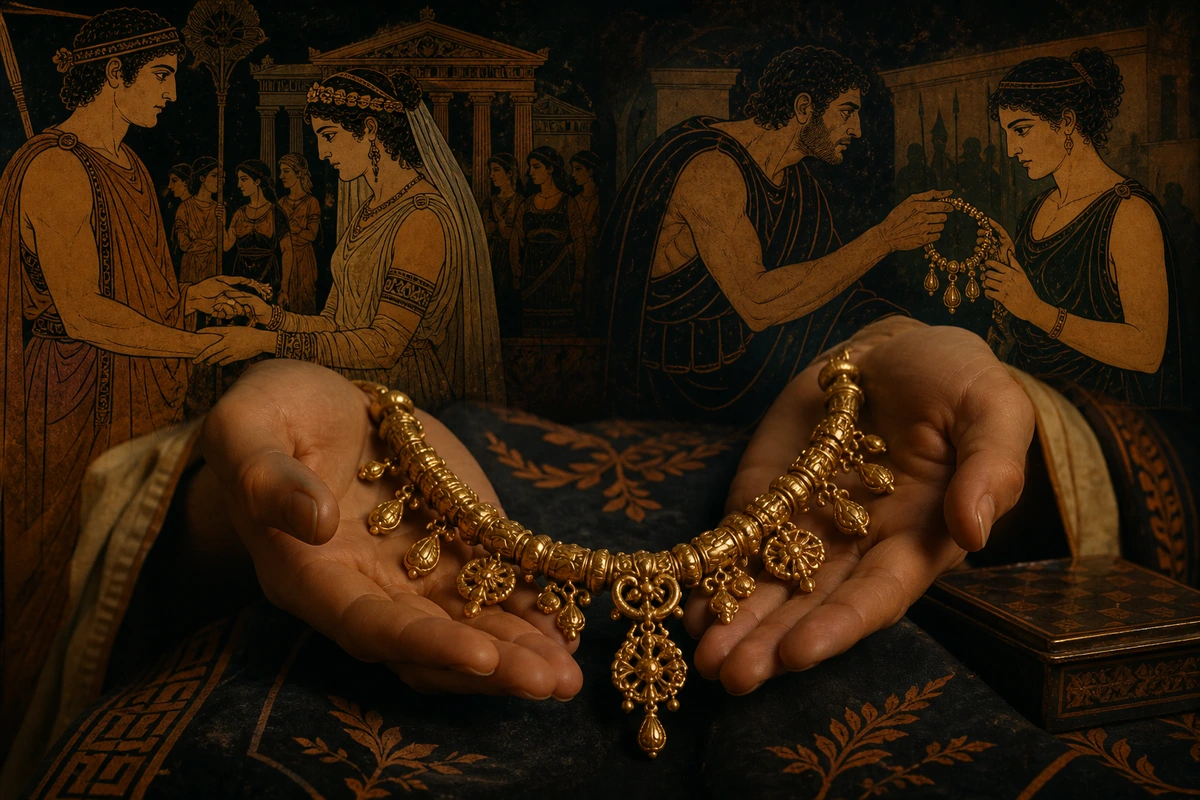
A gift at the wedding of Cadmus and Harmonia
Cadmus, founder of Thebes, marries Harmonia in a wedding attended by the gods. The bride receives a necklace and a robe or peplos. Pseudo-Apollodorus says Hephaestus made the necklace and Cadmus gave it to Harmonia, while also reporting a variant in which Europa received it from Zeus and passed it to Cadmus. Other authors place Aphrodite more directly in the gift’s transmission.
The popular claim that Hephaestus deliberately curses the necklace to avenge Aphrodite’s affair with Ares is a later harmonization of scattered traditions. It is possible as an interpretation, but it should not be presented as the one ancient account.
Eriphyle’s choice
Generations later, Polynices seeks allies for the expedition known as the Seven against Thebes. The seer Amphiaraus knows the campaign will kill him and resists joining. Polynices gives Harmonia’s necklace to Amphiaraus’s wife Eriphyle, who has authority to decide the dispute. She accepts the jewel and sends her husband to war.
Before leaving, Amphiaraus orders his sons to avenge him. He dies when the earth opens and receives him during the failed attack. His son Alcmaeon later kills Eriphyle, turning a bribed betrayal into matricide.
The robe and the Epigoni
The next generation repeats the pattern. Thersander, son of Polynices, offers Eriphyle Harmonia’s robe so that she will persuade her sons to join the Epigoni, the second expedition against Thebes. This campaign succeeds, but Eriphyle’s second bribe confirms the logic that precious gifts can purchase ruin.
Some retellings merge the necklace and robe or assign all later disasters to one supernatural curse. Pseudo-Apollodorus clearly treats them as two related wedding gifts used in two separate bribes.
Alcmaeon and the wandering jewel
After killing his mother, Alcmaeon is pursued by the Erinyes and wanders in madness. The necklace passes through further hands in competing versions before it is dedicated at Delphi. Pausanias reports traditions about jewels claimed to be Harmonia’s necklace and expresses skepticism about whether a green-stone example matched Homer’s description of Eriphyle accepting precious gold.
Ancient communities could therefore treat the necklace as a relic with a location, while learned travelers still questioned claims of authenticity. Myth and the culture of sacred objects overlapped without eliminating critical doubt.
Beauty, exchange, and responsibility
The necklace is often called a “poisoned gift,” but it does not compel every action in the surviving narratives. Polynices and Thersander choose bribery; Eriphyle accepts; Alcmaeon chooses revenge under divine and paternal pressure. The object concentrates desire and obligation, exposing fractures already present in a family and city.
That makes the necklace more troubling than a simple magical trap. It remains beautiful, valuable, and socially powerful—and people repeatedly decide that possessing it is worth someone else’s destruction.