

Accuracy note: The earliest surviving narratives about Konohanasakuya-hime concern her marriage to Ninigi, his suspicion about her pregnancy, and her proof by giving birth in a burning hut. Her strong association with Mount Fuji belongs to the later history of Asama/Sengen worship and should not be projected into every detail of the early myth.
Konohanasakuya-hime—“Princess Who Makes the Tree-Blossoms Bloom”—is a kami whose story joins beauty, mortality, dynastic ancestry, fire, and childbirth. The Kojiki and Nihon Shoki preserve related but not identical versions, while later shrine traditions make her one of the best-known deities associated with Mount Fuji.
Who is Konohanasakuya-hime?
She is a daughter of the mountain deity Ōyamatsumi. The Kojiki calls her Konohana-no-Sakuya-bime; the Nihon Shoki records several additional names. These variations matter because there was never a single fixed spelling or one completely uniform biography.
Ninigi, the heavenly descendant sent to rule the land, meets her at Cape Kasasa and asks to marry her. Ōyamatsumi offers both Konohanasakuya-hime and her elder sister Iwanagahime. Ninigi accepts the blossom princess but rejects the rock princess. In the Kojiki, their father explains that Iwanagahime would have made Ninigi’s descendants endure like stone, while Konohanasakuya-hime would make them flourish like blossoms. The rejection therefore accounts for the short lives of the imperial line’s mortal descendants.
The pregnancy and the fire-birth test
Konohanasakuya-hime becomes pregnant after a single night. Ninigi doubts that the children are his and suggests that an earthly kami may be their father. She responds with a dangerous oath: if the children are truly Ninigi’s, they will survive a birth inside a sealed or doorless hut that she sets on fire.
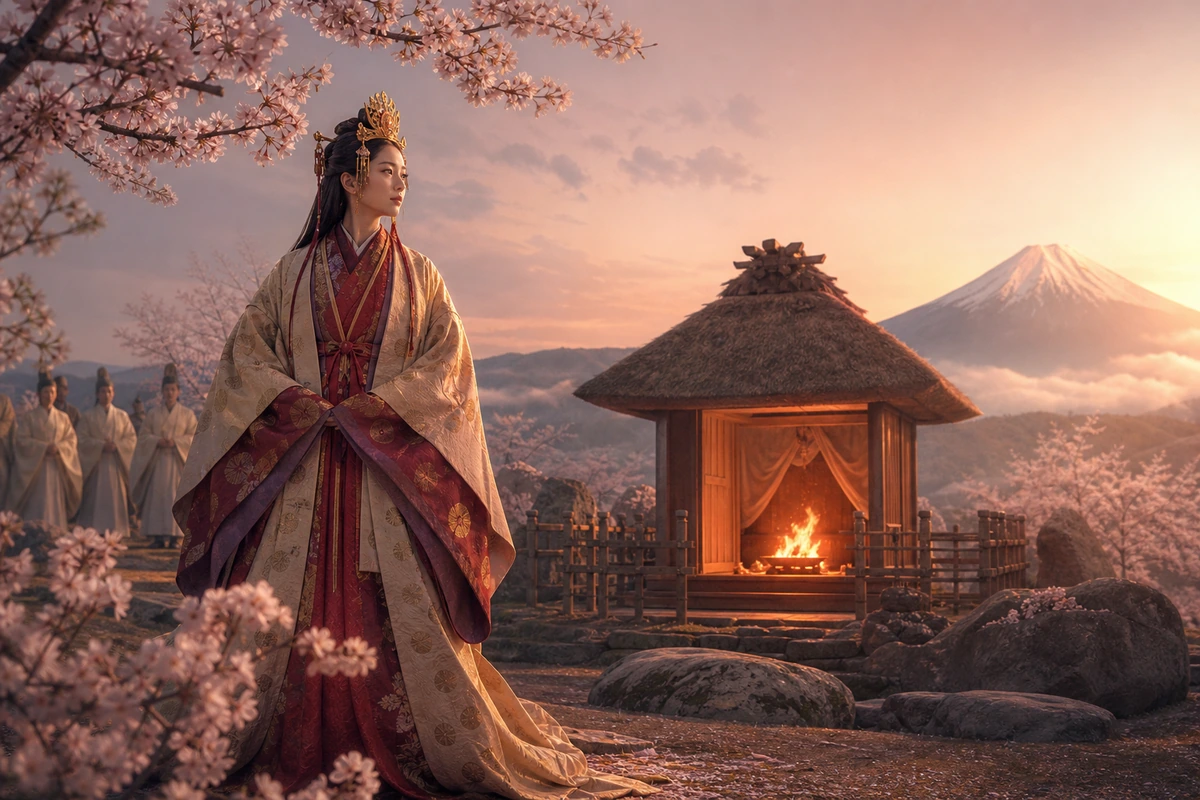
She gives birth safely to three sons. The names differ among textual versions, but the Kojiki names Hoderi, Hosuseri, and Hoori. Hoori becomes central to the story of the lost fishhook and the sea-god’s palace, and his descendants connect the divine descent myth to the lineage of Japan’s legendary first emperor.
The scene is not a generic story about “rebirth after destruction.” In its narrative setting, the fire proves paternity, restores the mother’s honor, and establishes the legitimacy of the children. Later readers may find broader symbolism in it, but those interpretations should be labeled as interpretations.
Blossoms, stone, and mortality
Her blossom-name gains its clearest meaning through contrast with Iwanagahime, whose name evokes enduring rock. Blossoms are beautiful and flourishing but short-lived; rock is unattractive to Ninigi yet permanent. The myth uses that pair to explain why heavenly descendants live mortal lives.
Modern retellings often make cherry blossoms the setting of the marriage or treat the goddess as a simple personification of spring. The texts support a flower-name and a contrast between flourishing and endurance, but they do not describe a romantic cherry-blossom wedding. The difference between a textual detail and a later visual convention is worth preserving.
How Mount Fuji entered her worship
Konohanasakuya-hime is enshrined in the Asama or Sengen shrine network associated with Mount Fuji, including Fujisan Hongū Sengen Taisha. This cult history explains why she is now widely called a “goddess of Mount Fuji” or a “volcano goddess.” It does not mean the Kojiki explicitly places the burning birth hut on Fuji.
Asama worship developed in response to the mountain’s sacred power and eruptive danger. Over time, the fire-birth kami became an apt divine presence for communities seeking protection, safe childbirth, and harmony with the volcano. Shrine tradition, pilgrimage, and the early myth therefore overlap without being identical.
Childbirth and protection
The successful birth amid fire gives Konohanasakuya-hime a clear connection with childbirth. Later devotion emphasizes safe delivery and maternal protection. Her story nevertheless begins with an accusation against a woman and a perilous demand for proof, so it is more complex than a serene fertility emblem.
What the main sources agree on
- She is the daughter of Ōyamatsumi and the wife of Ninigi.
- Ninigi rejects her elder sister Iwanagahime.
- A one-night pregnancy leads Ninigi to doubt the children’s paternity.
- Konohanasakuya-hime gives birth safely amid fire.
- The sons’ names and some details vary across the Kojiki and Nihon Shoki accounts.
Why source layers matter
Konohanasakuya-hime can be studied at three connected levels: as a character in early court myth, as a kami in the historical development of Fuji worship, and as a modern cultural image of blossoms, fire, and the mountain. Keeping those layers visible makes the tradition richer and prevents later devotional imagery from being mistaken for a verbatim ancient story.