
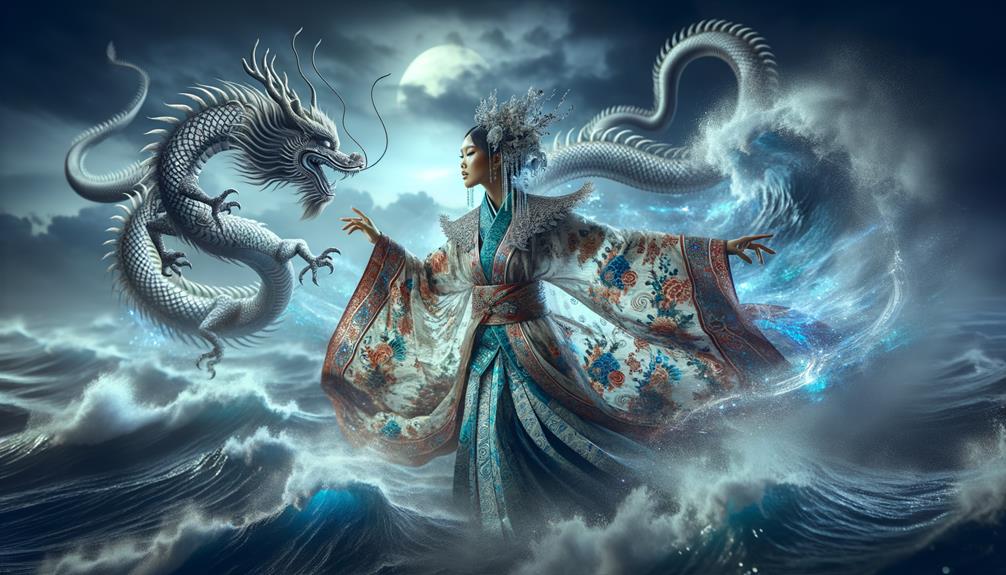
Toyotama-hime is the daughter of the sea deity and the wife of Hoori, the younger brother in Japan’s mythic “luck of the sea and luck of the mountains” cycle. She is often called a dragon princess, but the oldest texts are less tidy. In the Kojiki, the form revealed during childbirth is an eight-fathom wani, an archaic sea creature whose exact zoological translation remains disputed.
Hoori’s journey beneath the sea
Hoori loses the fishhook belonging to his elder brother Hoderi and cannot satisfy him with replacements. Guided to the sea realm, Hoori reaches the palace of the sea deity. There he meets Toyotama-hime beside a well. They marry, and Hoori remains in the sea palace before remembering the unresolved hook.
Daughter of the sea deity
The Kojiki identifies her father through titles translated as Sea Deity or Watatsumi. “Ryūjin, the Dragon King” is common in later retellings and religious traditions, but it should not be inserted into every ancient version as though the terminology were uniform. The Nihon Shoki preserves multiple variants, some of which use more explicitly draconic language.
The fishhook and the tide jewels
The sea deity finds the missing hook and equips Hoori with jewels that control the tides. Hoori returns to land, subdues his hostile elder brother, and establishes the line through which the imperial genealogy continues. Toyotama-hime’s marriage therefore connects the land-descended hero with the powers and ancestry of the sea.
A birth hut at the water’s edge
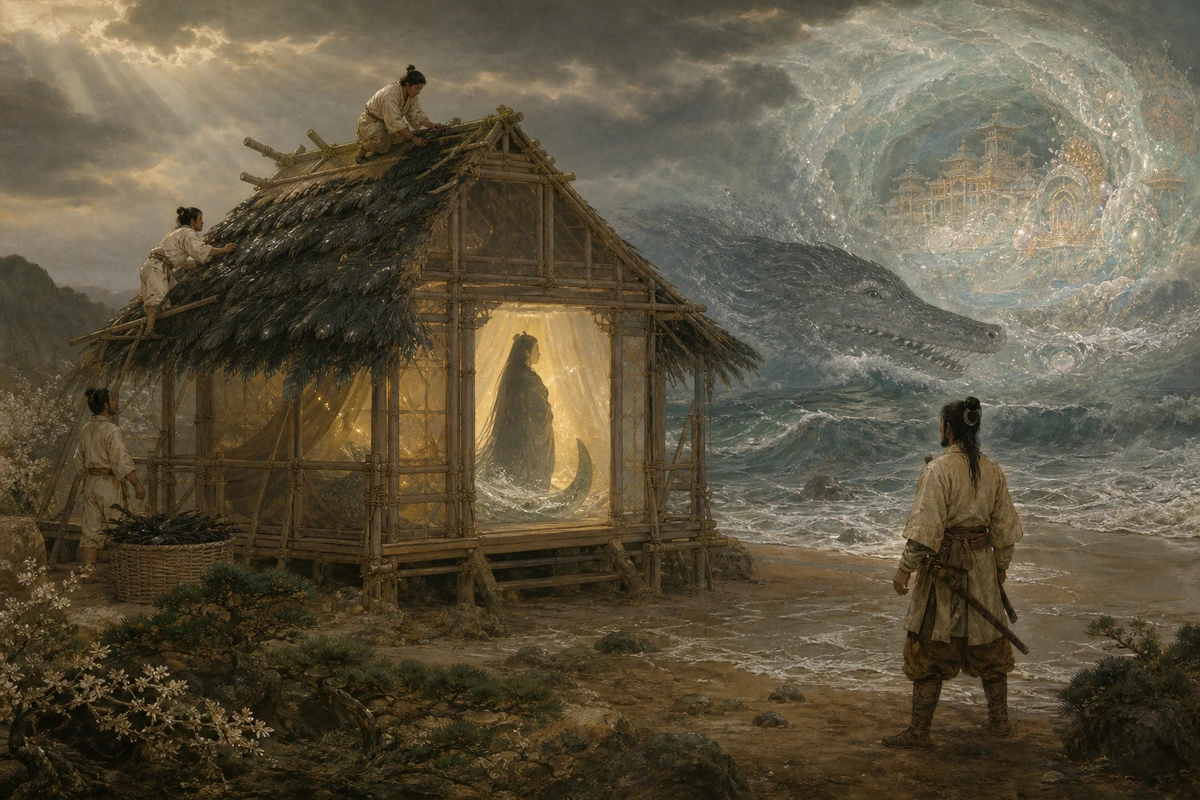
Toyotama-hime later comes ashore to bear Hoori’s child, explaining that a child of heavenly lineage should not be born in the sea. A hut is built for the birth and thatched with cormorant feathers, but labour begins before the roof is finished. The child’s long name, Ugayafukiaezu, memorializes the unfinished thatching.
The broken prohibition
Toyotama-hime tells Hoori that beings of another land assume their native form during childbirth and asks him not to look. He watches anyway. In the Kojiki, he sees her as an enormous wani crawling or writhing in the birth hut. Ashamed that the promise was broken and her form exposed, she returns to the sea.
What was the wani?
Older English translations often say crocodile, while other scholars prefer shark, sea monster, or leave the Japanese term untranslated. Japan did not have a native population of large crocodilians, yet ancient stories could draw on creatures known through travel, imported knowledge, or myth. The text’s purpose is not a field-guide identification. The wani marks Toyotama-hime’s powerful, nonhuman sea nature.
Separation without erased affection
The ending is more tender than summaries that say she simply abandoned her husband. Toyotama-hime closes the route between sea and land because of his betrayal, but the Kojiki says she still longs for him. She sends her younger sister Tamayori-hime to care for the child and exchanges poems with Hoori. Love continues even when the breached boundary cannot be repaired.
From Toyotama-hime to the imperial line
Ugayafukiaezu later marries Tamayori-hime. Their son Jimmu becomes, in the traditional genealogy, Japan’s first emperor. Toyotama-hime is therefore not a decorative princess within Hoori’s adventure: she is a sea-born ancestor who joins divine lineages and makes the transition from mythic generations toward human rulership possible.
Why “dragon princess” needs a footnote
The label is vivid and not wholly baseless, especially when discussing later traditions or variants of the Nihon Shoki. It becomes inaccurate when presented as the only ancient description. “Daughter of the sea deity” reflects the oldest narrative role, while wani preserves the deliberate strangeness of the childbirth scene.
Sources and further reading
- Kojiki, translated by Basil Hall Chamberlain, Hoori and Toyotama-hime cycle
- Kojiki Japanese text, Toyotama-hime’s childbirth episode
- Kokugakuin University, encyclopedia discussion of Toyotama-hime
- Nihon Shoki, trans. W. G. Aston, variants concerning Hoori and the sea deity’s daughter