

Cardea is a minor Roman divine figure associated with the hinge of a door. Most of her familiar story comes from one poetic source, Ovid’s Fasti, where a hinge goddess is blended through wordplay with Carna, a deity connected with flesh, digestion, and the protection of children. Treating every detail as evidence for one ancient “goddess of thresholds” hides a real scholarly problem.
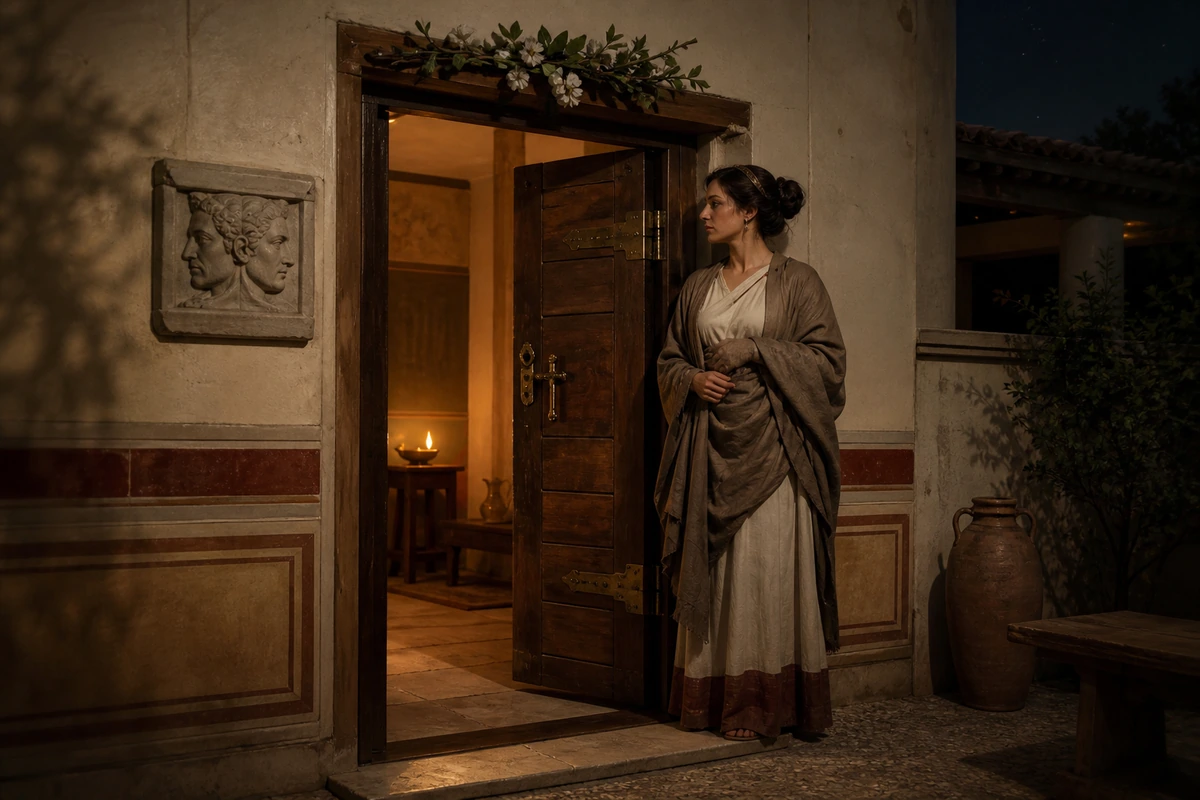
Cardea, Carna, and a Roman pun
Latin cardo means a hinge or pivot, making Cardea an intelligible name for the power that opens and closes a door. Caro means flesh, and other Roman evidence connects Carna with bodily nourishment or vital organs. Ovid begins his entry for June 1 by naming Carna, then immediately says she rules the hinge.
Many scholars conclude that the poet combined two figures because their names sounded alike. Augustine, writing centuries later, lists Cardea for the hinge alongside Forculus for the door and Limentinus for the threshold. That list supports a hinge goddess but not every element of Ovid’s Carna story.
The nymph and Janus
Ovid tells of a nymph named Crane who hunts in the countryside and deceives suitors by sending them ahead into a cave before escaping into the bushes. Janus, who sees both forward and backward, defeats the trick. The ensuing encounter is coercive in the poem and should not be softened into a mutual romance. Ovid then says Janus grants her power over hinges and gives her a white-thorn branch that repels harm from doors.
This is an aetiology—a poetic origin story for a name, ritual, or custom. It also reflects Ovid’s interest in erotic pursuit and verbal ingenuity. It is not an independent cult inscription documenting what every Roman believed.
Protecting the infant Proca
The poem next shifts to an infant named Proca, later a king of Alba Longa. Night creatures called striges attack him and drink his blood. The child’s nurse appeals to Crane/Carna, who touches the doorposts three times with an arbutus branch, sprinkles medicinal water, offers the entrails of a young pig, and places white thorn at the window. A substitute victim saves the child.
The episode joins doorway protection with the safeguarding of flesh, explaining why Carna and Cardea could be poetically fused. White thorn marks the boundary against an intrusive danger, while ritual exchange restores the infant’s body.
June 1 and bean porridge
Ovid identifies the Kalends of June as the deity’s day and connects it with a traditional dish of beans and bacon. The food fits Carna’s relationship with nourishment more easily than Cardea’s hinge. Later sources also discuss bean porridge as an old Roman custom.
Calling June 1 a modern-style “festival of Cardea” can therefore overstate the evidence. The date, food, child-protection story, and hinge etymology meet in Ovid, but they may not all derive from one original cult.
Roman thresholds
Roman religion often assigned precise divine agency to the components of ordinary life. A door could have a power for its leaf, another for its hinge, and another for its threshold. These were not necessarily fully personified gods with long biographies. Cardea is best approached as a focused divine function whose sparse evidence Ovid expands into memorable narrative.