
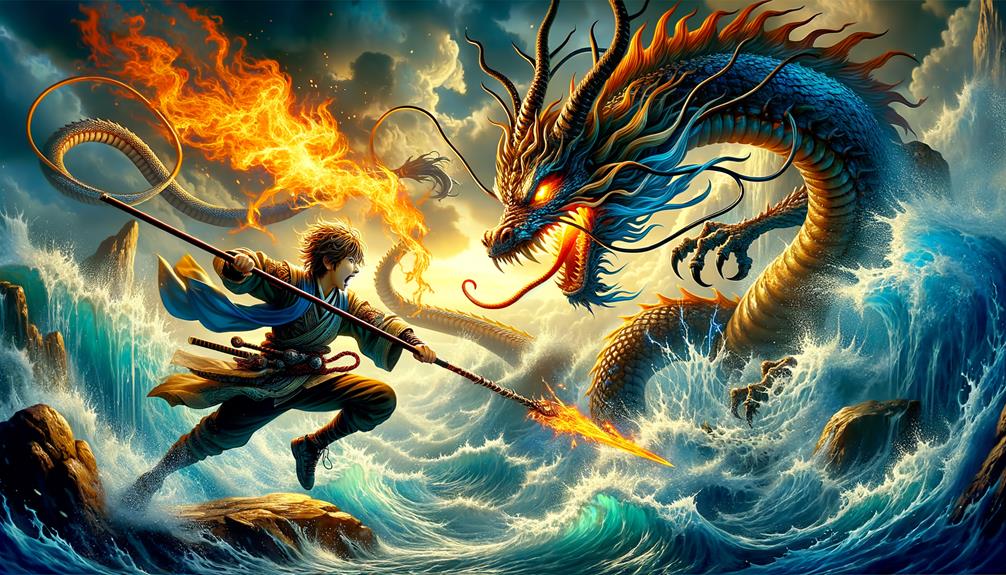
Nezha’s conflict with the Dragon King is one of the best-known episodes in Chinese popular literature and religious storytelling. Its most influential full version appears in the late-imperial novel Fengshen yanyi (Investiture of the Gods). The episode is not a historical report from the age in which the novel is set; it is a literary transformation of an older protective deity whose roots extend through Buddhist and Chinese traditions.
Conflict at Chentang Pass
In the novel, Nezha is the extraordinary son of the military commander Li Jing and Lady Yin. After an unusual birth and rapid growth, he plays near the coast with powerful divine objects. The disturbance reaches the palace of Ao Guang, Dragon King of the East Sea. Nezha defeats a sea messenger and kills Ao Bing, the dragon king’s son, escalating a local encounter into a crisis for both families.
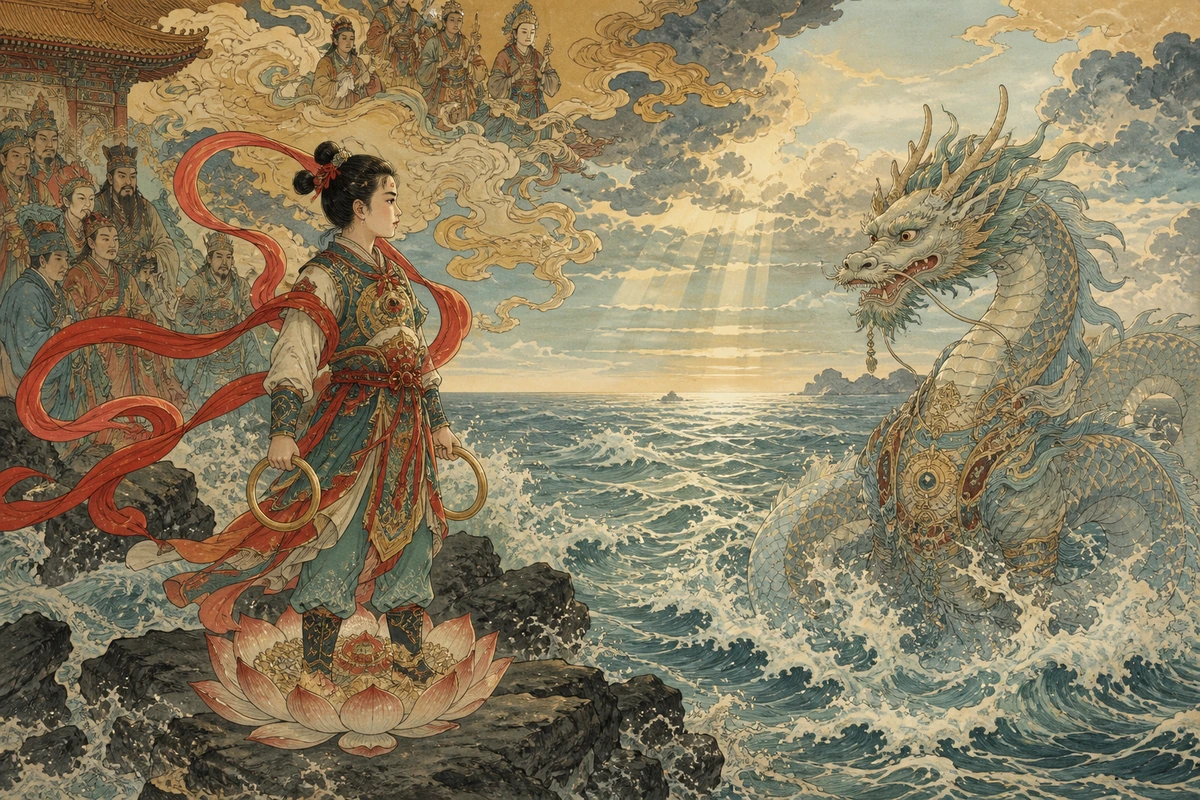
Ao Guang demands justice and threatens Nezha’s household and community. To end the danger to his parents, Nezha relinquishes the body they gave him. This grim part of the narrative is tied to debt, filial obligation, individual responsibility, and the impossible pressures placed on a divine child. Modern adaptations frequently soften, reorder, or openly challenge its moral logic.
Rebirth from lotus
Nezha’s teacher Taiyi Zhenren restores him using lotus roots and blossoms. The new body frees the hero from ordinary birth while preserving his identity. Armed with the Universe Ring, Red Armillary Sash, Fire-Tip Spear, and later the Wind Fire Wheels, he returns as a formidable divine warrior.
The lotus rebirth also helps explain why Nezha can remain eternally youthful in art. His appearance does not mean every story is aimed at children, and the violence of the novel should not be disguised as harmless play.
Older deity, late-imperial novel
Nezha did not originate with Investiture of the Gods. Scholars trace the name and protective character through the Buddhist figure Nalakūbara and through centuries of adaptation in China. Earlier religious material, temple worship, oral performance, and later fiction all contributed to the deity known today.
The Ming novel placed Nezha within a vast story about the fall of Shang and rise of Zhou. Keio University’s research on the work emphasizes its close relationship with popular religion and with performance traditions such as theater and puppetry. Modern film, animation, games, and comics continue that same process of reinterpretation.
Why versions disagree
Some retellings make the dragons tyrants exploiting coastal people. Others portray Ao Bing sympathetically and turn the conflict into a tragedy of inherited duty. Nezha may be rebellious, reckless, sacrificial, or a symbol of self-determination. These differences are not simply errors; they show how a living narrative is reshaped for new moral questions.
For the deity’s broader development, see Nezha stirs up the sea. That wider context prevents one novel episode from being mistaken for the complete religious tradition.