
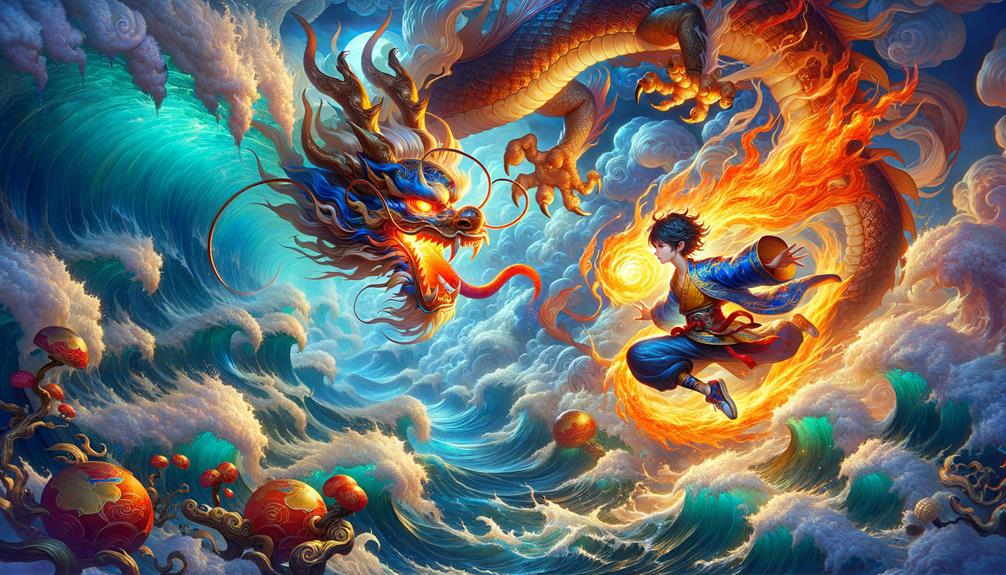
Nezha is a youthful protective deity whose history joins Buddhist transmission, Chinese religious practice, Daoist interpretation, temple worship, theater, and popular fiction. The episode commonly called “Nezha stirs up the sea” is best known from the late Ming novel Fengshen Yanyi (Investiture of the Gods). It should be read as one influential literary version, not as the sole origin or rulebook for every community that worships Nezha.
Source note: The novel deliberately reshapes deities already known to its audience. This article separates Nezha’s earlier Buddhist roots, the novel’s dragon-conflict narrative, later iconography, and living religious roles.
Before the sea battle: a deity in translation
Nezha’s name and early identity are connected to the Buddhist figure Nalakūbara, a son of the guardian king Vaiśravaṇa. As Buddhist stories and divine protectors traveled into China, names, family relationships, and functions were translated and transformed. Vaiśravaṇa became closely associated with the Chinese pagoda-bearing heavenly king Li Jing, while Nezha became Li Jing’s third son in popular religious and literary tradition.
This is not a simple case of one Indian character being copied without change. Chinese sources gave Nezha a new family drama, youthful body, weapons, cult, and place among local protective gods. Buddhist, Daoist, and popular categories overlap in his history; labeling him exclusively with only one of them hides that process.
The late Ming world of Fengshen Yanyi
Fengshen Yanyi sets a vast supernatural war against the legendary fall of the Shang and rise of the Zhou. Gods, immortals, generals, spirits, and ritual specialists are gathered into competing camps. Keio University scholar Kazuo Yamashita emphasizes that many figures were already worshipped and that the novel altered familiar images for entertainment.
Nezha becomes one of the work’s most memorable young warriors. His story is dramatic because private violence, family duty, religious power, and cosmic appointment collide. Modern films often streamline those tensions into a rebellion narrative, but the novel’s Nezha is also a son negotiating inherited debts and a deity being remade through death.

How Nezha disturbs the sea
In the novel, the child Nezha possesses powerful objects. When he bathes and moves the red sash through the water, its force shakes the Dragon King’s palace beneath the sea. A dragon attendant sent to investigate is killed. The conflict escalates when Ao Bing, a son of the Dragon King of the East Sea, confronts Nezha and also dies.
Retellings sometimes describe this as Nezha heroically rescuing children from a dragon who demands sacrifices. That is familiar from later stage, animation, and film versions, but it is not a neutral summary of every source. In Fengshen Yanyi, Nezha’s own uncontrolled divine weapons help begin the crisis. The story asks who bears responsibility when a supernaturally powerful child causes lethal harm.
The Dragon Kings and collective danger
The Dragon King of the East Sea, commonly called Ao Guang in popular tradition, does not treat the deaths as an isolated duel. He seeks judgment and threatens Nezha’s father, family, and community. Other Dragon Kings become involved, expanding the quarrel from one shoreline to the ordered administration of waters and weather.
Dragon kings in Chinese and wider East Asian religion have roles connected with rain, seas, rivers, wells, protection, and local ritual. They are not merely a fantasy species of villains. The novel can cast the dragon court as Nezha’s opponent while real communities petition dragon deities for water and safety.
Death as repayment
To stop the punishment from falling on his parents, Nezha returns flesh and bones to them and dies. The episode is often paraphrased as “repaying the body received from father and mother.” It turns filial obligation into an extreme physical accounting: if his body created the debt, surrendering it seems to release the family.
This is a violent mythic and literary episode, not a behavioral model. Adaptations change its imagery and emotional emphasis, especially for young audiences. Some make Nezha’s act a pure sacrifice; others stress conflict with his father or resistance to imposed fate. An accurate article can describe the plot without romanticizing self-harm.
The lotus-body rebirth
Death does not end Nezha’s story. His teacher, Taiyi Zhenren, works to restore him. The novel’s sequence includes an attempted shrine and, after its destruction, reconstruction through lotus roots and flowers. Nezha returns in a transformed body, no longer dependent on ordinary birth in the same way.
Lotus imagery carries Buddhist associations of purity and manifestation while also functioning brilliantly in Chinese visual storytelling. Roots, joints, flowers, and fragrance make a body that is organic but miraculous. Rebirth resolves the family debt enough for Nezha to enter the larger divine war, though conflict with Li Jing does not disappear immediately.
| Tradition or medium | Nezha’s emphasis | Accuracy caution |
|---|---|---|
| Buddhist transmission | Nalakūbara and the family of Vaiśravaṇa | Not yet the complete later Chinese biography |
| Fengshen Yanyi | Dragon conflict, family debt, death, lotus rebirth, divine war | A late Ming literary synthesis, not an early chronicle |
| Temple and popular religion | Youthful protection, martial power, local festivals and petitions | Practice varies by region and community |
| Modern film, opera, puppetry, games, and comics | Rebellion, destiny, family reconciliation, spectacular combat | Creative adaptations may substantially rewrite the novel |
Weapons and identifying attributes
The British Museum identifies Nezha as a youth riding fiery wheels, raising a ring, and holding a long sash. These are the Wind-Fire Wheels, Universe Ring, and Armillary Sash in common English naming. He may also carry a fire-tipped spear. Some images multiply his heads and arms to express martial capacity.
Attributes change across sculpture, prints, temple images, opera costume, and animation. The red sash and golden ring used in the sea episode are especially recognizable, while the wheels give artists a way to show speed and divine mobility. A generic child with a spear is not enough for a secure identification; the combination of weapons, wheels, costume, inscription, and religious setting matters.
Nezha as a protective deity
Museum records describe Nezha as a protection deity in Chinese popular religion. Temples and regional communities may connect him with children, young people, military power, vehicles, processions, or defense against dangerous forces. In Taiwan and parts of Southeast Asia, ritual traditions have developed distinctive local forms.
These roles cannot be read straight out of one chapter of a novel. Literature borrows from worship and sends altered images back into it. Opera, puppet theater, prints, television, and film reinforce some attributes while local ritual specialists preserve others. Nezha’s cultural strength lies in this circulation between sacred presence and mass entertainment.
Why modern Nezha keeps changing
Nezha offers storytellers a compelling contradiction: he is a child and a formidable warrior, born into a family yet remade beyond ordinary birth, responsible for harm yet capable of self-sacrifice and protection. Each adaptation can shift the balance among anger, justice, filial duty, autonomy, and reconciliation.
That flexibility does not mean every version says the same thing. A responsible comparison names whether it is discussing Buddhist antecedents, Fengshen Yanyi, temple practice, a twentieth-century animation, or a contemporary film. “Nezha stirs up the sea” is a powerful story layer; Nezha’s religious and cultural history is larger than the splash.

