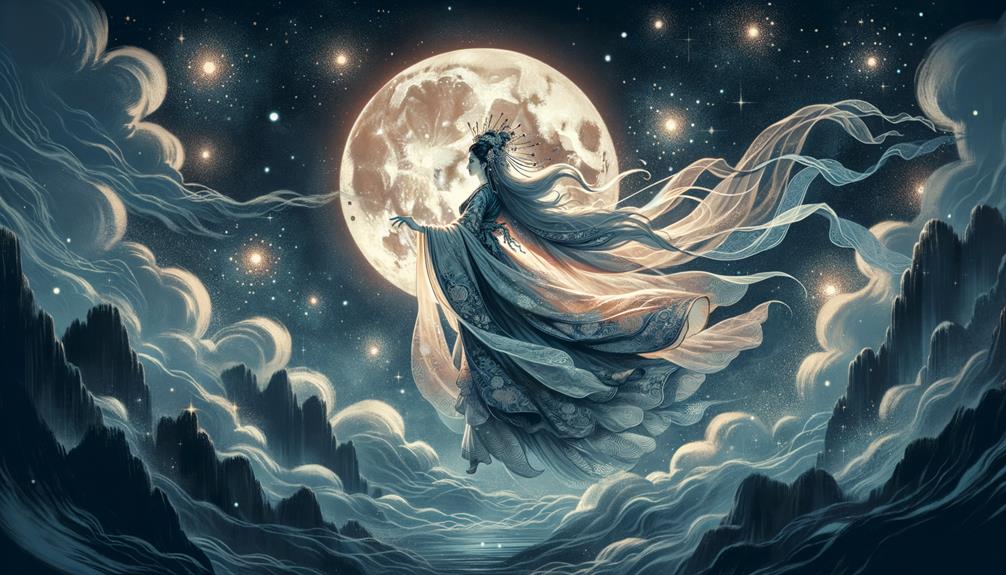
Chang’e is the Chinese moon goddess whose best-known story links her with the archer Yi (often called Hou Yi), an elixir of immortality, and a journey to the moon. There is no single canonical version. Early texts, later literature, festival traditions, and visual art preserve different motives and outcomes, so the legend is most accurate when those layers are kept distinct.
What the Early Account Says
One influential account is preserved in the seventh-century encyclopedia Yiwen Leiju, which attributes the passage to the Huainanzi. The Huainanzi itself was compiled at the court of Liu An during the second century BCE and presented to the Han throne in 139 BCE.
In the cited passage, Yi receives the medicine of immortality from Xiwangmu, the Queen Mother of the West. Chang’e—called Heng’e in some early forms of the name—takes it and flees to the moon palace, where she becomes an immortal lunar spirit. This concise account calls her Yi’s wife, but it does not contain every detail found in modern retellings.
Why Chang’e Takes the Elixir
The oldest surviving references do not give one complete biography or a single agreed motive. In the terse account attributed to the Huainanzi, Chang’e steals the medicine and escapes. Later tellings sometimes portray the act as selfish and followed by regret. Other popular versions introduce a would-be thief and say she swallows the elixir to prevent him from taking it. Still others frame her choice as an attempt to escape danger or sacrifice herself for someone else.
These versions should not be blended into one supposedly ancient narrative. They show how storytellers repeatedly reinterpreted the same central image: a woman leaves the human world, becomes immortal, and is separated from Yi by the distance between earth and moon.
The Toad, Jade Rabbit, and Moon Palace
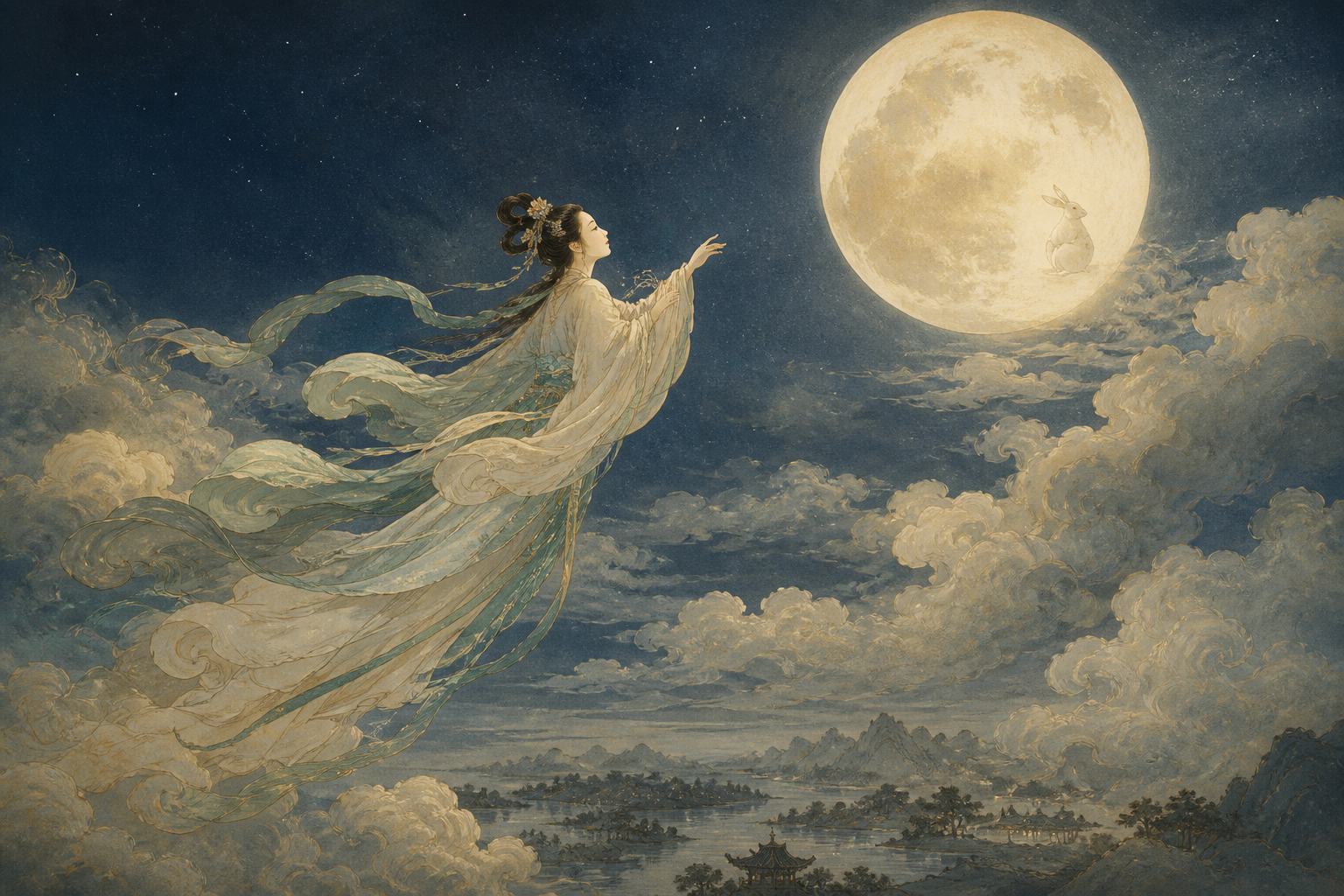
Chang’e’s appearance also changes across time. Some early traditions associate her with a toad, an animal long connected with the moon in Chinese imagery. Later art often depicts her as an elegant immortal woman. A Tang-dynasty bronze mirror in the Metropolitan Museum of Art combines several lunar figures: Chang’e, a toad, and a rabbit using a pestle and mortar to prepare the ingredients of an immortality elixir.
The jade rabbit therefore belongs to a broader body of Chinese moon lore as well as to Chang’e’s later visual world. The cassia tree and the endlessly laboring woodcutter Wu Gang are other familiar inhabitants of the lunar realm. These figures appear together in many modern summaries, but they did not necessarily enter the tradition at the same time or originate in one story.
Chang’e and the Mid-Autumn Festival
Chang’e is closely associated with the Mid-Autumn Festival, observed on the fifteenth day of the eighth lunar month when the moon is full. Moon viewing, family gatherings, seasonal foods, and offerings have histories broader than one myth. Chang’e became one of the festival’s best-known divine figures, but it would be misleading to say that every Mid-Autumn custom began with a single version of her flight.
Her story suits the festival because it brings together immortality and loss, distance and reunion. The full moon can represent wholeness while also reminding viewers of separated loved ones. That tension helps explain why poets, artists, and storytellers have returned to Chang’e for centuries.
Why the Legend Endures
Chang’e can appear as a transgressor, a victim, a protector, a lonely immortal, or a radiant goddess, depending on the source. No one interpretation erases the others. Reading the versions side by side reveals how Chinese lunar mythology developed through textual transmission, religious imagination, art, and festival practice rather than through one fixed storyline.