
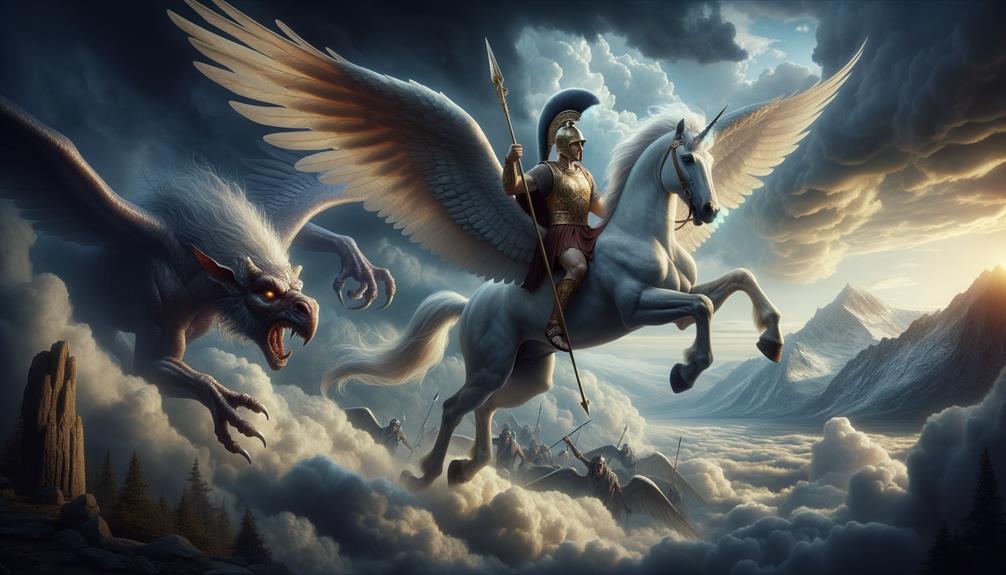
Bellerophon is the Greek hero who kills the Chimera and, in later accounts, accomplishes the feat from the back of Pegasus. That compact description hides an important source problem: Homer tells the hero’s ordeals without naming the winged horse, while Pindar makes the taming of Pegasus a central sign of Athena’s aid. The familiar adventure is a synthesis of traditions rather than one ancient script.
Bellerophon also has a story after the victory. In the Iliad, he goes from divine favor and royal success to isolation on the Aleian plain, hated by the gods. Later authors connect that fall with an attempt to fly to Olympus. Reading the source differences turns a monster fight into a larger study of hospitality, false accusation, signs, divine help, and the limits placed on heroic ambition.
Bellerophon in Homer’s Iliad
The earliest substantial surviving account appears in Iliad Book 6. It is embedded in a battlefield genealogy: the Lycian warrior Glaucus explains his ancestry to Diomedes. Bellerophon is presented as the son of Glaucus and grandson of Sisyphus, gifted by the gods with beauty and courage.
King Proetus turns against him after the king’s wife Anteia desires Bellerophon and, when rejected, falsely accuses him of making an advance. Proetus will not kill a guest directly. Instead, he sends Bellerophon to Lycia carrying a folded tablet marked with deadly signs and instructs him to present it to Anteia’s father.
The dangerous message and the rules of hospitality
The Lycian king—unnamed in Homer and called Iobates in later sources—welcomes Bellerophon for nine days before asking to see the message. The delay emphasizes hospitality: the host completes the rites of reception before learning that his guest has arrived with instructions for his own death.
Like Proetus, the Lycian ruler avoids direct murder. He assigns tasks expected to be fatal. The result is a chain of delegated violence in which royal men preserve the appearance of proper conduct while trying to make monsters, enemies, or an ambush do the killing for them.
The Chimera
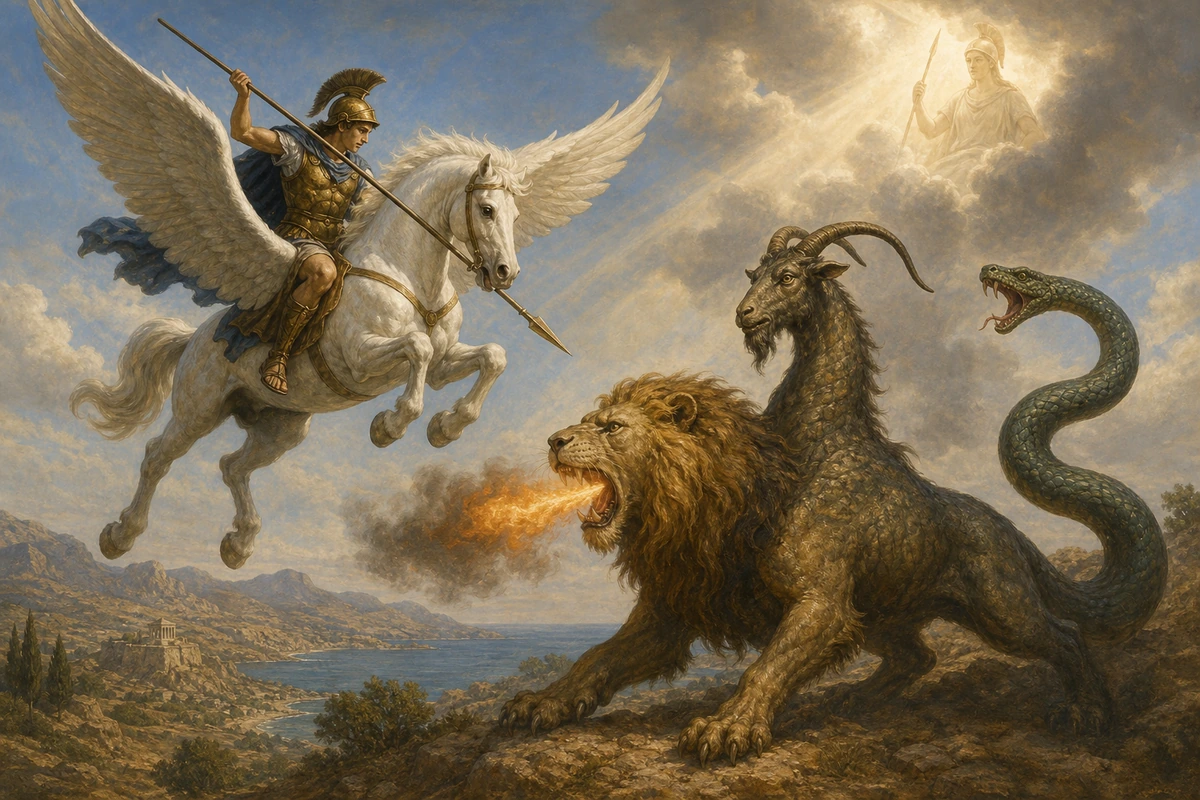
Homer calls the Chimera divine rather than human and describes a creature with a lion’s forepart, a goat’s middle, and a serpent’s rear, breathing terrible fire. Ancient artists varied the anatomy, often showing a lion-bodied animal with a goat head rising from its back and a snake for a tail. “Chimera” later became a general term for an impossible composite, but the mythic opponent is a particular creature with a specific genealogy.
The Iliad says Bellerophon kills her by following divine signs but gives no combat technique and does not mention Pegasus. Pindar explicitly places the hero on the winged horse. A still later account attributed to Apollodorus adds the famous device of lead fixed to a spear: the Chimera’s own fiery breath melts the metal in her throat. That ingenious detail should not be presented as Homer’s version.
How Bellerophon tames Pegasus
In Pindar’s thirteenth Olympian, Bellerophon struggles to capture Pegasus at the spring Peirene near Corinth. The seer Polyidus directs him to sleep at Athena’s altar. The goddess appears in a dream and gives him a golden bridle, while also instructing him to sacrifice to Poseidon.
When Bellerophon wakes, the bridle is present. Divine instruction, ritual action, and technical equipment make the taming possible. Pegasus is not simply a loyal pet the hero finds already saddled. The episode also anchors the story in Corinth and associates the horse with both Athena and Poseidon Hippios, “Horse-Tamer.”
| Source | What it emphasizes | What it does not say |
|---|---|---|
| Homer, Iliad 6 | False accusation, deadly tablet, Chimera, Solymi, Amazons, ambush, and later isolation | Does not name Pegasus in the Bellerophon narrative or explain the hero’s fall |
| Pindar, Olympian 13 | Athena’s golden bridle, Pegasus at Peirene, aerial combat, and divine help | Passes quickly over the hero’s death |
| Later mythography | Detailed weapon strategies and a flight toward Olympus | Should not be retrojected into every earlier text |
The Solymi, the Amazons, and the ambush
After the Chimera, the Lycian king sends Bellerophon against the Solymi and then the Amazons. Homer calls the fight with the Solymi the fiercest battle Bellerophon faces. He survives both assignments, so the king places selected Lycian warriors in ambush. None returns.
At last the king recognizes that Bellerophon must be of divine stock. He gives the hero his daughter in marriage and half the royal honor, while the Lycians grant him a valuable estate. The man sent to die becomes a dynastic figure, and his descendants connect the story back to Glaucus on the Trojan battlefield.
What causes Bellerophon’s fall?
Homer makes the reversal abrupt. After describing Bellerophon’s children, the poem says that he became hated by all the gods and wandered alone across the Aleian plain, avoiding human paths. No attempted ascent, gadfly, or explicit act of pride appears in this passage.
Later tradition supplies a cause: elated by success, Bellerophon tries to ride Pegasus to Olympus. Zeus prevents the violation of the divine realm; versions differ over whether a gadfly stings Pegasus, the horse throws the rider, or Bellerophon simply falls. Pegasus continues to Olympus, while the hero returns to earth injured or disgraced.
The later ending creates a clear warning against overreaching. Homer’s silence is more unsettling. The poem preserves the fact of divine hostility without giving readers the comfort of a simple offense-and-punishment equation.
Bellerophon is not Perseus
Pegasus springs from Medusa’s severed neck in the story of Perseus, which explains why modern art often blends the heroes. But Perseus does not ride Pegasus in the principal ancient narratives of his rescue of Andromeda. Bellerophon is the hero consistently associated with taming and riding the horse in classical literature.
The distinction matters in images and search results. A winged-horse rider fighting a fire-breathing composite monster is Bellerophon. A hero confronting Medusa with divine equipment or rescuing Andromeda belongs to the Perseus cycle.
Key takeaways
- Homer provides the earliest full surviving account of Bellerophon’s deadly tasks but does not name Pegasus in it.
- Pindar explains the taming of Pegasus through Athena’s bridle and ritual instruction.
- The lead-tipped spear and attempted flight to Olympus belong to later elaborations, not Homer’s narrative.
- Bellerophon, not Perseus, is the classical hero who rides Pegasus against the Chimera.