
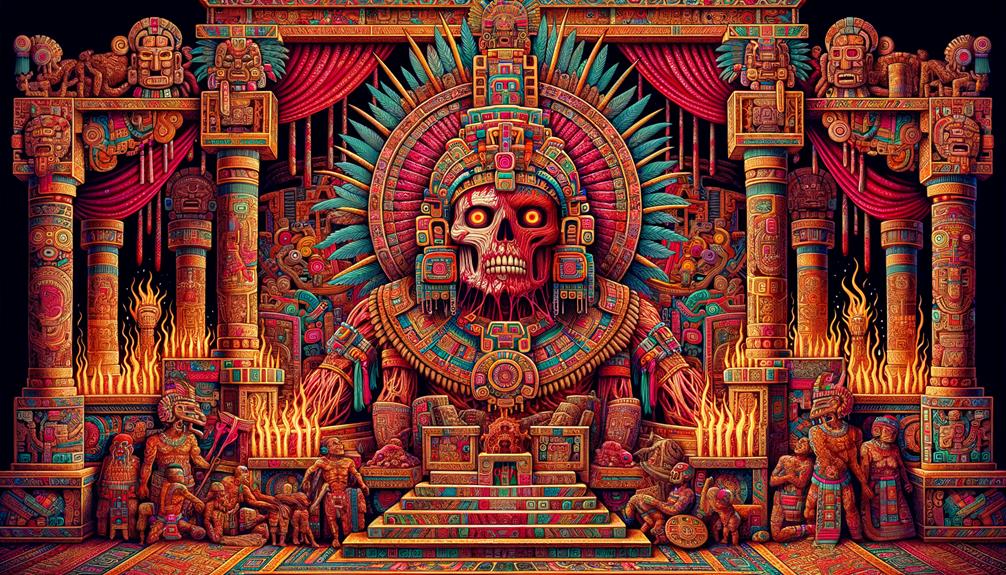
Xipe Totec, “Our Lord the Flayed One,” was a major Mesoamerican deity whose cult joined agricultural renewal, warfare, sacrifice, and elite craft production. His flayed-skin imagery is visually confronting, but treating him as a simple “god of spring” misses the historical setting. The strongest evidence comes from ritual calendars, colonial descriptions, sculpture, and archaeology across several regions of Mesoamerica.
What was Xipe Totec associated with?
Xipe Totec was worshipped by the Mexica, but his cult was not confined to Tenochtitlan. Images with Xipe-like traits appear in other parts of Mesoamerica and may predate the Mexica Empire. Archaeologists therefore speak carefully about the cult’s origins and development rather than assuming that every flayed figure represents one unchanged deity.
In Mexica religion, Xipe Totec was closely associated with Tlacaxipehualiztli, a festival held in the season that roughly overlapped February and March. Bernardino de Sahagún’s informants described captives being sacrificed and flayed; ritual participants then wore the skins for a period of days. The ceremony was bound to warfare because the victims were captives, and it publicly displayed the relationship between military achievement, tribute, and ritual obligation.
Skin, seed, and renewal
Modern summaries often explain the flayed skin as a direct symbol of a seed shedding its husk or the earth putting on new vegetation. Agricultural renewal was certainly part of Xipe Totec’s cult, and INAH notes that Tlacaxipehualiztli was performed with the successful completion of crops in view. Yet surviving sources do not give us one exhaustive key to every detail of the rite. The seed analogy is best presented as an interpretation that helps explain the cult’s renewal imagery—not as a quotation from a pre-Hispanic theology manual.
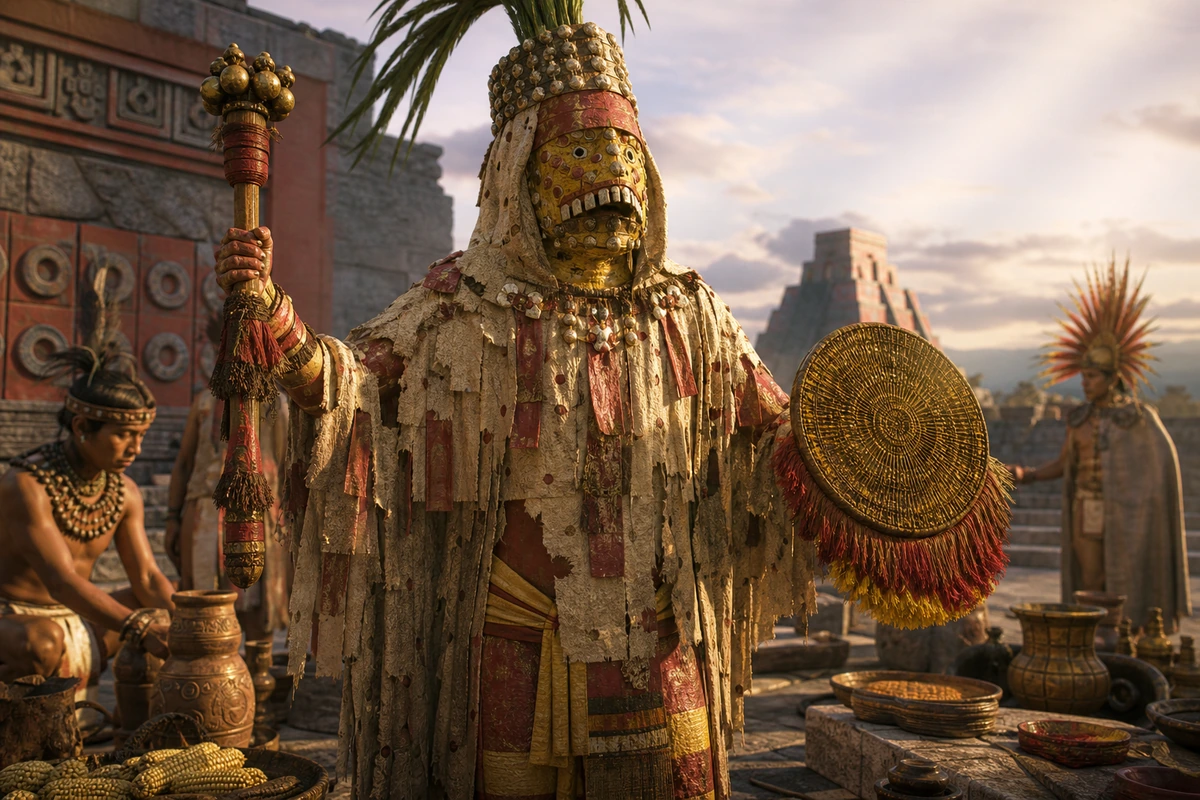
Representations of Xipe Totec are recognizable by the doubled mouth, hands, or eyes produced by a skin worn over the body. Sculptures may also show a pointed cap, tassels, a shield, and a rattle-staff. These images transformed the deity’s impersonator into a living ritual presence. They were not intended as naturalistic portraits.
Warfare and social display
Tlacaxipehualiztli included staged forms of combat as well as sacrifice. In one well-known rite, a captive was tethered to a stone and fought opponents with deliberately unequal equipment. Such ceremonies made military hierarchy visible in the heart of the city. They also linked the prestige of successful warriors to the ritual economy of the state.
Xipe Totec was additionally connected with goldworkers. Sahagún’s accounts place people who worked precious metals among the groups who honored him. That association cautions against reducing the deity to agriculture alone: his cult brought together fertility, valuable materials, conquest, bodily transformation, and public performance.
How to understand the cult today
The rites should be described plainly without either romanticizing or sensationalizing them. Human sacrifice was real, but a horror-focused account can distort the evidence just as badly as an overly symbolic one. For Mexica participants, Tlacaxipehualiztli belonged to a sacred calendar and a political order in which warfare, divine sustenance, and communal survival were inseparable.
Xipe Totec’s imagery is therefore about more than death. It presents identity as something that can be put on, transformed, and renewed—at a cost that Mexica ritual made publicly visible.