The Eleusinian Mysteries were initiations held for Demeter and Persephone at Eleusis, near Athens. Ancient witnesses connect them with hope for a better fate after death, but they do not reveal a complete script of the central ceremony. We can reconstruct the festival’s route, officials, buildings, and some public actions; claims to know the secret revelation itself remain hypotheses.
Demeter, Persephone, and Eleusis
The Homeric Hymn to Demeter, composed in the archaic period, is the foundational surviving narrative. Hades takes Persephone with Zeus’s consent. Demeter searches for her daughter, withdraws fertility from the earth, and comes to Eleusis disguised as an old woman. After mother and daughter are partly reunited, Demeter restores growth and teaches rites to the Eleusinian leaders.
What “mystery” meant
The Greek mystai were initiates, and mystēria referred to rites into which they were initiated. “Mystery” here does not mean a puzzle waiting for a modern solution. Secrecy was a condition of participation. Ancient authors could praise the experience or allude to it without describing everything that occurred inside.
Who could be initiated?
Eligibility was broad by the standards of many Greek civic cults. Men and women, Athenians and non-Athenians, and enslaved people could participate if they met ritual requirements. Ancient evidence also indicates exclusions connected with blood guilt and the ability to understand the ritual language. Access still required time, travel, fees, sponsors, and preparation, so “open to all” needs qualification.
Lesser and Greater Mysteries
Initiation was not necessarily a single visit. The Lesser Mysteries, associated with Agrai near Athens, served as a preliminary purification. The Greater Mysteries took place in the month Boedromion, roughly September or October. Participants could later return for a higher degree conventionally called epopteia, “beholding.” Details and procedures changed across the sanctuary’s long history.
The Sacred Way and public festival
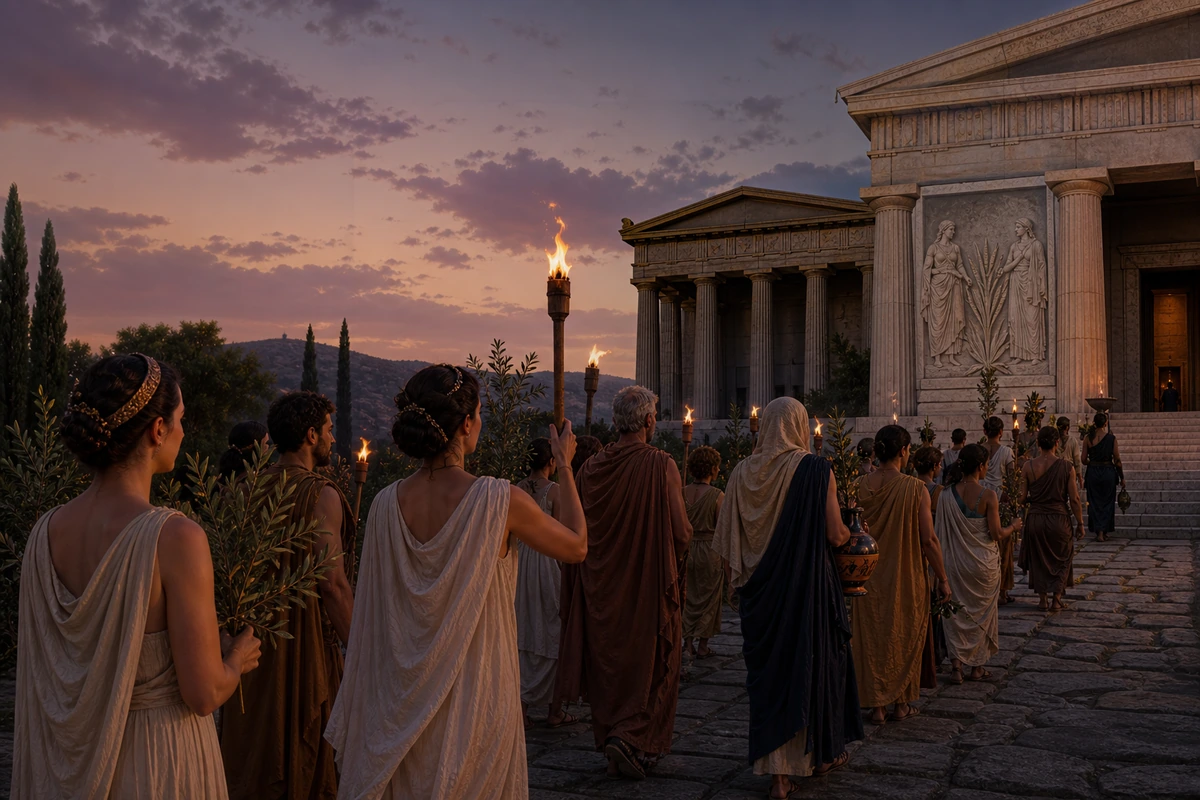
Before the most secret phase, events unfolded in public. Sacred objects were brought from Eleusis to Athens; heralds issued proclamations; initiates purified themselves; and a large procession travelled back along the Sacred Way. Participants carried myrtle, sang, exchanged ritual jokes at a bridge, and arrived by torchlight. The route joined Athenian civic space to Demeter’s sanctuary.
Fasting and the kykeon
The hymn says Demeter refused wine and requested a drink of water, barley meal, and pennyroyal. Initiates likewise fasted and drank a kykeon. The ingredients are better attested than popular claims about psychoactive additives. Ergot and other drug theories remain debated experimental hypotheses; no surviving ancient recipe proves that a hallucinogen produced the experience.
Inside the Telesterion
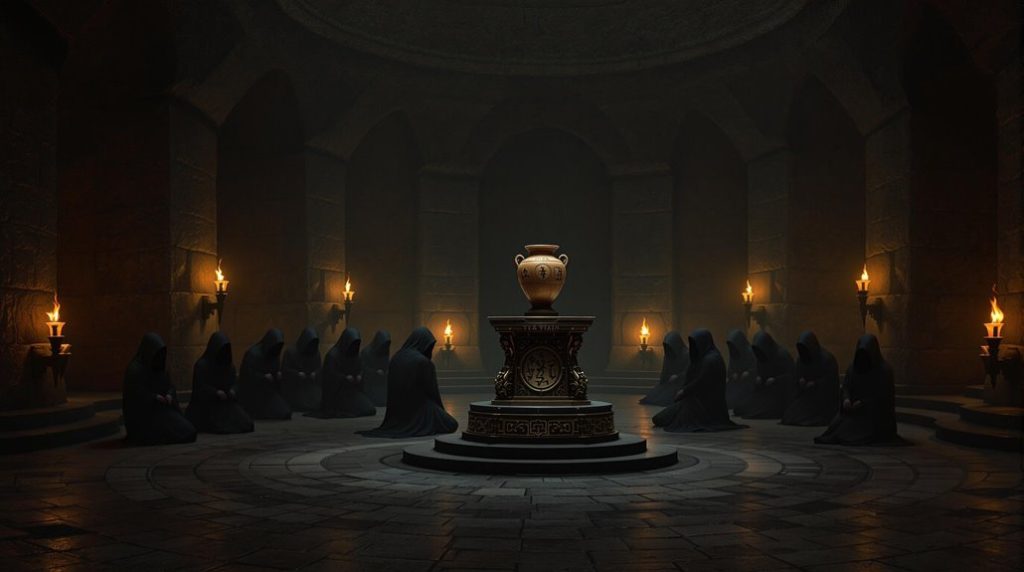
The main initiation took place in the Telesterion, a large hall repeatedly rebuilt to hold a substantial gathering. Later writers summarize mysteries through “things said, things done, and things shown,” but they do not provide an agreed inventory. A sacred fire, officiants, darkness, sound, light, and displayed objects are plausible parts of the setting. Specific dramatic scripts circulated by modern writers go beyond secure evidence.
Hope after death
The Homeric Hymn calls the person who has seen the rites blessed and contrasts that fate with the uninitiated dead. Pindar and Sophocles offer similarly hopeful allusions. The Mysteries did not publish a systematic theology of heaven and hell. Their promise was experienced through initiation and expressed in poetic, deliberately guarded language.
A long and changing institution
Eleusis developed from a local sanctuary into a major cult connected with Athens and, later, the Roman Empire. Political leaders and emperors became initiates. Buildings were damaged and restored; administration and ritual emphasis evolved. The sanctuary’s final decline in late antiquity involved imperial restrictions, warfare, and broader religious change rather than one perfectly documented closing ceremony.
Sources and further reading
- Homeric Hymn to Demeter, Perseus Digital Library
- Allen and Sikes, commentary on the Homeric Hymn to Demeter
- Eleusis: The Archaeological Site and Museum, with the Greek Ministry of Culture
- Kevin Clinton, Myth and Cult: The Iconography of the Eleusinian Mysteries