
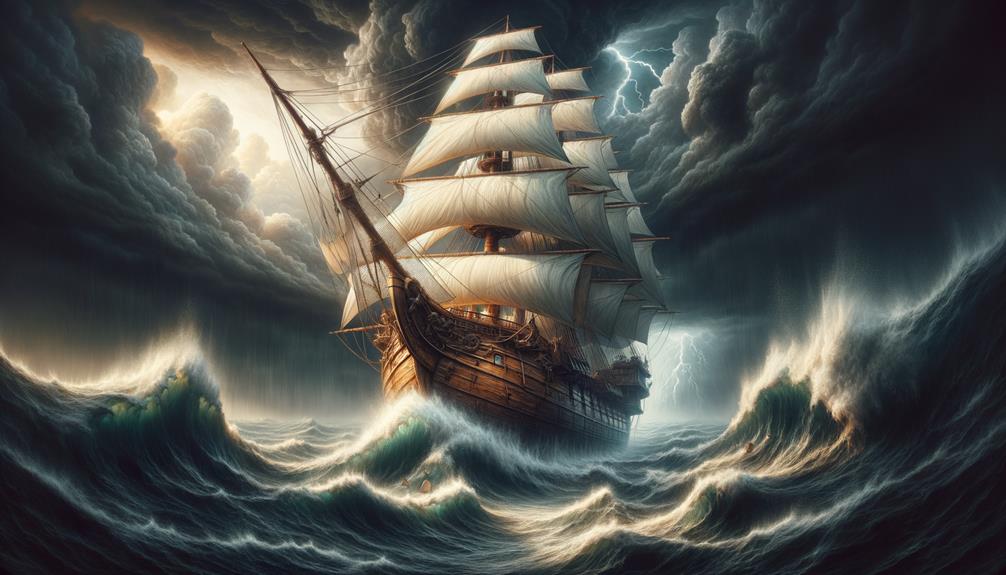
The Argo is the ship of Jason and the Argonauts, built for the voyage to recover the Golden Fleece from Colchis. Ancient accounts celebrate its construction, crew, and divine assistance, but they do not provide one fixed passenger list or a single technical design. The ship’s most remarkable component is not an entirely magical hull: it is one speaking beam of Dodonian oak placed by Athena.
Why Jason needs a ship
Pelias has taken power at Iolcus and fears a prophecy connected with a man wearing one sandal. When Jason appears, Pelias sends him to bring back the Golden Fleece, turning a political threat into an apparently impossible overseas task. The voyage requires a ship capable of carrying an exceptional company beyond familiar Greek waters.
The mission is not merely a search for adventure. It begins in a struggle over kingship and family, and its success will depend as much on alliances, local knowledge, and Medea as on heroic strength.
Argus, Athena, and the timbers of Pelion
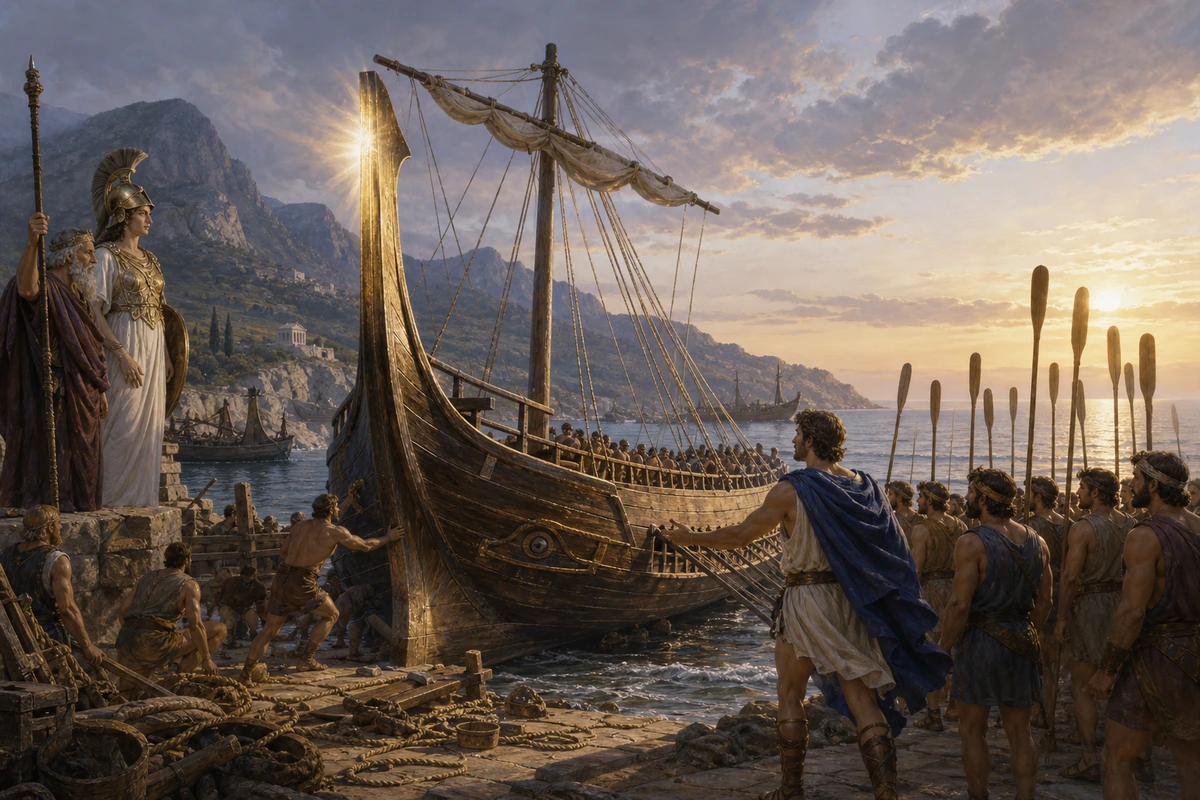
The ship is named Argo, and ancient authors commonly connect the name with its builder Argus. In Apollonius Rhodius, Argus works with the help of Athena. The timbers are cut near Mount Pelion, and the ship is assembled at Pagasae.
Athena brings one divine beam from an oak at Dodona and fits it into the stem. Dodona was an oracular sanctuary of Zeus where the oak’s sounds could communicate divine will. Saying that the entire Argo was carved from “mystical Dodonian wood” magnifies one component into the whole vessel.
The speaking beam
At the launch in Argonautica 1, the Argo itself urges the heroes to depart because the sacred beam can give voice. Much later in Book 4, after the killing of Medea’s brother Apsyrtus, the beam warns the crew that Zeus’s anger will not end until Circe purifies Jason and Medea.
The voice does not provide constant navigation or make the ship sail by itself. It intervenes at charged moments, turning the vessel into a moral and religious participant in the voyage.
Who were the Argonauts?
Jason’s crew takes its collective name from the ship. Apollonius includes figures such as Orpheus, Heracles, Castor and Polydeuces, Peleus, Telamon, Zetes and Calais, the seer Mopsus, and the helmsman Tiphys. Other ancient lists differ in both size and membership.
Claims that the Argo had exactly fifty heroes are conventional rather than universal. Ancient poets selected crews to suit their narratives and local traditions. Even Heracles leaves the voyage early in Apollonius after the disappearance of Hylas.
From Pagasae to Colchis
The outward journey moves through a chain of dangers and failed encounters: Lemnos, the tragic return to the Doliones, the loss of Hylas in Mysia, Polydeuces’s boxing match with Amycus, the blind seer Phineus, and the Clashing Rocks. The Argo is both transportation and the common space in which a diverse crew must make decisions.
Once the ship reaches Colchis, King Aeetes sets Jason deadly tasks. Medea’s knowledge and magic make survival possible. She helps Jason yoke the fire-breathing bulls, overcome the earthborn warriors, and take the fleece before escaping aboard the Argo. A version that makes Jason and the ship succeed without Medea leaves out the decisive agent.
The return and its moral cost
The homeward route is even more complicated and varies across sources. In Apollonius, the crew must navigate pursuit, murder, pollution, purification, storms, and unfamiliar seas. The speaking beam’s warning after Apsyrtus’s death makes clear that possession of the fleece has not produced a clean heroic triumph.
The Argo therefore carries glory and guilt at the same time. Its story is not a simple celebration of exploration; it repeatedly asks what the crew owes to hosts, gods, kin, and one another.
What happens to the Argo?
Later tradition links the ship with a dedication to Poseidon at the Isthmus and with the ancient constellation Argo. Euripides’ Medea contains a prophecy that a fragment of the Argo will end Jason’s life, a detail expanded by later retellings.
These endings belong to the ship’s reception rather than one universally agreed biography. What remains consistent is its unusual status: built by a mortal craftsperson with Athena’s help, carrying a coalition of heroes, and given a limited divine voice through one sacred timber.