
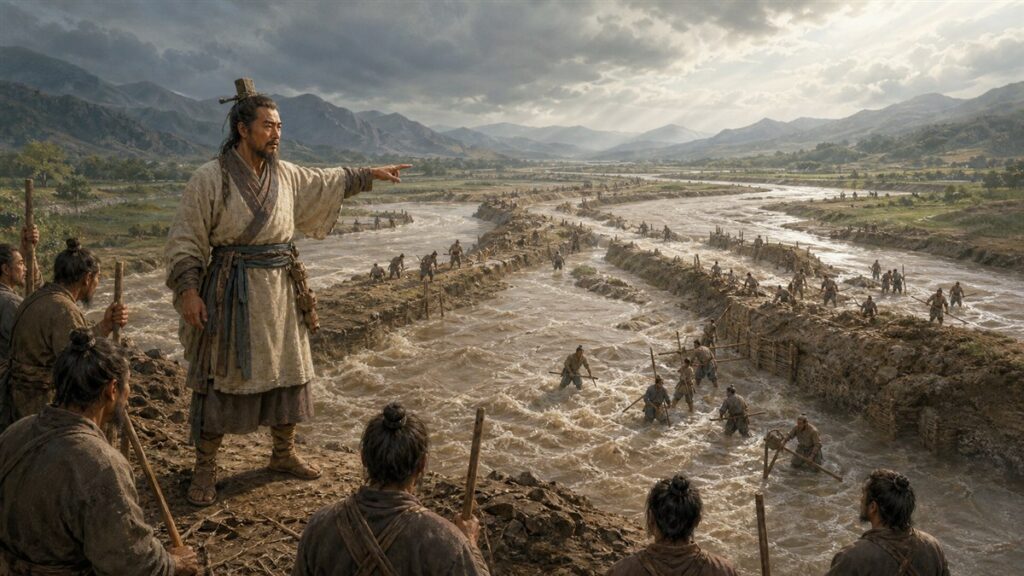
Yu the Great is remembered as the ruler who brought a devastating flood under control and made the landscape habitable. Early Chinese texts use his achievement to explain more than hydraulic engineering: Yu surveys mountains and rivers, organizes regions, restores agriculture, and proves that disciplined service can justify political authority. The story grew over many centuries, so its textual, legendary, and archaeological layers should not be treated as one eyewitness report.
Accuracy note: Archaeology confirms that ancient communities along the Yellow River faced severe floods. A proposed outburst flood around 1920 BCE is important evidence, but it does not prove that one historical individual performed every deed attributed to Yu or independently establish the later chronology of the Xia dynasty.
The flood in the early textual tradition
The Canon of Yao, preserved in the Book of Documents, describes inundating waters that overtop hills and leave the people suffering. The text frames the flood as a crisis of government: the ruler must find someone capable of restoring order. Gun is selected despite warnings about his character, and later traditions make his failure the prelude to Yu’s success.
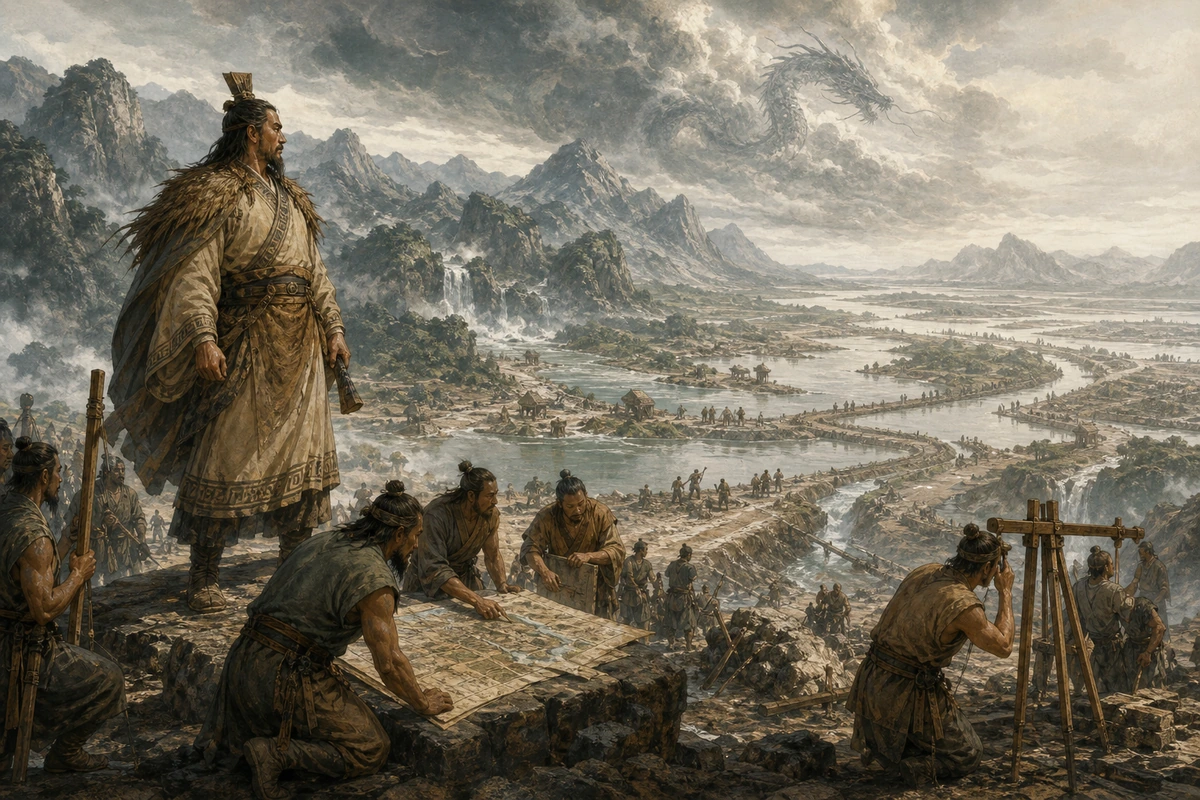
The Tribute of Yu presents a different kind of account. It follows Yu across a carefully ordered landscape of mountains, rivers, soils, fields, routes, and regional products. Waterways are led toward larger rivers and the sea, while the inhabited world is arranged into the Nine Provinces. This is sacred political geography as much as a construction diary. It imagines a realm made legible and governable through Yu’s labor.
Channeling water rather than blocking it
Later retellings commonly contrast Gun’s failed embankments with Yu’s successful dredging and channel cutting. The contrast expresses a memorable principle: water must be given paths through the landscape rather than merely opposed by higher walls. It also turns father and son into rival models of rule—one rigid and ineffective, the other observant and adaptable.
That principle should not be converted into a modern engineering patent. Ancient sources do not document Yu inventing a single standardized system of canals, irrigation gates, and mountain excavations exactly as a contemporary project report would. The narratives magnify his work to continental scale. They praise the ordering of waters, land, travel, agriculture, tribute, and government as one civilizing achievement.
Thirteen years and the home he passed
A famous tradition says Yu labored for thirteen years and passed his own doorway three times without entering. Some versions add that he heard his infant son but refused to interrupt the mission. The episode is not a neutral biographical detail. It makes private sacrifice the test of public duty and became a lasting image of the official who places a widespread emergency above household comfort.
Modern summaries sometimes say Yu never saw his son or abandoned his family permanently. That overstates the motif. The point is his refusal to pause during the flood-control campaign, not a complete absence from family life. The story was transmitted and interpreted in later historical and philosophical writing, where it could be praised as urgency or debated as an extreme demand on moral responsibility.
Dragons, maps, and supernatural helpers
Popular narratives give Yu a growing company of helpers: a dragon that traces channels, a tortoise that carries soil, river deities that reveal maps, and divine tools capable of dividing mountains. These beings make the landscape itself participate in the work. They also belong to variable story layers; there is no single early source that lists every helper and assigns each a fixed engineering job.
Yinglong, river gods, and miraculous animals can therefore be included as later mythic developments, but claims such as “fish-faced Hebo supplied the official flood map” or “giant turtles dredged every riverbed” need a named source. Treating one modern compilation as the definitive ancient account erases the way the Yu tradition accumulated motifs across texts, regions, temples, drama, and oral storytelling.
From successful worker to founder
Yu’s achievement validates his succession to Shun in the idealized sequence of sage rulers. Later historiography makes him founder of the Xia, traditionally China’s first dynasty, and tells how hereditary succession followed when his son Qi took power. In this political memory, flood control is what qualifies Yu to rule: he knows the land because he has traveled it, and he earns authority through visible benefit to the people.
The Records of the Grand Historian was compiled many centuries after the era it describes. It is indispensable for understanding how early imperial China remembered Yu and the Xia, but its narrative distance matters. “Traditional founder of the Xia” is more accurate than presenting every date, speech, and family episode as contemporary documentation.
| Evidence layer | What it contributes | What it cannot establish alone |
|---|---|---|
| Canon of Yao | A realm-wide flood crisis and the search for a capable administrator | A modern chronology or engineering blueprint |
| Tribute of Yu | Mountains, rivers, regions, routes, soils, and political geography | That one expedition surveyed every named place exactly as described |
| Later histories and legends | Gun’s failure, Yu’s sacrifice, succession, family, and supernatural helpers | One uniform version shared in every period |
| Archaeology and geology | Evidence for real flooding, settlement change, and landscape risk | Proof that every legendary episode occurred or that Yu has been identified |
The debated outburst-flood evidence
A 2016 scientific study proposed that an earthquake-triggered landslide dam at Jishi Gorge failed around 1920 BCE and released an enormous flood. The date was used to suggest a possible historical setting for memories of a “Great Flood” and a revised beginning for the Xia. The study generated strong interest because it connected geology, archaeology, and a foundational narrative.
The responsible conclusion is narrower than many headlines. A major flood in the right broad region and period can help explain how flood memories formed, but a geological event cannot name its engineer. Scholars continue to debate the flood’s scale, downstream effects, relation to sites such as Lajia, and whether it should be tied to the Xia. Legend and geology may illuminate one another without becoming interchangeable.
What Yu’s legend actually teaches
Yu’s enduring importance lies in a model of authority grounded in attention, movement, and service. He studies terrain, coordinates collective work, opens routes, and turns catastrophe into an ordered social landscape. Later rulers could invoke him when discussing water management, but the story also judged them: legitimate power was expected to reduce suffering rather than merely claim a noble lineage.
It is tempting to turn Yu into a modern environmental slogan about “working with nature.” That phrase captures part of the channeling tradition, yet it should not hide the legend’s political scale or the immense labor it imagines. Yu is simultaneously a flood hero, sacred geographer, exemplary official, dynastic ancestor, and figure through whom generations debated what good government owes people in danger.
Sources and further reading
- The Canon of Yao, Chinese Text Project
- The Tribute of Yu, Chinese Text Project
- Records of the Grand Historian, Annals, including the Annals of the Xia
- Wu et al., “Outburst flood at 1920 BCE supports historicity of China’s Great Flood”, Science (2016)