
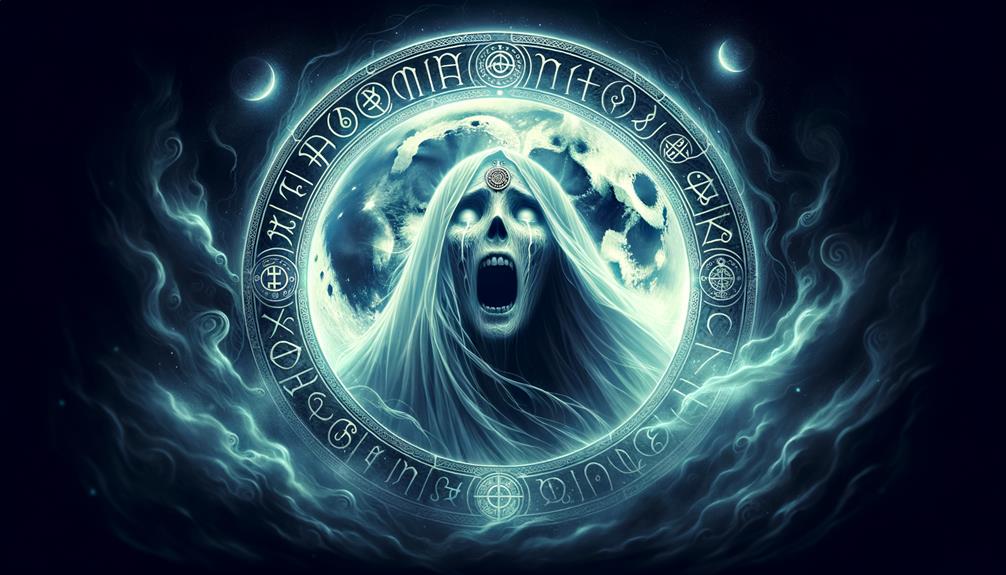
The banshee is a supernatural death-messenger in Irish folklore. Her English name comes from Irish bean sí, “woman of the sí” or otherworldly mound. She is most often heard lamenting before or around a death connected with a household or family. The crucial point is easy to lose in modern horror: the banshee usually announces or mourns death; she does not kill with her scream.
What does “banshee” mean?
Banshee is an English adaptation of Irish bean sí. The second element refers to the sí, the mounds and the otherworldly people associated with them. Older spellings such as bean sídhe often appear in English books. The phrase identifies an otherworld woman, but storytellers do not always classify her in the same way. She may be called a fairy woman, an ancestral attendant, or the spirit of a deceased woman connected with a family.
That uncertainty is part of the tradition. Folklore records what narrators said in particular places and times; it does not always supply a systematic theology. A collector’s label “fairy” or “ghost” may be less important to the story than the woman’s lament and the death that follows.
What does the banshee sound like?
Accounts describe keening, crying, wailing, moaning, or a thin unearthly call. The sound may be heard once or repeated, close to a window or far across the landscape. It can seem human at first and become impossible to locate. Some narrators recognize it immediately; others understand it only when news of a death arrives.
The lament resembles caoineadh, the improvised vocal mourning historically performed by human keening women at wakes and funerals. This resemblance helps explain titles such as an bhean chaointe, “the keening woman.” The supernatural figure and the human mourner should not be treated as identical, nor does the resemblance prove a simple one-time origin. It places the death omen inside a culture where grief had a public, skilled voice.
Does a banshee cause death?
In the usual Irish pattern, no. Her cry is a warning, accompaniment, or lament. The death may occur in the house, far away, or even before listeners understand what they heard. A story gains force when the timing of the sound and the later news match.
Movies, games, and fantasy fiction frequently give the banshee a sonic attack that injures or kills. That “deadly scream” is an effective modern monster power, but it reverses the older narrative relationship. The traditional bean sí knows or mourns what humans do not yet know; she is not normally the murderer.
| Feature | Recorded Irish folklore | Common modern alteration |
|---|---|---|
| Function | Announces, warns of, or laments a death | Attacks people as a predatory ghost |
| Sound | Keening, crying, wailing, or mournful calling | A supernatural shockwave that kills instantly |
| Relationship | Often attached to a family, household, or locality | A roaming species encountered at random |
| Appearance | Young or old woman; clothing and hair vary | One fixed skeletal monster design |
| Evidence | Personal-experience narratives, family accounts, and local tradition | A bestiary entry with standardized powers |
What does the bean sí look like?
Many stories report only a sound. When she is seen, descriptions range from a beautiful young woman with long hair to a small old woman, a pale figure in a cloak, or a dark shape that cannot be examined closely. Grey, white, green, red, and black clothing all appear in retellings. Combing long hair is familiar in later popular imagery, but it is not required in every encounter.
Variation makes the banshee adaptable to local landscape and family memory. A figure beside a road belongs to a different experience from a cry circling a house. A woman at a bridge or stream may overlap with washerwoman traditions. Treating every detail as simultaneous—a red-eyed crone in a green dress combing white hair while washing bloody clothes—creates a composite costume rather than an account anyone necessarily told.
Family banshees and inherited death omens
The bean sí is often said to “follow” a family. Her lament can announce the death of a member who is absent, allowing the story to connect kin across distance. This family attachment gives the figure an almost genealogical role: she knows who belongs to the line even when the living household has not heard the news.
A popular claim says only five ancient Gaelic surnames have banshees. Folklore archives contain a much wider and less orderly field of family and local associations. Lists of privileged surnames should therefore be treated as literary or popular formulas, not rules enforced across Ireland. The tradition also changed when English-speaking and settler families adopted banshee stories of their own.
What the Irish folklore archive records
Dúchas.ie, the digitization project of the National Folklore Collection at University College Dublin, provides hundreds of searchable references to banshees. Much of the Schools’ Collection was gathered in 1937–38, when pupils recorded traditions from parents, grandparents, neighbors, and other local informants. The archive preserves geographic and narrative variety that a modern dictionary definition cannot show.
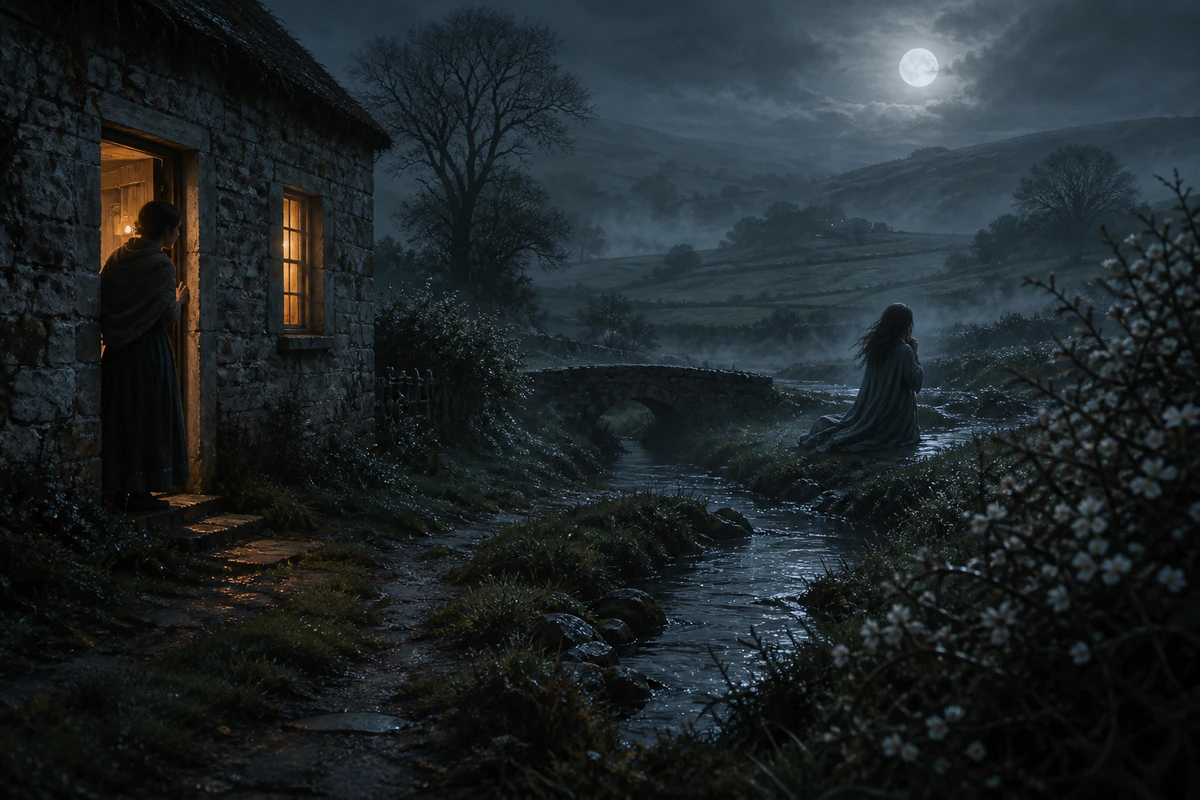
One Galway Schools’ Collection account places the crying woman near a bridge and later describes her washing and lamenting on a stone by the river. Another record says the banshee “follows” a named Wexford family and keens around the house before a death. These documents show what people remembered and believed; they are not police reports proving a supernatural cause.
The washerwoman and Scottish Gaelic tradition
The Scottish Gaelic bean-nighe, or washerwoman, is seen washing the clothes or shrouds of those about to die. Irish stories also place supernatural women washing near water, so the motifs overlap. They should not be collapsed into a single pan-Celtic character with one biography. Language, region, collection history, and the exact narrative all matter.
Other names likewise carry local histories. The badhbh or related forms in parts of Ireland can connect the death messenger with older words and figures associated with battle and doom. Similarity does not prove that every banshee is the medieval war figure Badb surviving unchanged. Folklore can preserve, borrow, and reinterpret motifs without maintaining a single uninterrupted identity.
Is the banshee an ancient Celtic goddess?
There are medieval Irish supernatural women and literary figures who foretell death, lament the fallen, or appear at water. Those precedents are relevant. Yet the family banshee documented in modern oral tradition cannot be mapped automatically onto one named pre-Christian goddess. Many surviving accounts were told in deeply Christian communities and include prayer, rosaries, wakes, priests, and ideas about souls alongside older otherworld language.
Calling the bean sí a “pagan survival” may sound explanatory while skipping a millennium of cultural change. It is more useful to trace particular motifs—lament, family attachment, otherworld woman, washing, night encounter—than to insist on one original deity behind all of them.
Why the banshee endures
The banshee gives form to the moment before loss becomes public knowledge. Her cry turns private death into something heard across a household and landscape. She can express the fear of bad news arriving from far away, the duty of a family to mourn its members, and the sense that death disrupts more than one individual life.
The Smithsonian Center for Folklife and Cultural Heritage’s family-banshee essay, drawing on Irish folklore scholarship, and the Dúchas National Folklore Collection portal are strong starting points. They reveal a figure more intimate than the shrieking monster of horror: a messenger whose terror comes from grief, recognition, and the certainty that someone belongs to a mortal family.