
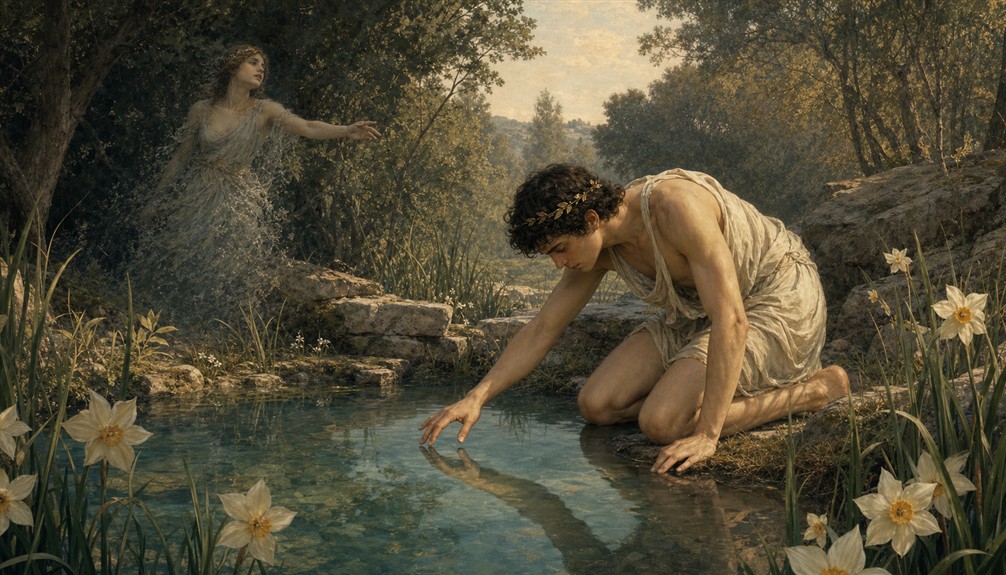
Echo and Narcissus are joined most famously in Book 3 of Ovid’s Metamorphoses. Their encounter is not a mutual romance interrupted by bad luck. Echo cannot initiate a complete statement, Narcissus rejects her, and each becomes trapped by a form of desire that cannot develop into reciprocal recognition.
Ovid composed the poem in Latin around the beginning of the first century CE, drawing on Greek names and traditions for a Roman literary audience. Earlier and alternative accounts of Narcissus survive, but Ovid’s decision to weave Echo’s failing voice together with Narcissus’s fatal reflection shaped most later European art and literature.
The prophecy about Narcissus
Narcissus is the son of the river Cephisus and the nymph Liriope. His mother asks the seer Tiresias whether the beautiful child will live to old age. Tiresias answers that he will, provided that he does not come to know himself. The prediction sounds obscure until the encounter with the spring turns self-recognition into catastrophe.
By adolescence Narcissus attracts admirers of different genders, but pride keeps him untouched. Ovid does not describe an ordinary lack of romantic interest. Narcissus repeatedly responds to desire with contempt, creating the conditions for the prayer that someone should make him experience equally impossible love.
How Echo loses an independent voice
Echo begins as a talkative nymph. Ovid says she used long conversation to delay Juno while other nymphs escaped Jupiter’s attention. Juno punishes the instrument of the deception: Echo can no longer begin speech or express a full thought of her own. She may only return the final words spoken by someone else.
The punishment is narrower and more painful than simple muteness. Echo still understands, desires, and answers, but must construct meaning from another person’s language. Ovid exploits the device in dialogue, allowing the same words to express Narcissus’s withdrawal and Echo’s hope.
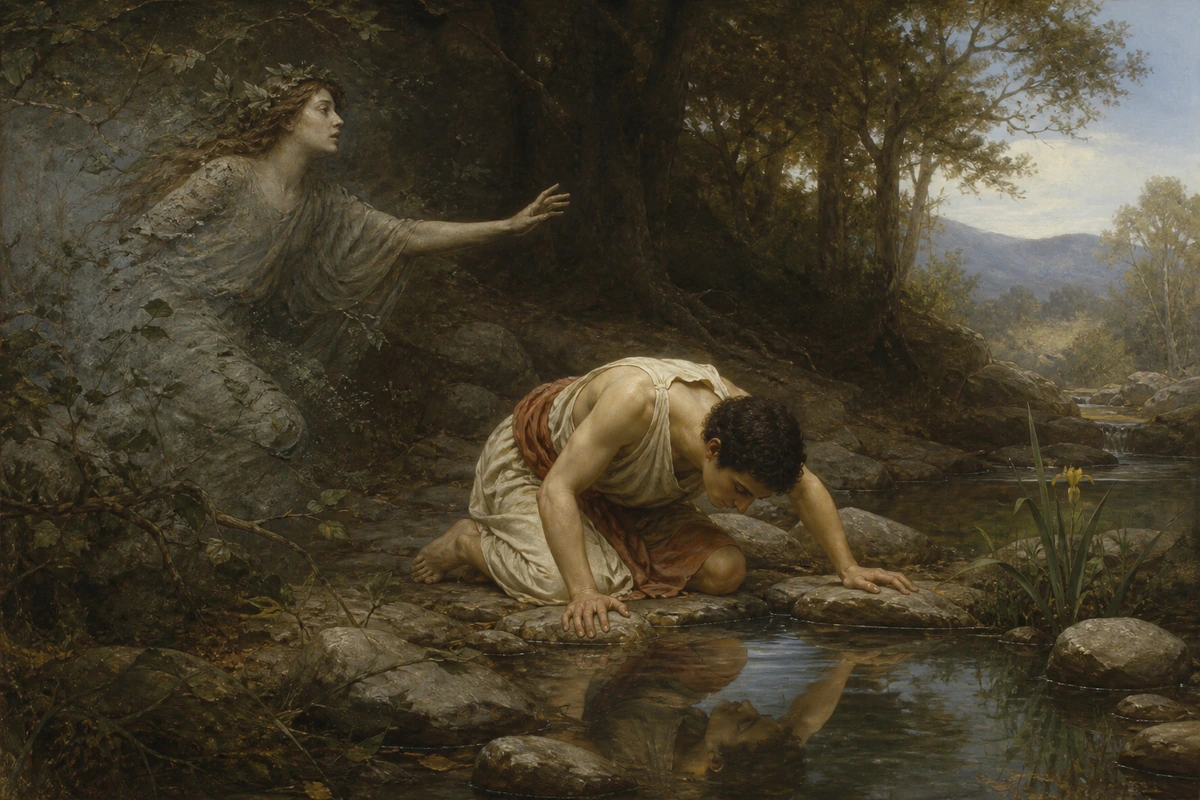
Echo approaches Narcissus
Echo sees Narcissus hunting and follows him. She cannot call to him first, so she waits for phrases she can reshape. When Narcissus asks whether anyone is present, her answer makes contact possible. When he calls for the unseen person to come together, Echo repeats the invitation and emerges to embrace him.
Narcissus recoils and says he would rather die than yield himself to her. Echo can repeat only the most painfully usable part of his rejection, turning his refusal into her offer. Humiliated, she hides in caves and woods. Love and shame consume her body until only voice and bone remain; the bones become stone, while the voice continues to answer across the landscape.
Nemesis and the impossible reflection
Echo is not the only rejected admirer. After another victim calls for Narcissus to love without obtaining the beloved, the goddess of retribution—named by Ovid through an epithet associated with Nemesis—grants the request. The punishment matches the injury: Narcissus will understand longing from inside it.
Exhausted from hunting and heat, he kneels at a spring so pure that neither animals nor falling branches have disturbed it. He sees a beautiful face in the water and initially treats it as another being. Every gesture is returned, yet touch destroys the apparent closeness. The beloved has no independent body and cannot cross the surface.
| Character | What is perceived | What prevents reciprocity | Transformation |
|---|---|---|---|
| Echo | Narcissus as a desired, independent person | She cannot initiate full speech, and he rejects contact | Her body fades; voice remains |
| Narcissus | His reflection as an apparently independent beloved | The image can only repeat him and vanishes when touched | His body is replaced by a flower |
| The reader | Two stories that mirror one another | Neither repetition creates mutual understanding | Voice and flower preserve memory after the bodies disappear |
The moment of recognition
Narcissus gradually notices that the image responds at exactly the same instant. He recognizes that the desired figure is himself. Knowledge fulfills Tiresias’s prophecy but does not free him. The object of desire is at once closer than any other and permanently unavailable as another person.
He wastes away beside the pool. Echo, despite her rejection, repeats his cries of grief. When the nymphs prepare funeral rites, his body is gone; in its place they find a flower with pale petals around a golden center. Ovid thus pairs two aetiologies: Echo explains the returning voice heard in empty places, while Narcissus becomes the flower bearing his name.
Earlier and alternative Narcissus traditions
Ovid’s version became dominant, but it was not the only ancient account. A narrative associated with Conon centers on the rejected youth Ameinias, whom Narcissus sends a sword; after Ameinias dies and calls for vengeance, Narcissus falls in love with his reflection and kills himself. Pausanias records another explanation involving Narcissus’s dead twin sister and presents a separate local tradition that the flower existed before the youth.
These variants show why it is misleading to describe Ovid’s poem as a single, timeless Greek myth copied without alteration. Ovid combines Echo and Narcissus with exceptional formal precision. His version is an ancient literary composition participating in a larger and less uniform mythic tradition.
Voice, image, and failed recognition
Echo and the reflection perform similar actions: each returns what comes from someone else. Echo repeats the end of Narcissus’s speech; the water repeats his face and gestures. But the parallel is not exact. Echo is a conscious person deprived of linguistic agency, while the reflection has no consciousness at all. Narcissus fails first to recognize Echo as someone worthy of response and then to recognize his image as no one else.
This structure makes the poem richer than a warning against vanity. It examines the limits of communication, the difference between repetition and reply, and desire’s need for an independent other. Beauty matters, but failed recognition drives both transformations.
Narcissus and modern “narcissism”
Modern psychology adopted the name Narcissus for concepts of self-directed desire, and “narcissism” now ranges from a casual insult to a specific clinical term. The myth can illuminate the history of that vocabulary, but Narcissus is not a case report and cannot be retrospectively diagnosed with narcissistic personality disorder.
Ovid’s character also does not begin by admiring a reflection he knows is his own. He mistakes the image for another beautiful being and only later understands. That sequence is essential: the tragedy concerns misrecognition and unattainable reciprocity as much as self-love.
Key takeaways
- Ovid’s Metamorphoses provides the most influential combined story of Echo and Narcissus.
- Echo can repeat final words but cannot initiate a complete statement of her own.
- Narcissus initially believes the reflection is another being; recognition comes only after desire has trapped him.
- The modern psychological term “narcissism” should not be projected backward as a diagnosis of a poetic character.