
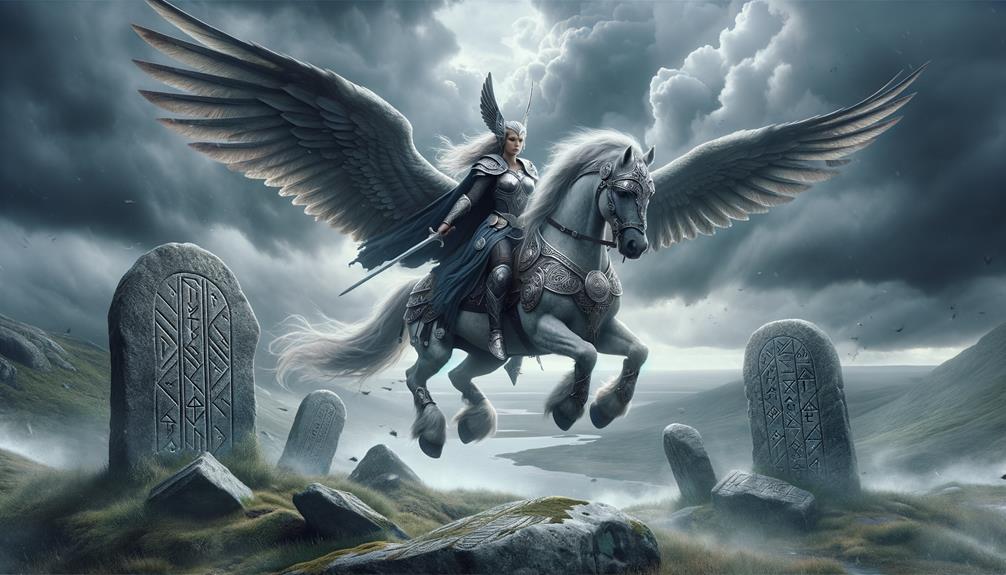
Valkyries are supernatural female figures in Old Norse poetry and prose whose name means choosers of the slain. They are tied to battle, fate, Odin, and the reception of dead warriors. The surviving sources do not give them one uniform appearance or a single role.
Choosing the Slain
The Old Norse word valkyrja combines words for the battle-slain and choosing. In the Prose Edda, Snorri Sturluson says Odin sends Valkyries to battles, where they decide who will fall and who will receive victory. This is more than battlefield escort. Their choice forms part of the outcome itself.
The poem Völuspá names Skuld, Skögul, Gunnr, Hildr, Göndul, and Geirskögul as Valkyries ready to ride. Other poems provide different lists. Their names often refer to battle, weapons, noise, or power, which fits their association with armed conflict.
Valhalla and Folkvangr
Valkyries are strongly connected with Odin’s hall, Valhalla. Grímnismál names Valkyries who carry drinking horns and serve ale to the einherjar, the slain fighters gathered there. Snorri repeats this serving role alongside their work in battle.
It is inaccurate, however, to say that every worthy warrior goes to Valhalla. Grímnismál states that Freyja chooses half of the slain for Fólkvangr while Odin receives the other half. The poem gives no detailed administrative system, so modern attempts to rank the two destinations go beyond the text.
Valkyries in Heroic Poetry
Eddic heroic poems place Valkyrie figures in stories about named warriors. Sváva rides through air and sea and protects Helgi in battle. Sigrún is also linked to Helgi, while the prose around Sigrdrífumál identifies Sigrdrífa as a Valkyrie punished by Odin after deciding a battle against his will.
Brynhildr and Sigrdrífa overlap in parts of the manuscript tradition, but the relationship is not consistent in every text. Retellings that make all Valkyrie stories part of one simple biography conceal differences among poems, prose notes, and later saga versions.
What Did Valkyries Look Like?
The medieval texts emphasize riding, shields, spears, armor, and supernatural authority more often than physical features. They do not establish a standard image of blond women with winged helmets. Horned and winged helmet designs belong largely to later art, stage costume, and popular culture.
Some poems connect supernatural women with swan garments or flight, and later art sometimes gives Valkyries literal wings or winged horses. Those images can represent later reception, but they should not be treated as a fixed description from the Eddas. Ordinary horses that travel through air and sea appear in the poetic material without turning Pegasus into a Norse figure.
Fate, Service, and Power
Valkyries cannot be reduced to benevolent guides or ruthless death spirits. They choose, protect, deny victory, serve drink, ride between worlds, and enter heroic relationships. Their loyalty is usually aligned with Odin, yet individual narratives allow disagreement and punishment.
Modern novels, games, comics, and opera select from these functions and often emphasize the armored warrior. A source-based account keeps that modern image separate from the varied medieval evidence. The central idea is choice at the edge of death, not one costume or personality.