
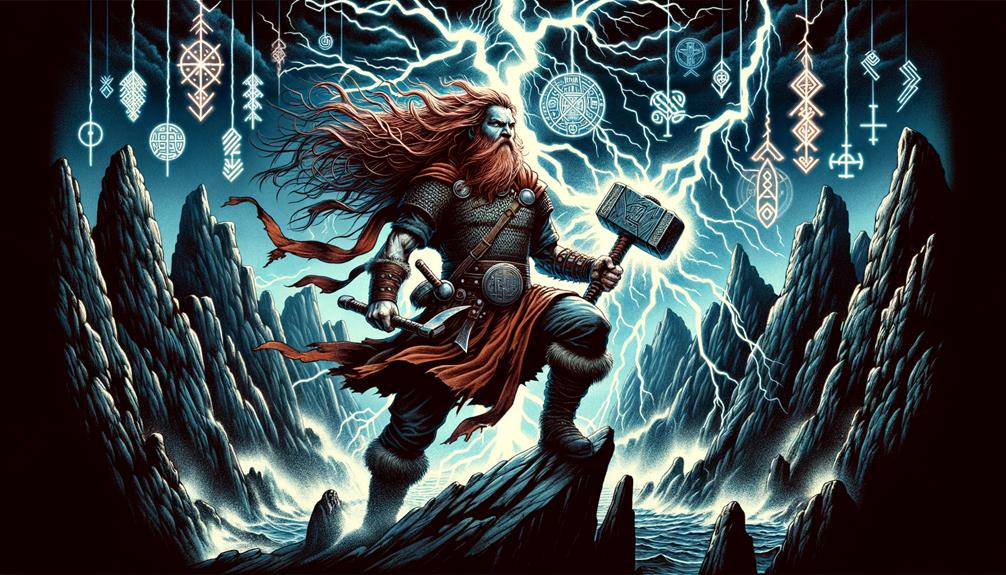
Thor is the thunder god of Old Norse tradition and one of the most frequently named gods in medieval Icelandic sources. He protects gods and humans against giants, travels with the hammer Mjölnir, and is associated with strength, storms, and the defense of social order.
Thor in the surviving tradition
Major stories appear in poems of the Poetic Edda and in Snorri Sturluson’s Prose Edda. Thor fishes for the world serpent Jörmungandr, visits the stronghold of Útgarða-Loki, recovers his stolen hammer by disguising himself at a wedding, and travels east to fight giants. These are literary versions recorded after Scandinavia’s conversion to Christianity, though archaeology and place-names show that devotion to Thor is older.
Texts, objects, and evidence
Hammer-shaped pendants, runic inscriptions, and images provide material evidence. Mjölnir is both a weapon and an instrument of blessing. In Þrymskviða, its return restores the threatened order of the gods. Thor’s chariot is drawn by the goats Tanngrisnir and Tanngnjóstr. The thunder connection is clear, but sources do not present a modern scientific scheme in which every lightning strike follows a single rule.
Key points
- Family: Thor is a son of Odin and the earth figure Jörð. His wife is Sif.
- Enemies: His repeated opponents are jötnar, a varied group often translated as giants.
- Final battle: At Ragnarök he kills Jörmungandr, then dies after taking nine steps because of the serpent’s poison.
- Worship: Personal names, place-names, pendants, and later written testimony point to broad popularity during the Viking Age.
How to read the material
Marvel’s character is a modern adaptation with different relationships and plot rules. Historical discussion should keep comics and film separate from medieval sources and archaeological evidence.