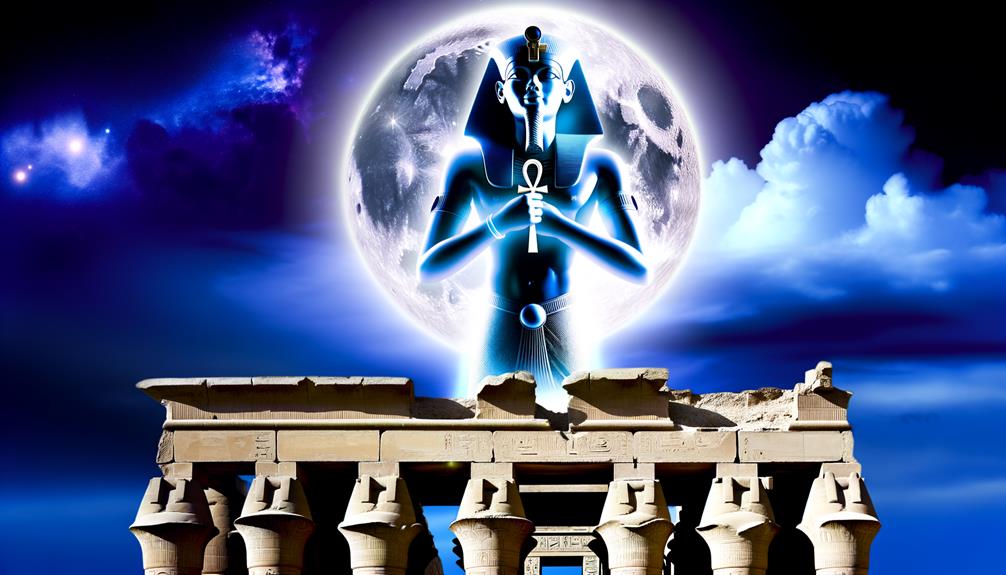
Khonsu was an ancient Egyptian moon god whose most prominent cult centre was Thebes. There he formed a divine family with Amun and Mut and received worship in the great Karnak temple complex. His lunar identity connected him with movement across the night sky, the measurement of time, protection, and healing, but these aspects developed through particular titles, images, and local traditions rather than one fixed biography.
Older English books often spell the name Khons, Khonsu, or Chons. The Egyptian name is commonly related to a word for travelling or traversing, an interpretation that suits the moon’s visible journey. Etymology alone, however, should not be used to invent stories that the texts do not tell.
Khonsu in the Theban triad
At Thebes, Khonsu was understood as the child of Amun and Mut. Together they formed the Theban triad: a major god associated with kingship and hidden creative power, a divine mother and queen, and a youthful lunar son. Family groupings allowed temples and festivals to express relationships among divine powers as well as relationships between deities, the king, and the city.
Khonsu’s role as “child” does not imply that he was weak or permanently infantile. Egyptian child gods embody renewal, succession, and the repeated restoration of life. A deity could appear youthful in one theological setting and exercise formidable independent power in another.
How ancient artists identified Khonsu
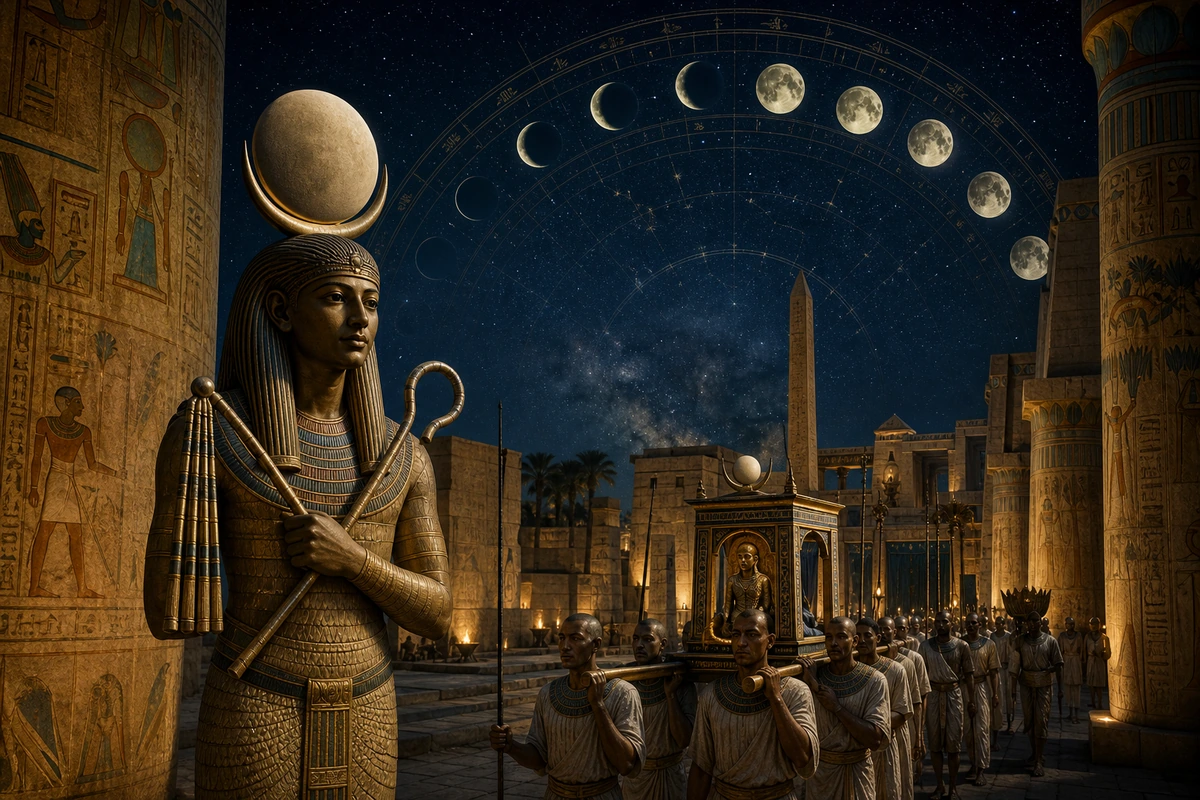
Khonsu is often shown as a young man in a close-fitting, mummiform garment. He may wear the sidelock of youth and a lunar crown composed of a crescent supporting a full disk. He can hold royal or divine insignia such as a crook, flail, or composite staff. Museum statuettes use this combination to identify “Khonsu the Child.”
He can also appear with a falcon head beneath the lunar disk and crescent. That form reflects his identity as a sky deity and visually overlaps with other falcon-headed gods. Context, inscriptions, headdress, and provenance are therefore more reliable than the head alone when identifying an ancient figure.
The moon, movement, and time
The moon’s cycle made it a natural measure of recurring time. Egyptian religion connected lunar deities with reckoning, renewal, and the restoration of what wanes. Khonsu’s name and imagery emphasize movement: he crosses the sky, marks change, and can protect those who travel at night.
These themes do not mean that Khonsu was the only Egyptian moon god. Thoth also had strong lunar and time-reckoning associations, while the moon could be understood through the Eye of Horus or connected with Osiris. Egyptian theology allowed several divine interpretations of the same celestial body. Khonsu and Thoth can share lunar functions without being identical.
Khonsu as healer and expeller of danger
Healing is most vividly illustrated by the story preserved on the Bentresh Stela. In the narrative, a portable image of “Khonsu-the-Authority” is sent from Egypt to the foreign land of Bakhtan to cure a princess afflicted by a hostile spirit. The divine image expels the danger and remains abroad until a dream persuades the prince to return it.
The monument is a late composition that sets its story in the reign of Ramesses II. It should not be cited as a straightforward contemporary report from that king’s court. Its value lies in what it reveals about later Egyptian ideas: a consecrated cult image could make the god effectively present, healing could be understood as the removal of an invading force, and Khonsu’s authority could extend beyond Egypt.
Temple and procession at Karnak
The Temple of Khonsu stands in the southwestern part of the Karnak complex. Much of its surviving construction belongs to the late New Kingdom and later periods. Its pylons, court, halls, and sanctuaries gave Khonsu an institutional home within the enormous sacred landscape of Thebes.
Divine statues normally remained in restricted temple spaces, but festivals brought shrines into movement. Evidence for Theban processions shows Amun, Mut, and Khonsu leaving Karnak in their sacred barques during major celebrations. Procession made the gods publicly present while maintaining the protective enclosure of their images.
Claims and evidence
| Claim | Evidence | Assessment |
|---|---|---|
| Khonsu is a moon god | Lunar crowns, inscriptions, temple theology, and museum objects | Fundamental and strongly supported |
| He is the son of Amun and Mut | Theban theology and triad images | Central at Thebes, though Egyptian genealogies can vary by place and period |
| His name means “traveller” | Common linguistic interpretation linked to the moon’s course | Plausible and traditional; avoid building unsupported myths from the etymology |
| He rules time | Lunar reckoning and later summaries | Better stated as an association with timekeeping and cyclical measure |
| He healed a foreign princess | The Bentresh Stela narrative | An important late religious story, not a verified diplomatic case record |
| Khonsu is another name for Thoth | Both can be lunar | Incorrect as a general statement; they are distinct deities with overlapping functions |
Early power and later gentleness
Khonsu’s character is not uniformly benign. In the Old Kingdom Pyramid Texts, a deity named Khonsu appears in forceful royal imagery that helps the deceased king overcome other divine beings. Later temple and popular evidence more often emphasizes the youthful moon god, protector, and healer. This is not necessarily a contradiction. Egyptian gods accumulated titles and theological roles over long periods.
It is therefore misleading to select one text and make it his timeless “true personality.” The violent power of early royal afterlife literature, the child of the Theban triad, and the healer of the Bentresh story all belong to Khonsu’s reception, but they arise from different genres and dates.
Why Khonsu mattered
The moon offers a visible model of loss and recovery. Its light grows, diminishes, disappears, and returns. Khonsu’s associations with healing and renewal fit this repeated restoration, while his journey gives movement a protective and measurable form.
At Thebes, those cosmic ideas became local and familial. Khonsu was not only a disk in the sky but the son who completed the household of Amun and Mut, the god whose temple stood within Karnak, and a sacred presence that could travel in festival or healing narrative. His worship joined astronomy, city identity, and embodied ritual.
Accuracy note and further reading
This article distinguishes early funerary references, Theban temple theology, museum iconography, and the later Bentresh Stela narrative. It also avoids identifying Khonsu with Thoth merely because both have lunar associations.