
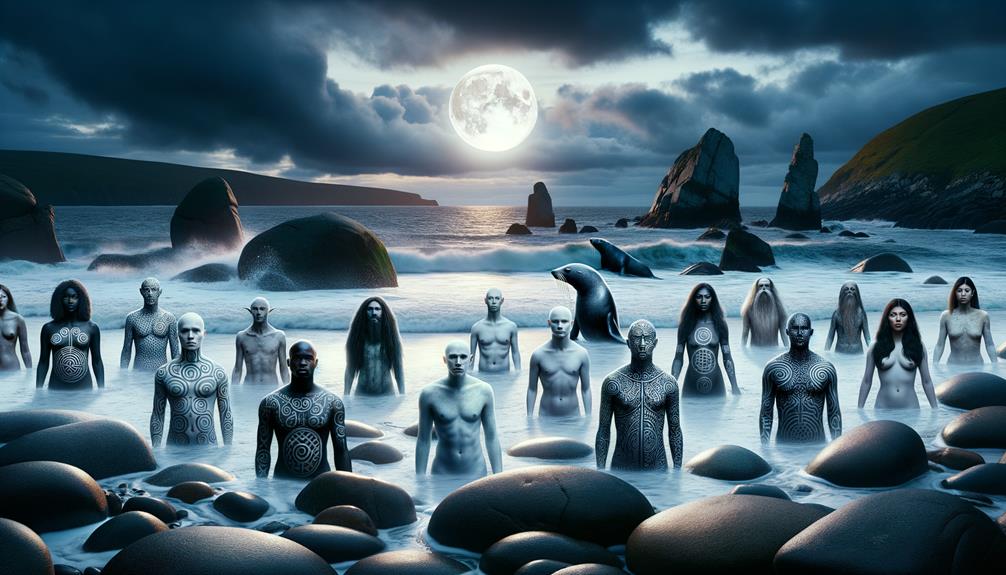
Selkies are seal-folk in the oral traditions of Scotland’s Northern Isles and neighboring North Atlantic coasts. In the sea they live as seals; on land they can remove a skin and appear human. The best-known stories are not simple romances. They turn the sealskin into a question of freedom, belonging, marriage, and the painful boundary between shore and ocean.
Where do selkie stories come from?
Selkie traditions are especially associated with Orkney and Shetland, where seals, fishing, dangerous crossings, and seasonal weather were part of everyday life. Related seal-person stories occur in the Hebrides, mainland Scotland, Ireland, the Faroe Islands, Iceland, and other northern coastal cultures. Those resemblances do not make every seal-being the same creature or prove one point of origin.
The name is related to Scots words for “seal,” including selkie, selchie, and silkie. Spellings shift with dialect and collection. “Selkie folk” therefore means seal people rather than a species defined by a modern fantasy rulebook.
Most surviving written collections are relatively recent compared with the age of the communities that told the stories. Nineteenth- and twentieth-century antiquarians, folklorists, singers, and sound archivists recorded material that had circulated orally. A publication date is evidence for when a version was collected, not necessarily when the tale began.
The stolen sealskin pattern
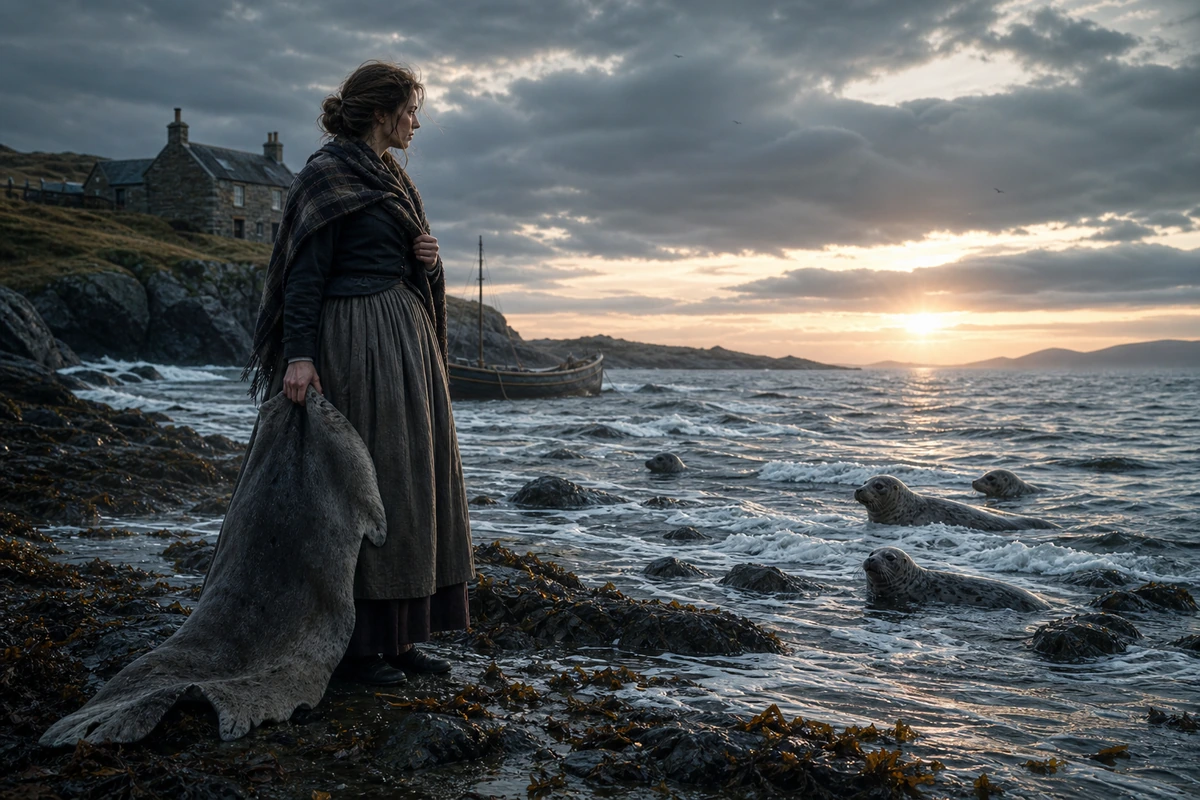
In the most familiar plot, a man sees seal women remove their skins and dance or rest on shore. He steals and hides one skin. Without it, its owner cannot return to seal form, so she is compelled to remain on land and becomes his wife. She may have children and manage a household for years, but she continues to long for the sea. Eventually she discovers the hidden skin—sometimes through a child—and leaves.
Walter Traill Dennison’s Orcadian “The Goodman o’ Wastness” is a well-known collected form. Versions differ in the location of the hiding place, the number of children, how the skin is recovered, and whether the selkie later visits her human family. The structural fact remains: the human man controls her movement by taking something inseparable from her identity.
Older summaries sometimes call this a love story while barely mentioning the theft. Modern readers are right to see coercion at its center. The selkie may become affectionate toward her children, but that does not retroactively create consent to the captivity. Her return to the water can be joyful, tragic, or both.
What the sealskin means
The sealskin is more than clothing. It is the material condition of transformation and the means of returning home. Whoever possesses it controls whether the selkie can cross the boundary between worlds. That makes the skin a powerful image of bodily autonomy, hidden identity, and enforced assimilation.
The skin can also hold divided loyalties. When a child returns it, the act frees a parent but may break the household the child knows. When the selkie leaves children behind, the story does not necessarily say she never loved them; it dramatizes an impossible choice created by the original theft. Some tellings soften the separation with visits at sea, gifts, protection, or knowledge passed to descendants.
Because a seal looks so different on land and in water, the animal itself reinforces this double belonging. Awkward movement on rocks becomes effortless motion in the sea. Island storytellers did not need an abstract theory of transformation to see two worlds embodied in one familiar creature.
Male selkies and “The Great Silkie of Sule Skerry”
Selkie men also enter human relationships. Folklore often portrays them as attractive visitors to women whose husbands or lovers are absent at sea. Some stories describe summoning a male selkie by shedding tears into the water. As with female selkies, details vary widely by place and narrator.
The traditional ballad commonly known as “The Great Silkie of Sule Skerry” tells of a supernatural seal-man who reveals that he fathered a woman’s child. He predicts or arranges a future involving the child and the sea, and in many versions a human gunner unknowingly kills both seal father and son. The ballad is a tragedy of kinship, foreknowledge, and maritime danger, not the same plot as the stolen-skin wife tale.
Putting male and female selkie stories side by side also reveals a difference in narrative power. The male visitor usually retains access to the sea. The stolen-skin woman does not. That contrast is one reason contemporary interpretations often focus on captivity and consent.
Selkies, seals, and island life
Seal-folk stories grew in communities that knew real seals closely—as animals seen on skerries, competitors for fish, sources of oil and hide, and possible signs of weather or danger. Folklore can express that closeness without being a disguised zoology lesson. A seal’s gaze, cry, and near-human forelimbs invited stories about kinship across species.
Some families were said to descend from selkies and to carry physical signs such as webbed fingers, rough skin, or horny growths on hands and feet. These claims served as local identity stories. They should be read as folklore and family tradition, not as medical or genetic evidence.
Stories sometimes connect the killing of seals with taboo or revenge. If a seal might be a transformed person or a relative of a human family, hunting becomes morally uncertain. This does not mean every island community prohibited seal hunting; belief, livelihood, and practice could coexist in tension.
Selkies are not mermaids or finfolk
A selkie is not ordinarily a half-human, half-fish being. The transformation depends on shifting between a complete seal body and a human appearance through the skin. Mermaids retain a combined body in many visual traditions, while selkies cross between bodies.
Orcadian finfolk are also often merged with selkies in popular summaries. Finfolk traditions describe powerful amphibious beings associated with an undersea realm, magic, abduction, and uneasy dealings with humans. There are overlaps in marine setting and marriage plots, but the names and story complexes are not interchangeable.
How major selkie story types differ
| Story pattern | Typical conflict | What varies |
|---|---|---|
| Stolen-skin wife | A human hides a seal woman’s skin and prevents her return | Where the skin is hidden, who finds it, and whether she revisits her children |
| Male selkie visitor | A relationship crosses the sea–land boundary | Summoning, consent, duration, gifts, and consequences |
| Selkie ancestry | A family explains unusual traits or maritime affinity through seal-folk descent | The named family, bodily sign, and remembered ancestor |
| Seal taboo or revenge | Harming a seal risks harming a person or provoking supernatural repayment | Whether the warning concerns one seal, a clan, or the wider selkie people |
| Ballad tradition | Supernatural parentage meets foreknown maritime tragedy | Lyrics, place-names, relationships, and the ending |
Are selkies “Celtic” or “Norse”?
Either label by itself is too simple. Orkney and Shetland have deep Norse as well as Scottish histories, and stories traveled through fishing routes, marriage, migration, and multilingual contact. Comparable animal-bride and stolen-garment tales occur far beyond the North Atlantic. Shared motifs can move between communities without erasing local names and meanings.
Claims that selkies began as memories of Inuit kayakers, Sámi visitors, shipwrecked strangers, or people wearing sealskin clothing are speculative. Such encounters may have influenced individual stories, but no single origin theory explains the full tradition. Folklore often accumulates rather than beginning in one recoverable event.
Modern meanings and adaptations
Contemporary writers and filmmakers use selkies to explore migration, adoption, ecological loss, queer identity, domestic abuse, and the feeling of living between cultures. These interpretations can be faithful to the tale’s emotional structure even when they invent new plots. They are adaptations, not evidence that every historical storyteller intended the same allegory.
The most durable element is the choice at the shoreline. Home on land includes real attachments, yet the landward life began with a stolen capacity to leave. Returning the skin restores agency; it does not erase grief. That tension keeps selkie stories powerful without turning captivity into romance.
Frequently asked questions
Can a selkie change shape without its skin?
In the common Scottish pattern, no. Removing the skin allows a seal person to appear human, and putting it on allows a return to the sea. A hidden skin traps the selkie in human form.
Do selkies return to their human children?
Some versions say they watch, visit, protect, or bring gifts; others end with permanent separation. There is no single rule across the oral tradition.
Are all selkie tales about women?
No. Male selkies appear in stories and ballads, most famously the “Great Silkie” tradition. The stolen-skin wife plot is simply the best-known modern form.
Are selkies real animals?
Selkies are folklore beings connected with real seals. Family legends and sightings belong to cultural tradition rather than zoological evidence for human–seal transformation.
Sources and further reading
- Historic Environment Scotland, Orkney folklore and “The Goodman o’ Wastness”
- University of Edinburgh, School of Scottish Studies selkie recordings
- National Museums Scotland, transformation in Scottish folklore
- Árni Magnússon Institute, Sagnagrunnur: Orkney folklore database
- Mermaid origins and traditions